Belongia Megan F, Hammond Wagner Courtney, Seipp Kimberly Quesnel, Ajami Newsha K
Stanford Woods Institute for the Environment, Stanford University, Stanford, CA, USA.
Bill Lane Center for the American West, Stanford University, Stanford, CA, USA.
Sci Adv. 2023 Sep 15;9(37):eadf9534. doi: 10.1126/sciadv.adf9534.
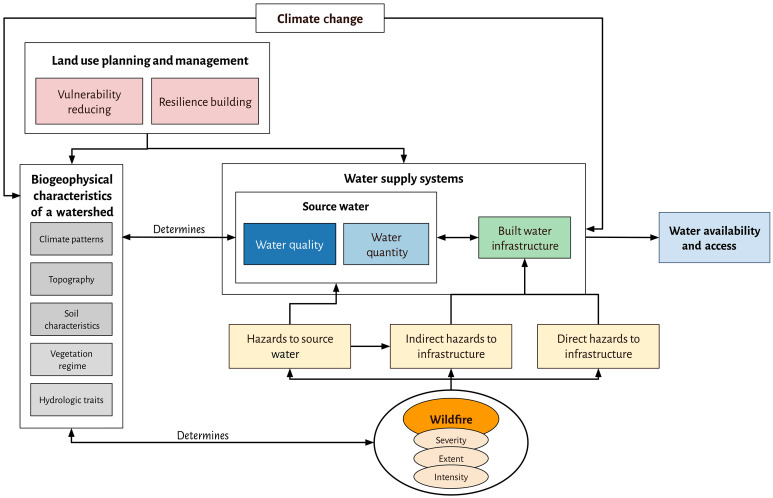
Severe wildfire is altering the natural and the built environment and posing risks to environmental and societal health and well-being, including cascading impacts to water systems and built water infrastructure. Research on wildfire-resilient water systems is growing but not keeping pace with the scale and severity of wildfire impacts, despite their intensifying threat. In this study, we evaluate the state of knowledge regarding wildfire-related hazards to water systems. We propose a holistic framework to assess interactions and feedback loops between water quality, quantity, and infrastructure hazards as determinants of post-fire water availability and access. Efforts to address the evolving threat of wildfires to water systems will require more interdisciplinary research on the complex relationships shaping wildfire's threat to water availability and access. To support this, we need reliable long-term data availability, consistent metrics, greater research in shared contexts, more extensive research beyond the burn area, and multistakeholder collaboration on wildfire risks to water systems.
严重野火正在改变自然环境和人造环境,并对环境及社会健康与福祉构成风险,包括对水系统和人造供水基础设施产生连锁影响。尽管野火对水系统的威胁日益加剧,但有关具备抗火能力的水系统的研究虽在增加,却仍跟不上野火影响的规模和严重程度。在本研究中,我们评估了与水系统相关的野火危害的知识现状。我们提出了一个整体框架,以评估水质、水量和基础设施危害之间的相互作用和反馈回路,这些因素决定了火灾后水的供应和获取情况。应对野火对水系统不断演变的威胁需要开展更多跨学科研究,以探究塑造野火对水供应和获取构成威胁的复杂关系。为此,我们需要可靠的长期数据、一致的指标、在共享背景下开展更多研究、在过火区域以外进行更广泛的研究,以及多利益相关方就野火对水系统的风险展开合作。