Department of Clinical and Molecular Medicine, Faculty of Medicine and Health Sciences, Norwegian University of Science and Technology, Postboks 8900, 7491, Trondheim, Norway.
Cancer Clinic, St. Olav's Hospital, Trondheim University Hospital, Trondheim, Norway.
J Endocrinol Invest. 2024 Mar;47(3):513-521. doi: 10.1007/s40618-023-02193-2. Epub 2023 Sep 15.
Diabetes mellitus type 1 is a chronic disease that implies mandatory external insulin delivery. The patients must monitor their blood glucose levels and administer appropriate insulin boluses to keep their blood glucose within the desired range. It requires a lot of time and endeavour, and many patients struggle with suboptimal glucose control despite all their efforts.
This narrative review combines existing knowledge with new discoveries from animal experiments.
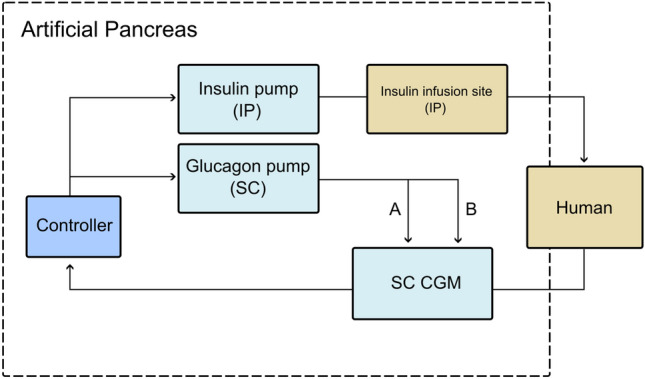
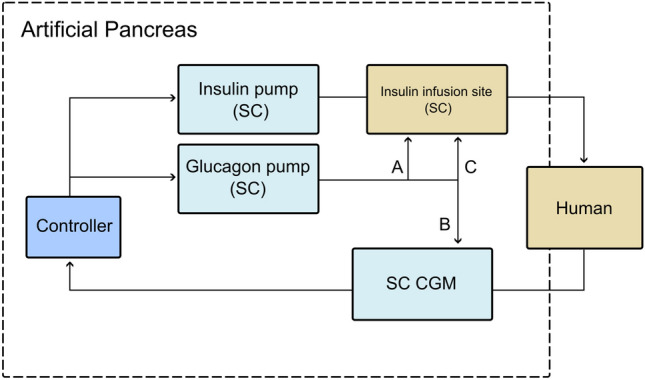
In the last decade, artificial pancreas (AP) devices have been developed to improve glucose control and relieve patients of the constant burden of managing their disease. However, a feasible and fully automated AP is yet to be developed. The main challenges preventing the development of a true, subcutaneous (SC) AP system are the slow dynamics of SC glucose sensing and particularly the delay in effect on glucose levels after SC insulin infusions. We have previously published studies on using the intraperitoneal space for an AP; however, we further propose a novel and potentially disruptive way to utilize the vasodilative properties of glucagon in SC AP systems.
This narrative review presents two lesser-explored viable solutions for AP systems and discusses the potential for improvement toward a fully automated system: A) using the intraperitoneal approach for more rapid insulin absorption, and B) besides using glucagon to treat and prevent hypoglycemia, also administering micro-boluses of glucagon to increase the local SC blood flow, thereby accelerating SC insulin absorption and SC glucose sensor site dynamics.
1 型糖尿病是一种慢性病,需要强制外源性胰岛素输注。患者必须监测血糖水平,并给予适当的胰岛素推注,以使血糖保持在目标范围内。这需要大量的时间和努力,尽管患者付出了所有努力,但许多患者的血糖控制仍不理想。
本综述结合了现有知识和动物实验的新发现。
在过去十年中,已经开发出人工胰腺 (AP) 设备来改善血糖控制,并减轻患者管理疾病的持续负担。然而,一种可行且完全自动化的 AP 仍有待开发。阻止真正的皮下 (SC) AP 系统发展的主要挑战是 SC 葡萄糖感测的动态缓慢,特别是 SC 胰岛素输注后对血糖水平的影响延迟。我们之前已经发表了关于将腹腔空间用于 AP 的研究;然而,我们进一步提出了一种新颖且潜在有颠覆性的方法,利用 SC AP 系统中胰高血糖素的血管扩张特性。
本综述介绍了两种针对 AP 系统的探索性可行解决方案,并讨论了朝着完全自动化系统改进的潜力:A)利用腹腔途径更快地吸收胰岛素,B)除了使用胰高血糖素治疗和预防低血糖外,还给予胰高血糖素微剂量以增加局部 SC 血流,从而加速 SC 胰岛素吸收和 SC 葡萄糖传感器部位动力学。