Harvard John A. Paulson School of Engineering and Applied Sciences, Harvard University, Cambridge, Massachusetts.
Department of Chemical Engineering, University of California Santa Barbara, Santa Barbara, California.
Diabetes Obes Metab. 2017 Dec;19(12):1698-1705. doi: 10.1111/dom.12999. Epub 2017 Jul 6.
To compare intraperitoneal (IP) to subcutaneous (SC) insulin delivery in an artificial pancreas (AP).
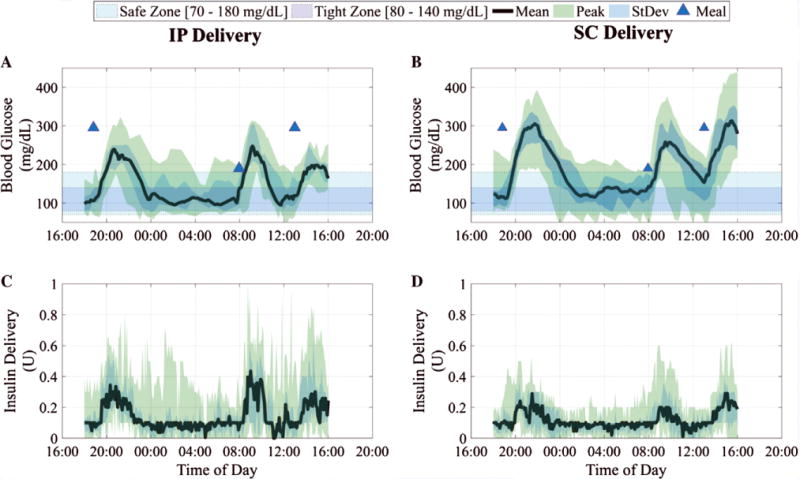
Ten adults with type 1 diabetes participated in a non-randomized, non-blinded sequential AP study using the same SC glucose sensing and Zone Model Predictive Control (ZMPC) algorithm adjusted for insulin clearance. On first admission, subjects underwent closed-loop control with SC delivery of a fast-acting insulin analogue for 24 hours. Following implantation of a DiaPort IP insulin delivery system, the identical 24-hour trial was performed with IP regular insulin delivery. The clinical protocol included 3 unannounced meals with 70, 40 and 70 g carbohydrate, respectively. Primary endpoint was time spent with blood glucose (BG) in the range of 80 to 140 mg/dL (4.4-7.7 mmol/L).
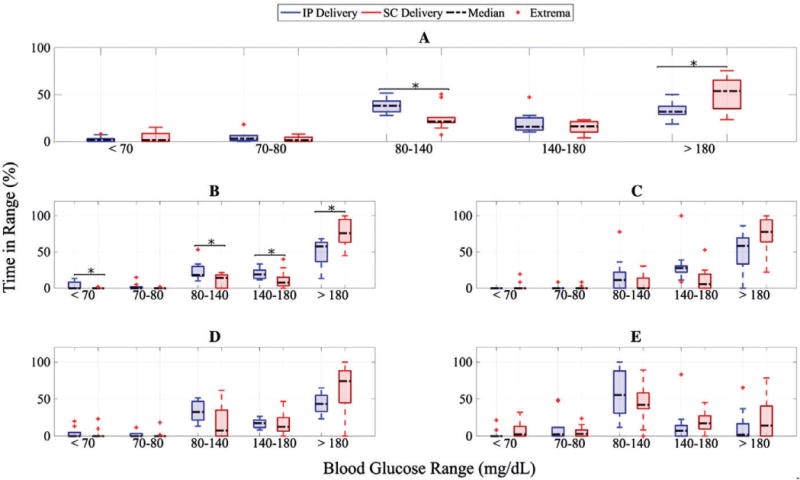
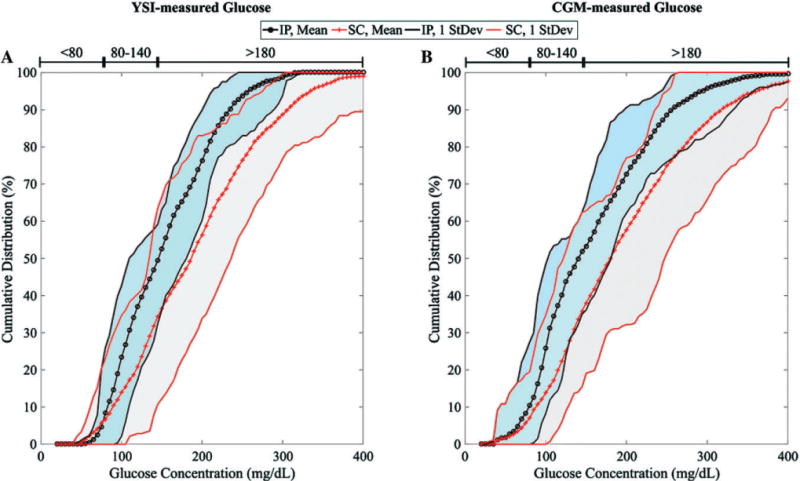
Percent of time spent within the 80 to 140 mg/dL range was significantly higher for IP delivery than for SC delivery: 39.8 ± 7.6 vs 25.6 ± 13.1 ( P = .03). Mean BG (mg/dL) and percent of time spent within the broader 70 to 180 mg/dL range were also significantly better for IP insulin: 151.0 ± 11.0 vs 190.0 ± 31.0 ( P = .004) and 65.7 ± 9.2 vs 43.9 ± 14.7 ( P = .001), respectively. Superiority of glucose control with IP insulin came from the reduced time spent in hyperglycaemia (>180 mg/dL: 32.4 ± 8.9 vs 53.5 ± 17.4, P = .014; >250 mg/dL: 5.9 ± 5.6 vs 23.0 ± 11.3, P = .0004). Higher daily doses of insulin (IU) were delivered with the IP route (43.7 ± 0.1 vs 32.3 ± 0.1, P < .001) with no increased percent time spent <70 mg/dL (IP: 2.5 ± 2.9 vs SC: 4.1 ± 5.3, P = .42).
Glycaemic regulation with fully-automated AP delivering IP insulin was superior to that with SC insulin delivery. This pilot study provides proof-of-concept for an AP system combining a ZMPC algorithm with IP insulin delivery.
比较人工胰腺(AP)中腹腔内(IP)和皮下(SC)胰岛素输送的效果。
10 名 1 型糖尿病患者参加了一项非随机、非盲的 AP 序贯研究,使用相同的 SC 葡萄糖感应和区域模型预测控制(ZMPC)算法,根据胰岛素清除率进行调整。首次入院时,患者接受了 24 小时的 SC 输送速效胰岛素类似物的闭环控制。在植入 DiaPort IP 胰岛素输送系统后,使用 IP 常规胰岛素输送进行了相同的 24 小时试验。临床方案包括 3 次未宣布的餐食,分别含有 70、40 和 70g 碳水化合物。主要终点是血糖(BG)在 80 至 140mg/dL(4.4-7.7mmol/L)范围内的时间百分比。
与 SC 输送相比,IP 输送时血糖在 80 至 140mg/dL 范围内的时间百分比明显更高:39.8±7.6%比 25.6±13.1%(P=0.03)。IP 胰岛素的平均 BG(mg/dL)和在更广泛的 70 至 180mg/dL 范围内的时间百分比也明显更好:151.0±11.0 比 190.0±31.0(P=0.004)和 65.7±9.2%比 43.9±14.7%(P=0.001)。IP 胰岛素控制血糖的优越性来自于高血糖时间的减少(>180mg/dL:32.4±8.9 比 53.5±17.4,P=0.014;>250mg/dL:5.9±5.6 比 23.0±11.3,P=0.0004)。IP 途径输送的胰岛素剂量(IU)更高(43.7±0.1 比 32.3±0.1,P<0.001),但<70mg/dL 的时间百分比没有增加(IP:2.5±2.9 比 SC:4.1±5.3,P=0.42)。
使用全自动 AP 输送 IP 胰岛素进行血糖调节优于 SC 胰岛素输送。这项初步研究为结合 ZMPC 算法和 IP 胰岛素输送的 AP 系统提供了概念验证。