De Lange Glenn, Bouroumeau Antonin, Coron Emmanuel, Koessler Thibaud
Medical School, University of Geneva, 1206 Geneva, Switzerland.
Division of Clinical Pathology, University Hospitals of Geneva, 1205 Geneva, Switzerland.
Mol Clin Oncol. 2023 Aug 30;19(4):81. doi: 10.3892/mco.2023.2677. eCollection 2023 Oct.
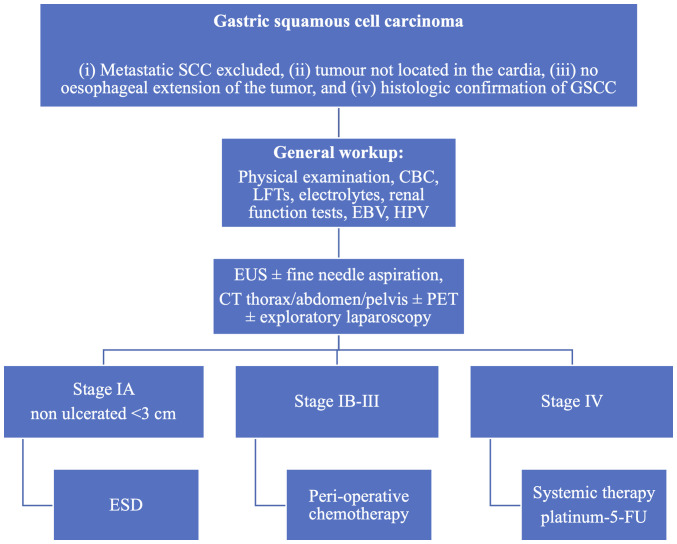
Gastric cancer serves a major role in the global cancer burden, being the fourth most frequent cause of mortality among all types of cancer. Gastric squamous cell carcinoma (GSCC) is a rare histological variant accounting for 0.04-0.5% of all gastric cancer cases. Diagnostic work-up of GSCC is essential and involves multiple criteria: i) Tumour not located in the cardia, ii) no oesophageal extension of the tumour, and iii) no evidence of SCC in any other part of the body. Little is known about this rare variant in terms of pathogenesis, risk factors or evolution. Consequently, neither the European Society of Medical Oncology nor the National Comprehensive Cancer Network societies have published recommendations for GSCC. The aim of the present review is to provide an in-depth analysis of the current literature on this pathology, from pathophysiological hypothesis and clinical presentation to diagnostic work-up and treatment trends, in order to establish a possible management algorithm.
胃癌在全球癌症负担中占据主要地位,是所有类型癌症中第四大常见死因。胃鳞状细胞癌(GSCC)是一种罕见的组织学变体,占所有胃癌病例的0.04 - 0.5%。GSCC的诊断检查至关重要,涉及多个标准:i)肿瘤不在贲门处,ii)肿瘤无食管侵犯,iii)身体其他任何部位均无鳞状细胞癌证据。关于这种罕见变体的发病机制、危险因素或演变情况知之甚少。因此,欧洲医学肿瘤学会和美国国立综合癌症网络协会均未发布关于GSCC的诊疗建议。本综述的目的是对有关该病理学的当前文献进行深入分析,从病理生理假说、临床表现到诊断检查和治疗趋势,以建立一种可能的管理算法。