Ma Yong
Department of Urology, Shanghai Songjiang District Sijing Hospital, Shanghai 201601, P.R. China.
Oncol Lett. 2023 Sep 4;26(4):452. doi: 10.3892/ol.2023.14039. eCollection 2023 Oct.
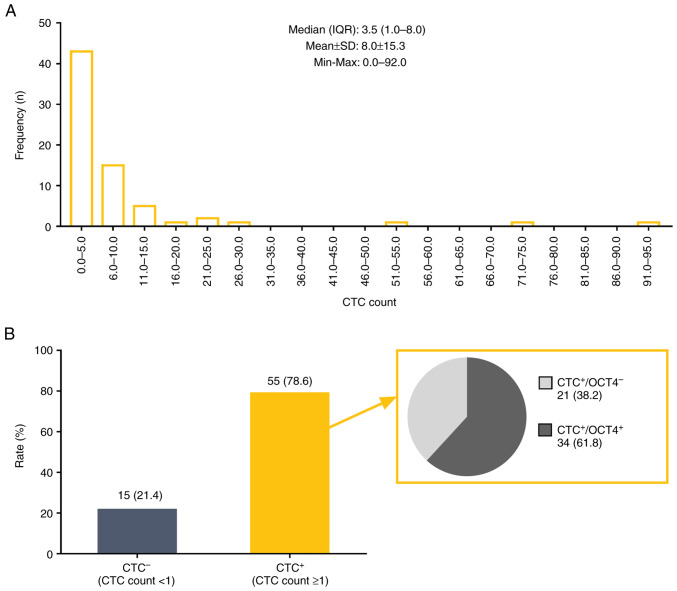
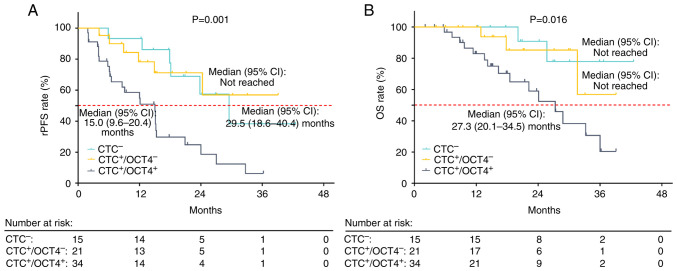
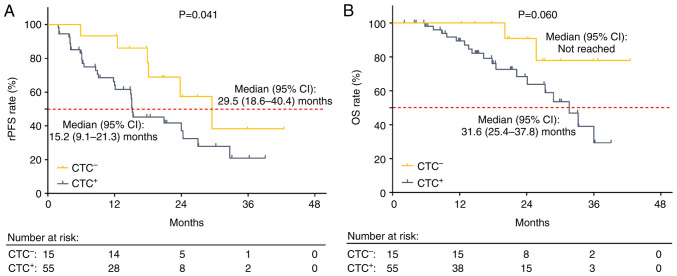
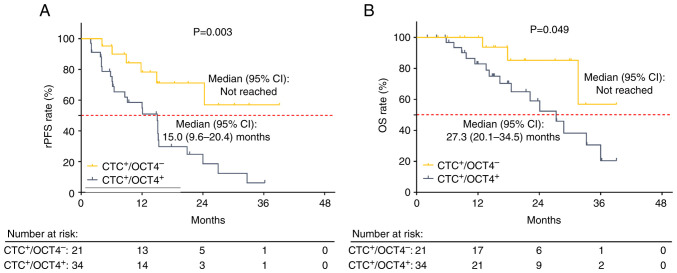
Octamer-binding transcription factor 4 (OCT4) and circulating tumor cells (CTCs) are key factors associated with tumor metastasis and drug resistance in cancer. The present prospective study aimed to investigate the prevalence of OCT4-positive (OCT4) CTCs and the potential association with the clinical features and survival of patients with metastatic castration-resistant prostate cancer (mCRPC) treated with abiraterone + prednisone. In total, 70 patients with mCRPC treated with abiraterone + prednisone were enrolled in the present study and peripheral blood samples were collected prior to treatment initiation to determine CTC count via a Canpatrol system. RNA hybridization was performed for OCT4 CTC quantification. Lactate dehydrogenase (LDH) was detected by automatic biochemical analyzer (AU54000, OLYMPUS). Results demonstrated that 34 (48.6%), 21 (30.0%) and 15 (21.4%) patients harbored OCT4 (CTC/OCT4) or OCT4-negative CTCs (CTC/OCT4) or were CTC-negative (CTC), respectively. Notably, CTC/OCT4 occurrence was associated with visceral metastasis and high levels of LDH. In addition, radiographic progression-free survival [rPFS; median, 15.0, 95% confidence interval (CI), 9.6-20.4 vs. not reached vs. median, 29.5, 95% CI, 18.6-40.4 months; P=0.001] and overall survival (OS) were significantly decreased (median, 27.3, 95% CI, 20.1-34.5 vs. not reached vs. not reached; P=0.016) in CTC/OCT4 compared with CTC/OCT4 and CTC patients. Subsequently, the adjustment was performed by multivariate Cox regression models, which revealed that CTC/OCT4 (vs. CTC/OCT4 or CTC) was independently associated with decreased rPFS [hazard ratio (HR), 3.833; P<0.001] and OS (HR, 3.938; P=0.008). In conclusion, OCT4 CTCs were highly prevalent in patients with mCRPC and associated with visceral metastasis and increased levels of LDH. Thus, the presence of OCT4 CTCs may serve as an independent prognostic factor for patients with mCRPC treated with abiraterone + prednisone.
八聚体结合转录因子4(OCT4)和循环肿瘤细胞(CTC)是与癌症肿瘤转移和耐药性相关的关键因素。本前瞻性研究旨在调查OCT4阳性(OCT4+)CTC的发生率,以及其与接受阿比特龙+泼尼松治疗的转移性去势抵抗性前列腺癌(mCRPC)患者的临床特征和生存情况之间的潜在关联。本研究共纳入70例接受阿比特龙+泼尼松治疗的mCRPC患者,并在开始治疗前采集外周血样本,通过Canpatrol系统确定CTC计数。采用RNA杂交法对OCT4+ CTC进行定量分析。用自动生化分析仪(AU54000,OLYMPUS)检测乳酸脱氢酶(LDH)。结果显示,分别有34例(48.6%)、21例(30.0%)和15例(21.4%)患者存在OCT4+ CTC(CTC/OCT4+)或OCT4阴性CTC(CTC/OCT4-)或CTC阴性(CTC-)。值得注意的是,CTC/OCT4+的出现与内脏转移和高LDH水平相关。此外,与CTC/OCT4-和CTC-患者相比,CTC/OCT4+患者的影像学无进展生存期[rPFS;中位数,15.0,95%置信区间(CI),9.6 - 20.4个月 vs. 未达到 vs. 中位数,29.5,95%CI,18.6 - 40.4个月;P = 0.001]和总生存期(OS)显著缩短(中位数,27.3,95%CI,20.1 - 34.5个月 vs. 未达到 vs. 未达到;P = 0.016)。随后,通过多变量Cox回归模型进行校正,结果显示CTC/OCT4+(与CTC/OCT4-或CTC-相比)与rPFS降低独立相关[风险比(HR),3.833;P < 0.001]和OS降低(HR,3.938;P = 0.008)。总之,OCT4+ CTC在mCRPC患者中高度普遍,且与内脏转移和LDH水平升高相关。因此,OCT4+ CTC的存在可能是接受阿比特龙+泼尼松治疗的mCRPC患者的独立预后因素。