Hadar-Shoval Dorit, Elyoseph Zohar, Lvovsky Maya
Department of Psychology and Educational Counseling, The Center for Psychobiological Research, Max Stern Yezreel Valley College, Emek Yezreel, Israel.
Department of Brain Sciences, Faculty of Medicine, Imperial College London, London, United Kingdom.
Front Psychiatry. 2023 Sep 1;14:1234397. doi: 10.3389/fpsyt.2023.1234397. eCollection 2023.
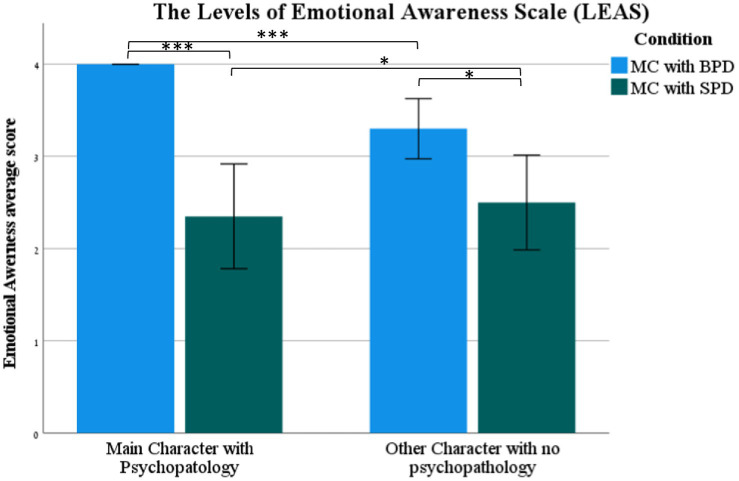
This study evaluated the potential of ChatGPT, a large language model, to generate mentalizing-like abilities that are tailored to a specific personality structure and/or psychopathology. Mentalization is the ability to understand and interpret one's own and others' mental states, including thoughts, feelings, and intentions. Borderline Personality Disorder (BPD) and Schizoid Personality Disorder (SPD) are characterized by distinct patterns of emotional regulation. Individuals with BPD tend to experience intense and unstable emotions, while individuals with SPD tend to experience flattened or detached emotions. We used ChatGPT's free version 23.3 and assessed the extent to which its responses akin to emotional awareness (EA) were customized to the distinctive personality structure-character characterized by Borderline Personality Disorder (BPD) and Schizoid Personality Disorder (SPD), employing the Levels of Emotional Awareness Scale (LEAS). ChatGPT was able to accurately describe the emotional reactions of individuals with BPD as more intense, complex, and rich than those with SPD. This finding suggests that ChatGPT can generate mentalizing-like responses consistent with a range of psychopathologies in line with clinical and theoretical knowledge. However, the study also raises concerns regarding the potential for stigmas or biases related to mental diagnoses to impact the validity and usefulness of chatbot-based clinical interventions. We emphasize the need for the responsible development and deployment of chatbot-based interventions in mental health, which considers diverse theoretical frameworks.
本研究评估了大型语言模型ChatGPT生成针对特定人格结构和/或精神病理学的类心理化能力的潜力。心理化是理解和解释自己及他人心理状态的能力,包括思想、情感和意图。边缘型人格障碍(BPD)和分裂样人格障碍(SPD)具有不同的情绪调节模式。BPD患者往往经历强烈且不稳定的情绪,而SPD患者往往经历平淡或疏离的情绪。我们使用了ChatGPT的23.3免费版本,并采用情绪觉察量表(LEAS)评估其类似于情绪觉察(EA)的回答在多大程度上针对由边缘型人格障碍(BPD)和分裂样人格障碍(SPD)所特有的独特人格结构特征进行了定制。ChatGPT能够准确地将BPD患者的情绪反应描述为比SPD患者更强烈、更复杂和更丰富。这一发现表明,ChatGPT可以生成与一系列精神病理学相一致的类心理化反应,符合临床和理论知识。然而,该研究也引发了人们对与精神诊断相关的污名或偏见可能影响基于聊天机器人的临床干预的有效性和实用性的担忧。我们强调在心理健康领域负责任地开发和部署基于聊天机器人的干预措施的必要性,这需要考虑多种理论框架。