• 文献检索
  • 文档翻译
  • 深度研究
  • 学术资讯
  • Suppr Zotero 插件Zotero 插件
  • 邀请有礼
  • 套餐&价格
  • 历史记录
应用&插件
Suppr Zotero 插件Zotero 插件浏览器插件Mac 客户端Windows 客户端微信小程序
定价
高级版会员购买积分包购买API积分包
服务
文献检索文档翻译深度研究API 文档MCP 服务
关于我们
关于 Suppr公司介绍联系我们用户协议隐私条款
关注我们

Suppr 超能文献

核心技术专利:CN118964589B侵权必究
粤ICP备2023148730 号-1Suppr @ 2026

文献检索

告别复杂PubMed语法,用中文像聊天一样搜索,搜遍4000万医学文献。AI智能推荐,让科研检索更轻松。

立即免费搜索

文件翻译

保留排版,准确专业,支持PDF/Word/PPT等文件格式,支持 12+语言互译。

免费翻译文档

深度研究

AI帮你快速写综述,25分钟生成高质量综述,智能提取关键信息,辅助科研写作。

立即免费体验

生成式人工智能在心理健康领域的应用及伦理意义:系统综述

The Application and Ethical Implication of Generative AI in Mental Health: Systematic Review.

作者信息

Wang Xi, Zhou Yujia, Zhou Guangyu

机构信息

School of Psychological and Cognitive Sciences, Beijing Key Laboratory of Behavior and Mental Health, Key Laboratory of Machine Perception (Ministry of Education), Peking University, Beijing, China.

Department of Computer Science and Technology, Tsinghua University, Beijing, China.

出版信息

JMIR Ment Health. 2025 Jun 27;12:e70610. doi: 10.2196/70610.

DOI:10.2196/70610
PMID:40577783
原文链接:https://pmc.ncbi.nlm.nih.gov/articles/PMC12254713/
Abstract

BACKGROUND

Mental health disorders affect an estimated 1 in 8 individuals globally, yet traditional interventions often face barriers, such as limited accessibility, high costs, and persistent stigma. Recent advancements in generative artificial intelligence (GenAI) have introduced AI systems capable of understanding and producing humanlike language in real time. These developments present new opportunities to enhance mental health care.

OBJECTIVE

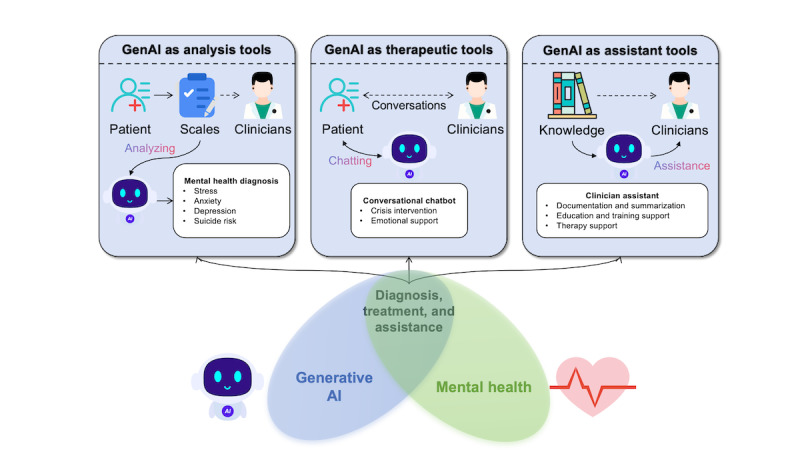
We aimed to systematically examine the current applications of GenAI in mental health, focusing on 3 core domains: diagnosis and assessment, therapeutic tools, and clinician support. In addition, we identified and synthesized key ethical issues reported in the literature.

METHODS

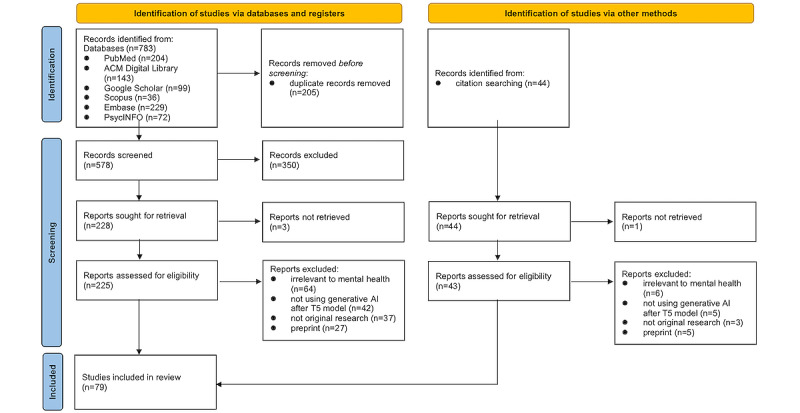
We conducted a comprehensive literature search, following the PRISMA (Preferred Reporting Items for Systematic Reviews and Meta-Analyses) 2020 guidelines, in PubMed, ACM Digital Library, Scopus, Embase, PsycInfo, and Google Scholar databases to identify peer-reviewed studies published from October 1, 2019, to September 30, 2024. After screening 783 records, 79 (10.1%) studies met the inclusion criteria.

RESULTS

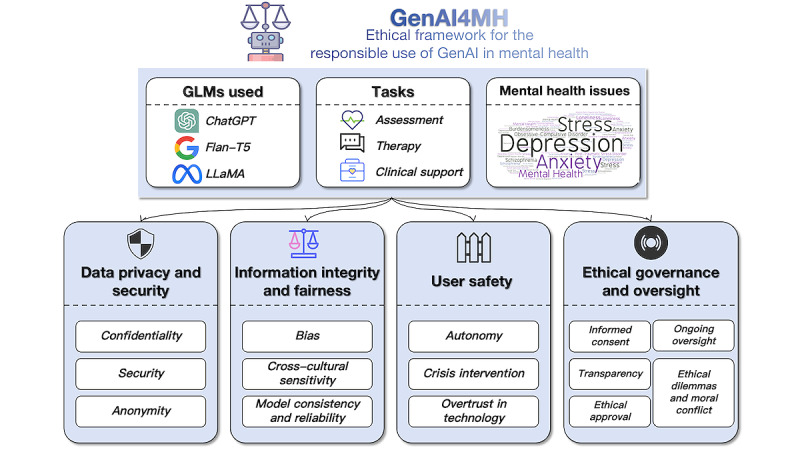
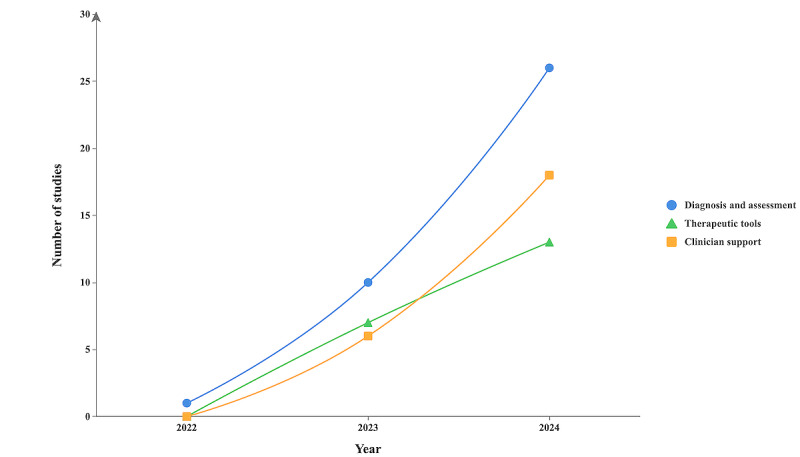
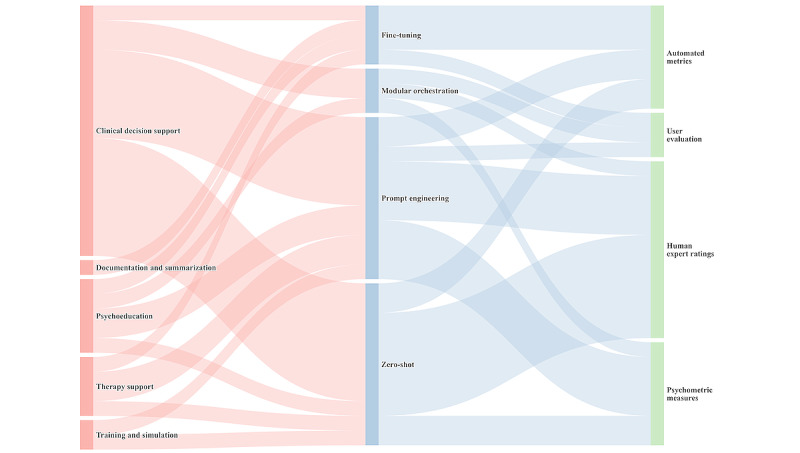
The number of studies on GenAI applications in mental health has grown substantially since 2023. Studies on diagnosis and assessment (37/79, 47%) primarily used GenAI models to detect depression and suicidality through text data. Studies on therapeutic applications (20/79, 25%) investigated GenAI-based chatbots and adaptive systems for emotional and behavioral support, reporting promising outcomes but revealing limited real-world deployment and safety assurance. Clinician support studies (24/79, 30%) explored GenAI's role in clinical decision-making, documentation and summarization, therapy support, training and simulation, and psychoeducation. Ethical concerns were consistently reported across the domains. On the basis of these findings, we proposed an integrative ethical framework, GenAI4MH, comprising 4 core dimensions-data privacy and security, information integrity and fairness, user safety, and ethical governance and oversight-to guide the responsible use of GenAI in mental health contexts.

CONCLUSIONS

GenAI shows promise in addressing the escalating global demand for mental health services. They may augment traditional approaches by enhancing diagnostic accuracy, offering more accessible support, and reducing clinicians' administrative burden. However, to ensure ethical and effective implementation, comprehensive safeguards-particularly around privacy, algorithmic bias, and responsible user engagement-must be established.

摘要

背景

据估计,全球每8个人中就有1人受到心理健康障碍的影响,但传统干预措施往往面临诸多障碍,如可及性有限、成本高昂以及持续存在的污名化问题。生成式人工智能(GenAI)的最新进展引入了能够实时理解和生成类人语言的人工智能系统。这些发展为加强心理健康护理带来了新机遇。

目的

我们旨在系统地研究GenAI在心理健康领域的当前应用,重点关注三个核心领域:诊断与评估、治疗工具以及临床医生支持。此外,我们还识别并综合了文献中报道的关键伦理问题。

方法

我们按照PRISMA(系统评价和Meta分析优先报告项目)2020指南,在PubMed、ACM数字图书馆、Scopus、Embase、PsycInfo和谷歌学术数据库中进行了全面的文献检索,以识别2019年10月1日至2024年9月30日期间发表的同行评审研究。在筛选了783条记录后,79项(10.1%)研究符合纳入标准。

结果

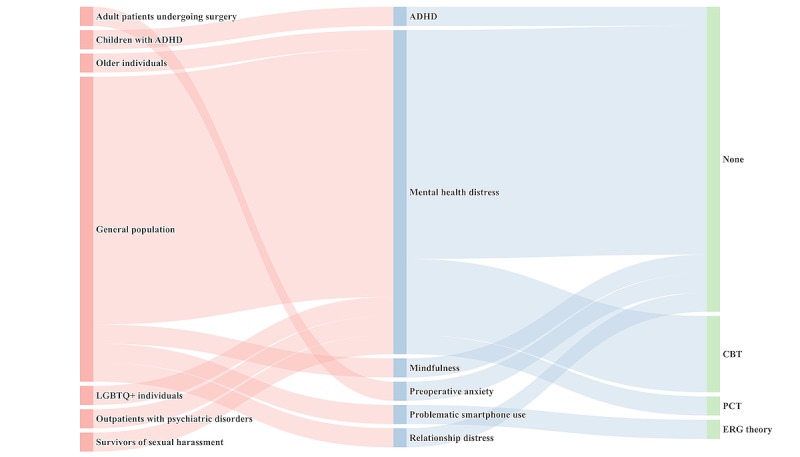
自2023年以来,关于GenAI在心理健康领域应用的研究数量大幅增长。诊断与评估方面的研究(37/79,47%)主要使用GenAI模型通过文本数据检测抑郁症和自杀倾向。治疗应用方面的研究(20/79,25%)调查了基于GenAI的聊天机器人和用于情感与行为支持的自适应系统,报告了有前景的结果,但显示出实际应用有限且缺乏安全保障。临床医生支持方面的研究(24/79,30%)探讨了GenAI在临床决策、文档记录与总结、治疗支持、培训与模拟以及心理教育中的作用。各领域均一致报告了伦理问题。基于这些发现,我们提出了一个综合伦理框架GenAI4MH,它包含四个核心维度——数据隐私与安全、信息完整性与公平性、用户安全以及伦理治理与监督——以指导在心理健康背景下负责任地使用GenAI。

结论

GenAI在满足全球对心理健康服务不断增长的需求方面显示出前景。它们可以通过提高诊断准确性、提供更易获得的支持以及减轻临床医生的行政负担来增强传统方法。然而,为确保伦理且有效的实施,必须建立全面的保障措施,特别是围绕隐私、算法偏差和负责任的用户参与方面。
https://cdn.ncbi.nlm.nih.gov/pmc/blobs/36ba/12254713/b61c97dfe6ef/mental_v12i1e70610_fig7.jpg
https://cdn.ncbi.nlm.nih.gov/pmc/blobs/36ba/12254713/eb3e63a59bcf/mental_v12i1e70610_fig1.jpg
https://cdn.ncbi.nlm.nih.gov/pmc/blobs/36ba/12254713/bba011f36d0f/mental_v12i1e70610_fig2.jpg
https://cdn.ncbi.nlm.nih.gov/pmc/blobs/36ba/12254713/59f1c1f0c146/mental_v12i1e70610_fig3.jpg
https://cdn.ncbi.nlm.nih.gov/pmc/blobs/36ba/12254713/87f6de85979c/mental_v12i1e70610_fig4.jpg
https://cdn.ncbi.nlm.nih.gov/pmc/blobs/36ba/12254713/516cc0b53006/mental_v12i1e70610_fig5.jpg
https://cdn.ncbi.nlm.nih.gov/pmc/blobs/36ba/12254713/a6a6dee89106/mental_v12i1e70610_fig6.jpg
https://cdn.ncbi.nlm.nih.gov/pmc/blobs/36ba/12254713/b61c97dfe6ef/mental_v12i1e70610_fig7.jpg
https://cdn.ncbi.nlm.nih.gov/pmc/blobs/36ba/12254713/eb3e63a59bcf/mental_v12i1e70610_fig1.jpg
https://cdn.ncbi.nlm.nih.gov/pmc/blobs/36ba/12254713/bba011f36d0f/mental_v12i1e70610_fig2.jpg
https://cdn.ncbi.nlm.nih.gov/pmc/blobs/36ba/12254713/59f1c1f0c146/mental_v12i1e70610_fig3.jpg
https://cdn.ncbi.nlm.nih.gov/pmc/blobs/36ba/12254713/87f6de85979c/mental_v12i1e70610_fig4.jpg
https://cdn.ncbi.nlm.nih.gov/pmc/blobs/36ba/12254713/516cc0b53006/mental_v12i1e70610_fig5.jpg
https://cdn.ncbi.nlm.nih.gov/pmc/blobs/36ba/12254713/a6a6dee89106/mental_v12i1e70610_fig6.jpg
https://cdn.ncbi.nlm.nih.gov/pmc/blobs/36ba/12254713/b61c97dfe6ef/mental_v12i1e70610_fig7.jpg

相似文献

1
The Application and Ethical Implication of Generative AI in Mental Health: Systematic Review.生成式人工智能在心理健康领域的应用及伦理意义:系统综述
JMIR Ment Health. 2025 Jun 27;12:e70610. doi: 10.2196/70610.
2
Applications of Large Language Models in the Field of Suicide Prevention: Scoping Review.大语言模型在自杀预防领域的应用:范围综述
J Med Internet Res. 2025 Jan 23;27:e63126. doi: 10.2196/63126.
3
Using Generative Artificial Intelligence in Health Economics and Outcomes Research: A Primer on Techniques and Breakthroughs.在卫生经济学与结果研究中使用生成式人工智能:技术与突破入门
Pharmacoecon Open. 2025 Apr 29. doi: 10.1007/s41669-025-00580-4.
4
Advancements in Herpes Zoster Diagnosis, Treatment, and Management: Systematic Review of Artificial Intelligence Applications.带状疱疹诊断、治疗与管理的进展:人工智能应用的系统评价
J Med Internet Res. 2025 Jun 30;27:e71970. doi: 10.2196/71970.
5
AI for IMPACTS Framework for Evaluating the Long-Term Real-World Impacts of AI-Powered Clinician Tools: Systematic Review and Narrative Synthesis.用于评估人工智能驱动的临床医生工具长期现实世界影响的AI for IMPACTS框架:系统评价与叙述性综合分析
J Med Internet Res. 2025 Feb 5;27:e67485. doi: 10.2196/67485.
6
Conversational Systems for Social Care in Older Adults: Protocol for a Scoping Review.老年人社会护理对话系统:范围综述方案
JMIR Res Protoc. 2025 Jul 10;14:e72310. doi: 10.2196/72310.
7
The impact of generative AI on health professional education: A systematic review in the context of student learning.生成式人工智能对卫生专业教育的影响:在学生学习背景下的系统综述。
Med Educ. 2025 Jun 18. doi: 10.1111/medu.15746.
8
AI in Medical Questionnaires: Innovations, Diagnosis, and Implications.医学问卷中的人工智能:创新、诊断及影响
J Med Internet Res. 2025 Jun 23;27:e72398. doi: 10.2196/72398.
9
Evolving Zero Trust Architectures for AI-Driven Cyber Threats in Healthcare and Other High-Risk Data Environments: A Systematic Review.医疗保健及其他高风险数据环境中针对人工智能驱动的网络威胁的不断演进的零信任架构:一项系统综述
Cureus. 2025 Jun 5;17(6):e85446. doi: 10.7759/cureus.85446. eCollection 2025 Jun.
10
Education support services for improving school engagement and academic performance of children and adolescents with a chronic health condition.改善患有慢性病的儿童和青少年的学校参与度和学业成绩的教育支持服务。
Cochrane Database Syst Rev. 2023 Feb 8;2(2):CD011538. doi: 10.1002/14651858.CD011538.pub2.

引用本文的文献

1
The Ability of AI Therapy Bots to Set Limits With Distressed Adolescents: Simulation-Based Comparison Study.人工智能治疗机器人对情绪困扰青少年设定限制的能力:基于模拟的比较研究。
JMIR Ment Health. 2025 Aug 18;12:e78414. doi: 10.2196/78414.

本文引用的文献

1
The role of generative artificial intelligence in psychiatric education- a scoping review.生成式人工智能在精神科教育中的作用——一项范围综述
BMC Med Educ. 2025 Mar 25;25(1):438. doi: 10.1186/s12909-025-07026-9.
2
Mental-LLM: Leveraging Large Language Models for Mental Health Prediction via Online Text Data.心理语言模型:通过在线文本数据利用大语言模型进行心理健康预测。
Proc ACM Interact Mob Wearable Ubiquitous Technol. 2024 Mar;8(1). doi: 10.1145/3643540. Epub 2024 Mar 6.
3
The MI-CLAIM-GEN checklist for generative artificial intelligence in health.
用于健康领域生成式人工智能的MI-CLAIM-GEN检查表。
Nat Med. 2025 May;31(5):1394-1398. doi: 10.1038/s41591-024-03470-0.
4
Large Language Models and Empathy: Systematic Review.大语言模型与同理心:系统综述
J Med Internet Res. 2024 Dec 11;26:e52597. doi: 10.2196/52597.
5
Exploring the efficacy and potential of large language models for depression: A systematic review.探索大语言模型治疗抑郁症的疗效和潜力:一项系统综述。
J Affect Disord. 2025 Feb 15;371:234-244. doi: 10.1016/j.jad.2024.11.052. Epub 2024 Nov 22.
6
Large Language Models for Mental Health Applications: Systematic Review.大型语言模型在精神健康应用中的应用:系统评价。
JMIR Ment Health. 2024 Oct 18;11:e57400. doi: 10.2196/57400.
7
Using Large Language Models to Detect Depression From User-Generated Diary Text Data as a Novel Approach in Digital Mental Health Screening: Instrument Validation Study.利用大型语言模型从用户生成的日记文本数据中检测抑郁,作为数字心理健康筛查的新方法:仪器验证研究。
J Med Internet Res. 2024 Sep 18;26:e54617. doi: 10.2196/54617.
8
Language sentiment predicts changes in depressive symptoms.语言情绪可预测抑郁症状的变化。
Proc Natl Acad Sci U S A. 2024 Sep 24;121(39):e2321321121. doi: 10.1073/pnas.2321321121. Epub 2024 Sep 16.
9
Assessing dimensions of thought disorder with large language models: The tradeoff of accuracy and consistency.使用大型语言模型评估思维障碍的维度:准确性和一致性的权衡。
Psychiatry Res. 2024 Nov;341:116119. doi: 10.1016/j.psychres.2024.116119. Epub 2024 Aug 3.
10
Debate and Dilemmas Regarding Generative AI in Mental Health Care: Scoping Review.心理健康护理中生成式人工智能的争论与困境:范围综述
Interact J Med Res. 2024 Aug 12;13:e53672. doi: 10.2196/53672.