Beijing Key Laboratory of Preclinical Research and Evaluation for Cardiovascular Implant Materials, Animal Experimental Centre, National Centre for Cardiovascular Disease, Department of Cardiac Surgery, State Key Laboratory of Cardiovascular Disease, National Center for Cardiovascular Diseases, Fuwai Hospital, Chinese Academy of Medical Sciences and Peking Union Medical College, Beijing, 100037, China.
Curr Cardiol Rep. 2023 Oct;25(10):1299-1317. doi: 10.1007/s11886-023-01944-0. Epub 2023 Sep 15.
This article aims to review the accurate classification of non-ischemic cardiomyopathy, including the methods, basis, subtype characteristics, and prognosis, especially the similarities and differences between different classifications.
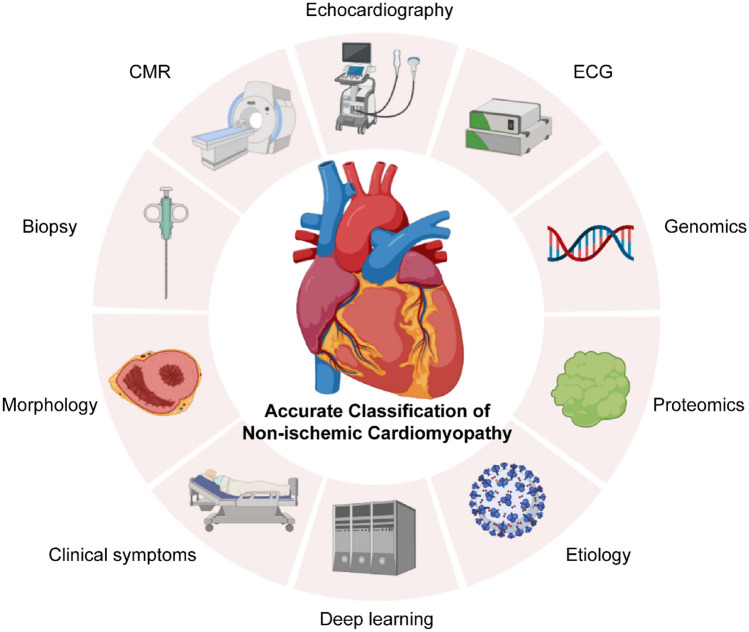
Non-ischemic cardiomyopathy refers to a myocardial disease that excludes coronary artery disease or ischemic injury and has a variety of etiologies and high incidence. Recent studies suggest that traditional classification methods based on primary/mixed/acquired or genetic/non-genetic cannot meet the precise needs of contemporary clinical management. This article systematically describes the history of classifications of cardiomyopathy and presents etiological and genetic differences between cardiomyopathies. The accurate classification is described from the perspective of morphology, function, and genomics in hypertrophic cardiomyopathy, dilated cardiomyopathy, restrictive cardiomyopathy, arrhythmogenic right ventricular cardiomyopathy, left ventricular noncompaction, and partially acquired cardiomyopathy. The different clinical characteristics and treatment needs of these cardiomyopathies are elaborated. Some single-gene mutant cardiomyopathies have unique phenotypes, and some cardiomyopathies have mixed phenotypes. These special classifications require personalized precision treatment, which is worthy of independent research. This article describes recent advances in the accurate classification of non-ischemic cardiomyopathy from clinical phenotypes and causative genes, discusses the advantages and usage scenarios of each classification, compares the differences in prognosis and patient management needs of different subtypes, and summarizes common methods and new exploration directions for accurate classification.
本文旨在综述非缺血性心肌病的准确分类,包括方法、依据、亚类特征和预后,特别是不同分类之间的异同。
非缺血性心肌病是指排除冠状动脉疾病或缺血性损伤的心肌疾病,具有多种病因且发病率较高。最近的研究表明,基于原发性/混合性/获得性或遗传性/非遗传性的传统分类方法不能满足当代临床管理的精确需求。本文系统地描述了心肌病分类的历史,并介绍了心肌病之间的病因和遗传差异。从肥厚型心肌病、扩张型心肌病、限制型心肌病、致心律失常性右室心肌病、左室心肌致密化不全和部分获得性心肌病的形态、功能和基因组学角度描述了准确的分类。阐述了这些心肌病不同的临床特征和治疗需求。一些单基因突变型心肌病具有独特的表型,而一些心肌病具有混合表型。这些特殊分类需要个性化的精准治疗,值得独立研究。本文从临床表型和致病基因方面描述了非缺血性心肌病的准确分类的最新进展,讨论了每种分类的优缺点和使用场景,比较了不同亚类的预后和患者管理需求的差异,并总结了准确分类的常见方法和新的探索方向。