Department of Food Science, Cornell University, Ithaca, NY, 14853, USA.
Department of Food Science, Virginia Polytechnic Institute and State University, Blacksburg, VA, 24061, USA.
Sci Rep. 2023 Sep 19;13(1):15472. doi: 10.1038/s41598-023-42347-z.
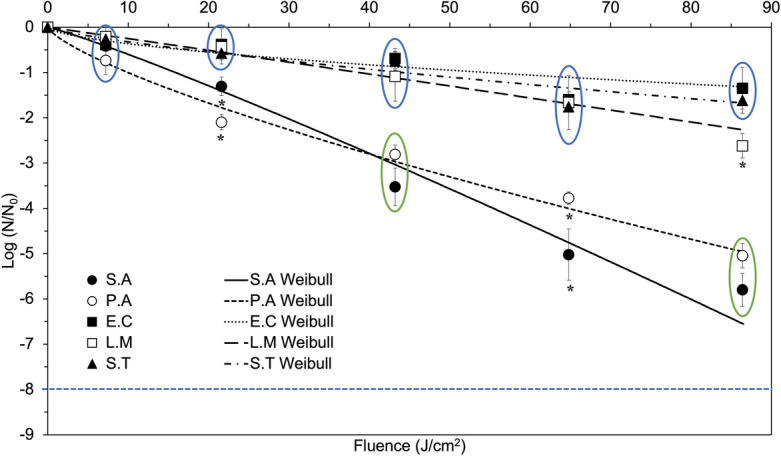
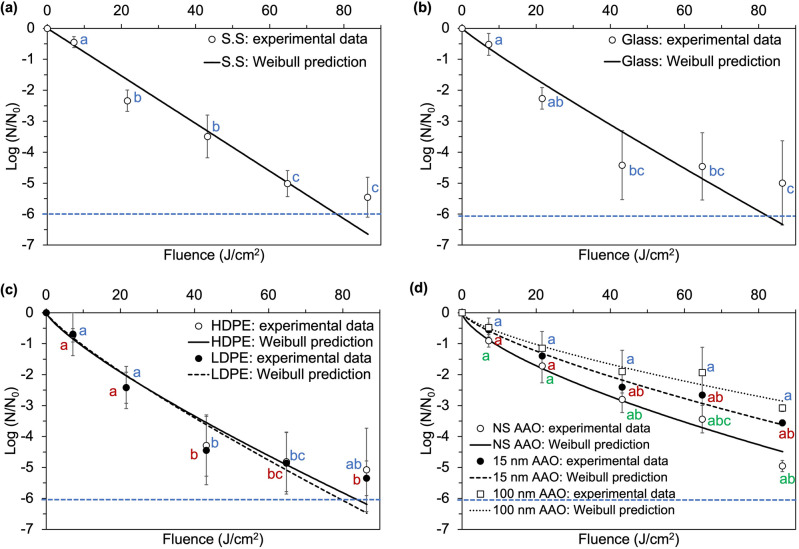
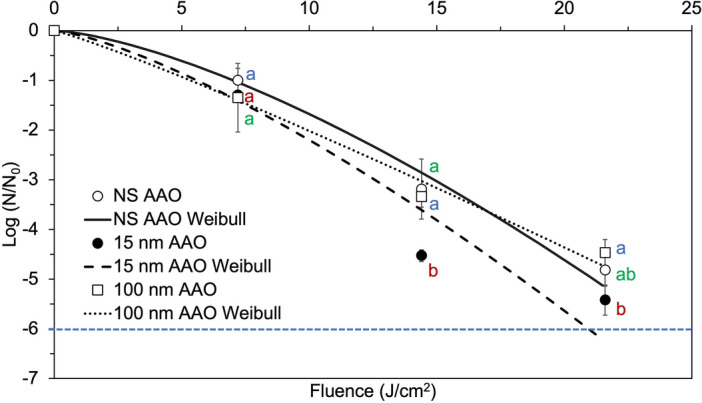
This study investigates the antimicrobial effectiveness of 405 nm light emitting diodes (LEDs) against pathogenic Escherichia coli O157:H7, Listeria monocytogenes, Pseudomonas aeruginosa, Salmonella Typhimurium, and Staphylococcus aureus, in thin liquid films (TLF) and on solid surfaces. Stainless steel (SS), high density polyethylene (HDPE), low density polyethylene (LDPE), and borosilicate glass were used as materials typically encountered in food processing, food service, and clinical environments. Anodic aluminum oxide (AAO) coupons with nanoscale topography were used, to evaluate the effect of topography on inactivation. The impact of surface roughness, hydrophobicity, and reflectivity on inactivation was assessed. A 48 h exposure to 405 nm led to reductions ranging from 1.3 (E. coli) to 5.7 (S. aureus) log CFU in TLF and 3.1 to 6.3 log CFU on different solid contact surfaces and packaging materials. All inactivation curves were nonlinear and followed Weibull kinetics, with better inactivation predictions on surfaces (0.89 ≤ R ≤ 1.0) compared to TLF (0.76 ≤ R ≤ 0.99). The fastest inactivation rate was observed on small nanopore AAO coupons inoculated with L. monocytogenes and S. aureus, indicating inactivation enhancing potential of these surfaces. These results demonstrate significant promise of 405 nm LEDs for antimicrobial applications in food processing and handling and the healthcare industry.
本研究调查了 405nm 发光二极管(LED)对致病性大肠杆菌 O157:H7、李斯特菌、铜绿假单胞菌、鼠伤寒沙门氏菌和金黄色葡萄球菌在薄液膜(TLF)和固体表面的抗菌有效性。不锈钢(SS)、高密度聚乙烯(HDPE)、低密度聚乙烯(LDPE)和硼硅酸盐玻璃被用作食品加工、食品服务和临床环境中常见的材料。使用具有纳米级形貌的阳极氧化铝(AAO)片来评估形貌对失活动力学的影响。评估了表面粗糙度、疏水性和反射率对失活动力学的影响。在 48 小时内,405nm LED 照射导致 TLF 中的减少范围从 1.3(大肠杆菌)到 5.7(金黄色葡萄球菌)对数 CFU,而在不同的固体接触表面和包装材料上的减少范围从 3.1 到 6.3 对数 CFU。所有失活动力学曲线是非线性的,并遵循 Weibull 动力学,与 TLF(0.76≤R≤0.99)相比,在表面上的失活动力学预测更好(0.89≤R≤1.0)。在接种有李斯特菌和金黄色葡萄球菌的小纳米孔 AAO 片上观察到最快的失活动力学,表明这些表面具有增强失活动力学的潜力。这些结果表明,405nm LED 在食品加工和处理以及医疗保健行业中的抗菌应用具有重要的应用前景。