Department of Psychosomatic Medicine and Psychotherapy, University Hospital Tübingen, Tübingen, Germany.
Clinic for Psychosomatic Medicine and Psychotherapy, LVR University-Hospital Essen, University of Duisburg-Essen, Essen, Germany.
Sci Rep. 2023 Sep 19;13(1):15527. doi: 10.1038/s41598-023-42156-4.
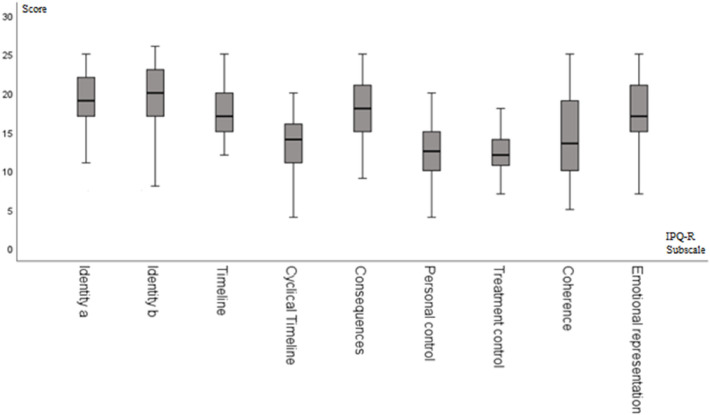
Illness representations explain the individual's perception and processing of health-related information. In a chronic condition such as persistent pain, illness representations might influence treatment adherence and outcome. This study aims to exploratively identify illness representations of patients with chronic pain and their association to mental disorders and subjective distress. 95 participants admitted to an inpatient university clinic were included. Validated instruments were used to assess illness representations (IPQ-R), mental health disorders (PHQ-D), and subjective distress (PSQ). Sociodemographic data and scores for the instruments were first inspected descriptively. Correlation, regression, and mediator analyses were conducted. Analyses indicated that the distributions of the IPQ-R range toward higher values. In regard to mental disorders (PHQ-D) and subjective distress (PSQ), we found several significant correlations with subscales of the IPQ-R. A regression analysis showed the IPQ-R subscales personal control, emotional representation and sex (males) to be significant predictors of subjective distress measured with the PSQ (F = 11.55, p < .001, adjusted R = 0.545). Depression, anxiety, and stress syndromes (PHQ-D) significantly mediated the positive association between emotional representations (IPQ-R, predictor) and subjective distress (PSQ, outcome) with a total effect of c = .005, 95% CI [.005; .129]. Illness representations play a significant role in evaluating patients' subjective distress and mental health. It is advised to incorporate illness representations into standard protocols for psychological interventions to comprehend their influence on targeted therapeutic strategies, particularly those tailored for pain management.
疾病认知解释了个体对与健康相关信息的感知和处理。在慢性疾病(如持续性疼痛)的情况下,疾病认知可能会影响治疗依从性和结果。本研究旨在探索性地确定慢性疼痛患者的疾病认知及其与精神障碍和主观困扰的关联。95 名入住大学门诊的患者参与了研究。使用了经过验证的工具来评估疾病认知(IPQ-R)、精神健康障碍(PHQ-D)和主观困扰(PSQ)。首先对社会人口统计学数据和工具评分进行描述性检查。进行了相关性、回归和中介分析。分析表明,IPQ-R 的分布趋于更高的值。关于精神障碍(PHQ-D)和主观困扰(PSQ),我们发现 IPQ-R 的几个亚量表与它们存在显著相关性。回归分析表明,IPQ-R 的亚量表个人控制、情绪表达和性别(男性)是 PSQ 衡量的主观困扰的显著预测因素(F = 11.55,p < .001,调整后的 R = 0.545)。抑郁、焦虑和压力综合征(PHQ-D)显著中介了情绪表达(IPQ-R,预测因素)和主观困扰(PSQ,结果)之间的正相关,总效应 c = .005,95%CI [.005;.129]。疾病认知在评估患者的主观困扰和精神健康方面起着重要作用。建议将疾病认知纳入心理干预的标准方案中,以理解其对靶向治疗策略的影响,特别是那些针对疼痛管理的策略。