Department of Radiation Oncology, The University of Texas MD Anderson Cancer Center, Houston, Texas, USA.
Département de physique, de génie physique et d'optique, et Centre de recherche sur le cancer, Université Laval, Québec, Québec, Canada.
J Appl Clin Med Phys. 2023 Dec;24(12):e14150. doi: 10.1002/acm2.14150. Epub 2023 Sep 20.
To evaluate the performance of an electromagnetic (EM)-tracked scintillation dosimeter in detecting source positional errors of IVD in HDR brachytherapy treatment.
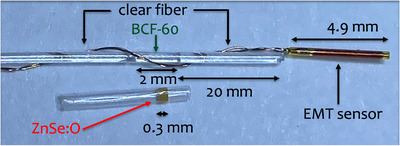
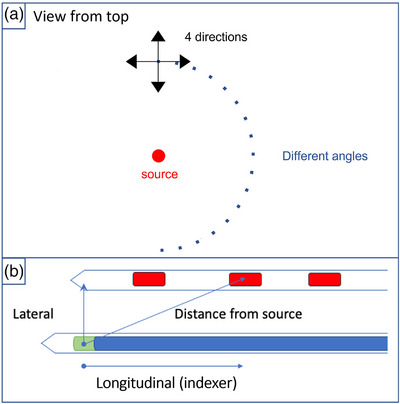
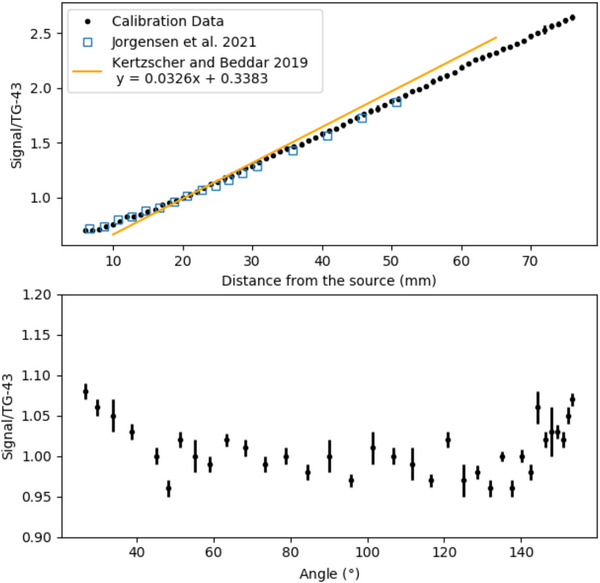
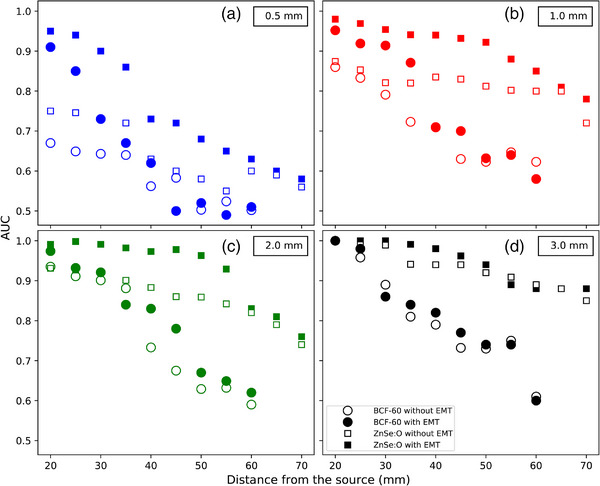
Two different scintillator dosimeter prototypes were coupled to 5 degrees-of-freedom (DOF) EM sensors read by an Aurora V3 system. The scintillators used were a 0.3 × 0.4 × 0.4 mm ZnSe:O and a BCF-60 plastic scintillator of 0.5 mm diameter and 2.0 mm in length (Saint-Gobain Crystals). The sensors were placed at the dosimeter's tip at 20.0 mm from the scintillator. The EM sampling rate was 40/s while the scintillator signal was sampled at 100 000/s using two photomultiplier tubes from Hamamatsu (series H10722) connected to a data acquisition board. A high-pass filter and a low-pass filter were used to separate the light signal into two different channels. All measurements were performed with an afterloader unit (Flexitron-Elekta AB, Sweden) in full-scattered (TG43) conditions. EM tracking was further used to provide distance/angle-dependent energy correction for the ZnSe:O inorganic scintillator. For the error detection part, lateral shifts of 0.5 to 3 mm were induced by moving the source away from its planned position. Indexer length (longitudinal) errors between 0.5 to 10 mm were also introduced. The measured dose rate difference was converted to a shift distance, with and without using the positional information from the EM sensor.
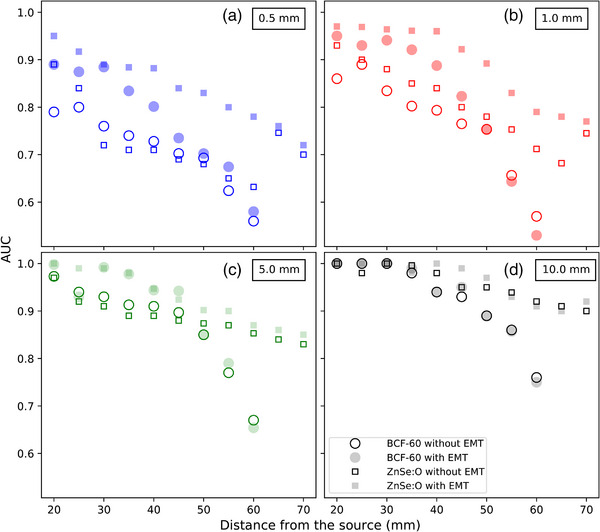
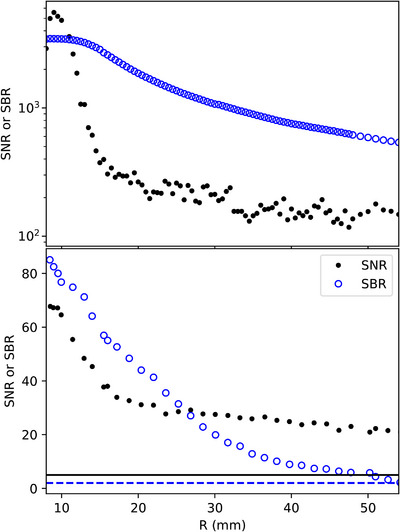
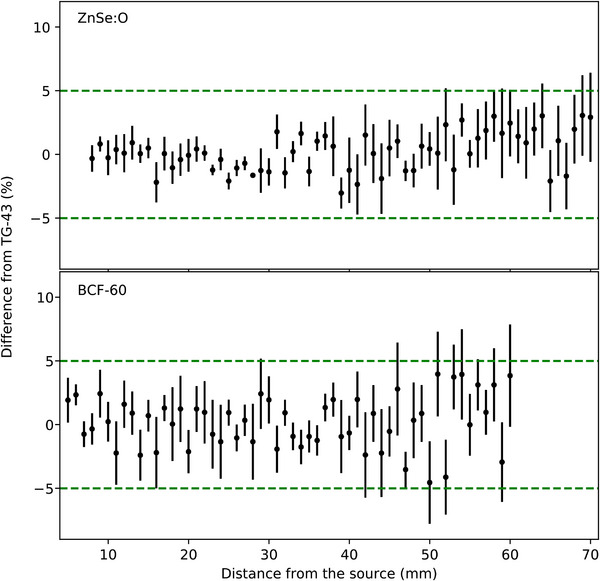
The inorganic scintillator had both a signal-to-noise-ratio (SNR) and signal-to-background-ratio (SBR) close to 70 times higher than those of the plastic scintillator. The mean absolute difference from the dose measurement to the dose calculated with TG-43U1 was 1.5% ±0.7%. The mean absolute error for BCF-60 detector was 1.7% when compared to TG-43 calculations formalism. With the inorganic scintillator and EM tracking, a maximum area under the curve (AUC) gain of 24.0% was obtained for a 0.5-mm lateral shift when using the EMT data with the ZnSe:O. Lower AUC gains were obtained for a 3-mm lateral shifts with both scintillators. For the plastic scintillator, the highest gain from using EM tracking information occurred for a 0.5-mm lateral shift at 20 mm from the source. The maximal gain (17.4%) for longitudinal errors was found at the smallest shifts (0.5 mm).
This work demonstrates that integrating EM tracking to in vivo scintillation dosimeters enables the detection of smaller shifts, by decreasing the dosimeter positioning uncertainty. It also serves to perform position-dependent energy correction for the inorganic scintillator,providing better SNR and SBR, allowing detection of errors at greater distances from the source.
评估电磁(EM)跟踪闪烁剂量计在检测 HDR 近距离治疗中 IVD 源位置误差中的性能。
两个不同的闪烁剂量计原型与 5 自由度(DOF)EM 传感器耦合,由 Aurora V3 系统读取。所使用的闪烁体是 0.3×0.4×0.4mm 的 ZnSe:O 和直径为 0.5mm、长度为 2.0mm 的 BCF-60 塑料闪烁体(圣戈班晶体)。传感器放置在距离闪烁体 20.0mm 的剂量计尖端。EM 采样率为 40/s,而闪烁体信号使用两个 Hamamatsu 光电倍增管(系列 H10722)以 100000/s 的速度进行采样,并连接到数据采集板。使用高通滤波器和低通滤波器将光信号分离成两个不同的通道。所有测量均在完全散射(TG43)条件下使用后装器单元(Flexitron-Elekta AB,瑞典)进行。EM 跟踪进一步用于为 ZnSe:O 无机闪烁体提供距离/角度相关的能量校正。对于误差检测部分,通过将源从计划位置移开来引起 0.5 至 3mm 的横向移位。还引入了 0.5 至 10mm 的索引器长度(纵向)误差。测量的剂量率差异被转换为移位距离,使用和不使用 EM 传感器的位置信息。
与塑料闪烁体相比,无机闪烁体的信噪比(SNR)和信号与背景比(SBR)都接近 70 倍。与 TG-43U1 剂量测量相比,剂量计算的平均绝对差值为 1.5%±0.7%。与 TG-43 计算形式相比,BCF-60 探测器的平均绝对误差为 1.7%。使用无机闪烁体和 EM 跟踪,对于 0.5mm 的横向位移,使用 ZnSe:O 的 EMT 数据可获得最大 24.0%的曲线下面积(AUC)增益。对于两个闪烁体,3mm 的横向位移获得的 AUC 增益较低。对于塑料闪烁体,使用 EM 跟踪信息获得的最大增益发生在距源 20mm 处的 0.5mm 横向位移。最小移位(0.5mm)时,纵向误差的最大增益(17.4%)。
这项工作表明,通过降低剂量计定位不确定性,将 EM 跟踪集成到体内闪烁剂量计中可以检测到更小的移位。它还有助于为无机闪烁体执行位置相关的能量校正,提供更好的 SNR 和 SBR,允许在离源更远的距离检测到误差。