Shu Long, Zhang Xiaoyan, Zhu Qin, Lv Xiaoling, Si Caijuan
Department of Nutrition, Zhejiang Hospital, Hangzhou, China.
Department of Digestion, Zhejiang Hospital, Hangzhou, China.
Front Nutr. 2023 Sep 4;10:1250361. doi: 10.3389/fnut.2023.1250361. eCollection 2023.
Some epidemiological studies have examined the association between consumption of ultra-processed food (UPF) and the risk of breast cancer. However, the results were inconsistent. Therefore, we carried out a systematic review and dose-response meta-analysis to examine whether an association exists between high consumption of UPF and breast cancer risk.
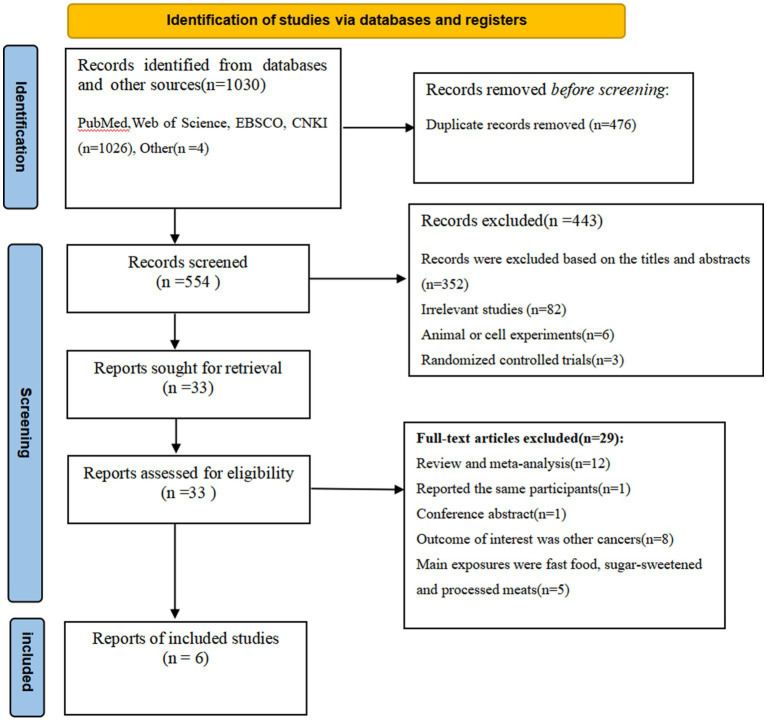
PubMed/MEDLINE, ISI Web of Science, EBSCO and CNKI databases were systematically searched from inception to May 2023. The summary relative risks (RRs) and 95% confidence intervals (CIs) associated with UPF consumption and breast cancer were calculated using a random-effects model (DerSimonian-Laird method). Heterogeneity between included studies was examined using the Cochran's test and I-square () statistics. Publication bias was studied by visual inspection of funnel plot asymmetry and Begg's and Egger's tests.
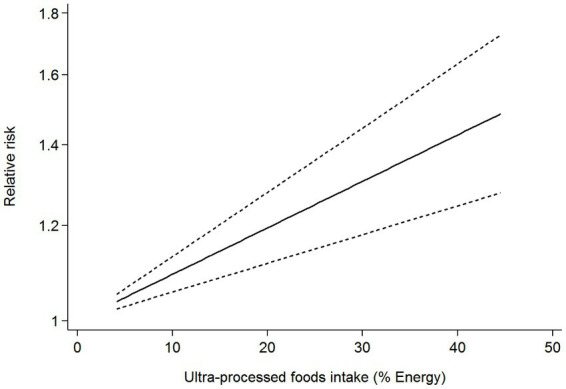
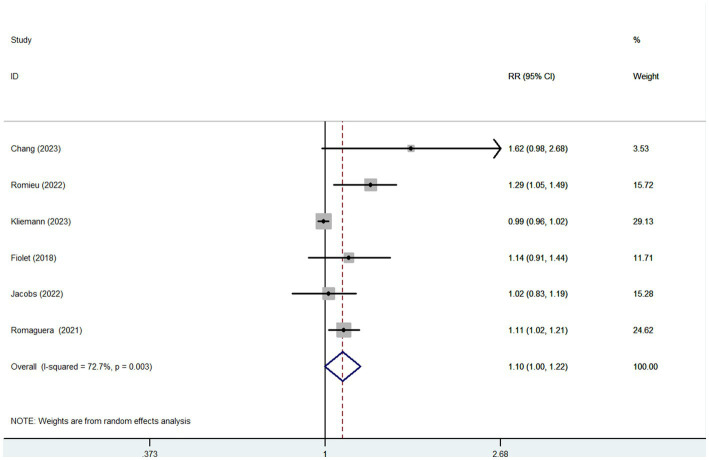
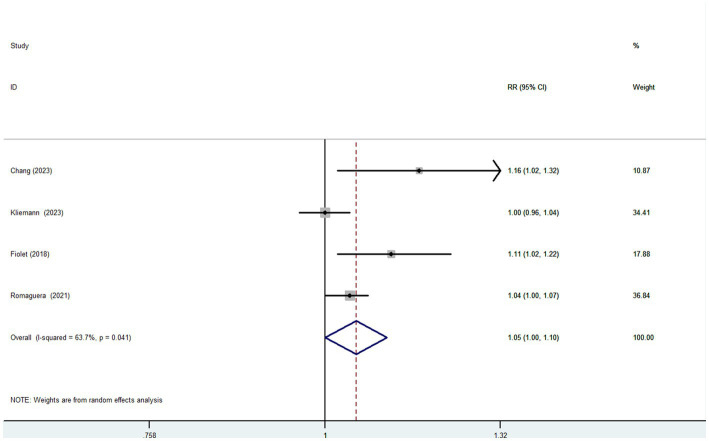
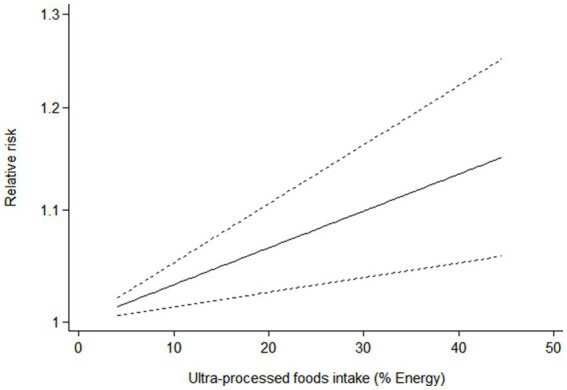
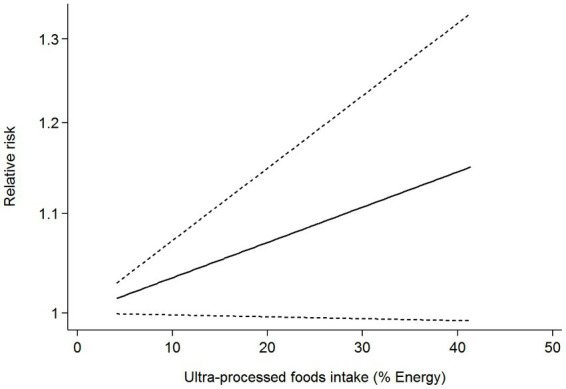
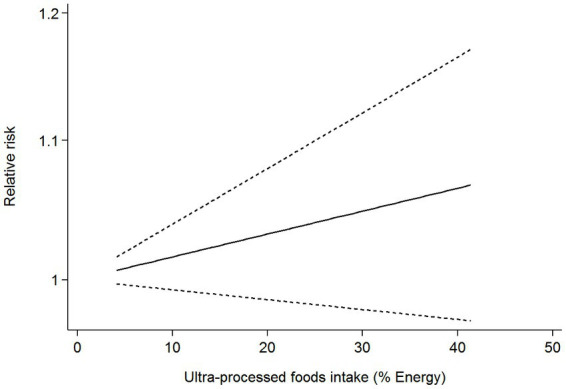
Overall, six articles involving 462,292 participants, were eligible to be included in this study. Compared to the lowest consumption, highest consumption of UPF was related to a higher risk of breast cancer (RR = 1.10; 95%CI: 1.00-1.22, = 0.056). Besides, the linear dose-response analysis showed that each 10% increment in UPF consumption was related to a 5% higher risk of breast cancer (RR = 1.05; 95%CI: 1.00-1.10, = 0.048). Subgroup analyses suggested that UPF consumption was positively associated with breast cancer risk in case-control studies (RR = 1.13; 95%CI: 1.01-1.26, = 0.028). Additionally, there was also a significant positive association between UPF consumption and breast cancer risk in the subgroup with sample size<5,000(RR = 1.17; 95%CI: 1.02-1.35, = 0.028).
Our results indicate that higher consumption of UPF is slightly related to a higher risk of breast cancer. Further studies in particular of large prospective cohort studies are warranted to confirm these results.
一些流行病学研究探讨了超加工食品(UPF)的摄入量与乳腺癌风险之间的关联。然而,结果并不一致。因此,我们进行了一项系统综述和剂量反应荟萃分析,以研究大量摄入UPF与乳腺癌风险之间是否存在关联。
系统检索了PubMed/MEDLINE、ISI Web of Science、EBSCO和中国知网数据库,检索时间从建库至2023年5月。使用随机效应模型(DerSimonian-Laird法)计算与UPF摄入量和乳腺癌相关的汇总相对风险(RR)和95%置信区间(CI)。采用Cochran's检验和I²统计量检验纳入研究之间的异质性。通过直观检查漏斗图不对称性以及Begg检验和Egger检验研究发表偏倚。
总体而言,6篇文章涉及462,292名参与者,符合纳入本研究的条件。与最低摄入量相比,最高摄入量的UPF与更高的乳腺癌风险相关(RR = 1.10;95%CI:1.00 - 1.22,P = 0.056)。此外,线性剂量反应分析表明,UPF摄入量每增加10%,乳腺癌风险就会增加5%(RR = 1.05;95%CI:1.00 -