Cicero Arrigo F G, Fogacci Federica, Tocci Giuliano, D'Addato Sergio, Grandi Elisa, Banach Maciej, Borghi Claudio
Hypertension and Cardiovascular Risk Research Group, Medical and Surgical Sciences Department, University of Bologna, Bologna, Italy.
Italian Nutraceutical Society (SINut), Bologna, Italy.
Arch Med Sci. 2023 Jun 17;19(5):1169-1179. doi: 10.5114/aoms/167969. eCollection 2023.
There is growing interest in head-to-head comparison between different lipid-lowering nutraceuticals. The aim of our study was to test the lipid-lowering effect of dietary supplementation with low-dose monacolins from red yeast rice (2.8 mg per daily dose) combined with berberine (Armolipid Plus) or highly standardized artichoke extract versus placebo.
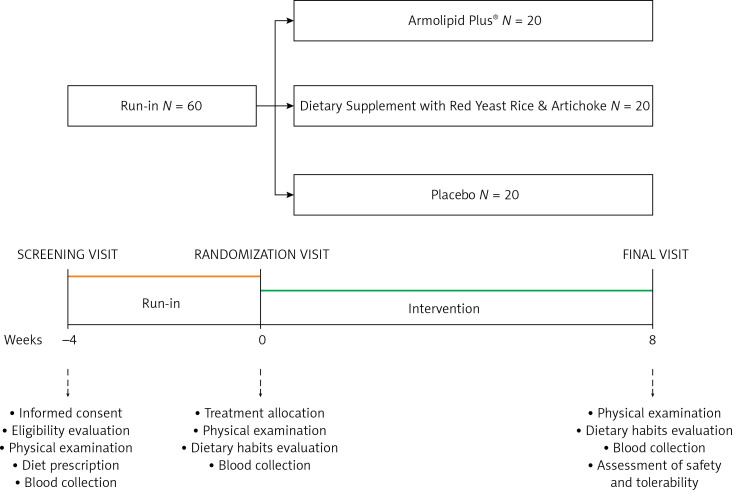
60 overall healthy adult volunteers with polygenic hypercholesterolemia (baseline low-density lipoprotein cholesterol (LDL-C) = 160.2 ±9.2 mg/dl) were enrolled in a 3-arm, double-blind, non-inferiority, randomized, parallel-group clinical trial. After 4-week diet standardization, enrolled individuals were randomized to be treated for 8 weeks with red yeast rice and highly standardized artichoke extracts (ATC group), Armolipid Plus, or placebo.
At the enrolment visit, LDL-C values were similar in the compared groups. After 8 weeks, all actively treated subjects experienced significant improvements in baseline total cholesterol (TC), LDL-C and apolipoprotein B (Apo-B) (all < 0.01) (ATC group: TC = -18.9%, LDL-C = -26.7% (placebo-corrected: -12.4%), Apo-B = -19.6%; Armolipid Plus: TC = -18.4%, LDL-C = -25.8% (placebo-corrected: -12.1%), Apo-B = -23.2%; placebo: TC = -6.2%, LDL-C = -8%, Apo-B = -8.4%). Participants in the ATC group attained significantly lower body mass index (BMI) values (-2.1%), while individuals treated with Armolipid Plus showed improvements in baseline high-density lipoprotein cholesterol (HDL-C) (+8.7%) and triglyceride (TG) (+17.5%) levels. Finally, baseline hepatic steatosis index (HSI) values significantly decreased in both actively treated groups (by -2.4% and -2.4% in ATC and in Armolipid Plus, respectively).
Patients with polygenic hypercholesterolemia experienced a significant improvement in several cardiovascular risk factors in both ATC and Armolipid Plus groups.
人们对不同降脂营养保健品之间的直接比较越来越感兴趣。我们研究的目的是测试低剂量红曲米中莫纳可林(每日剂量2.8毫克)与小檗碱联合使用(Armolipid Plus)或高标准化朝鲜蓟提取物与安慰剂相比的降脂效果。
60名患有多基因高胆固醇血症的总体健康成年志愿者(基线低密度脂蛋白胆固醇(LDL-C)=160.2±9.2毫克/分升)参加了一项三臂、双盲、非劣效性、随机、平行组临床试验。经过4周的饮食标准化后,将入选个体随机分为三组,分别接受8周的红曲米和高标准化朝鲜蓟提取物治疗(ATC组)、Armolipid Plus治疗或安慰剂治疗。
在入组时,各比较组的LDL-C值相似。8周后,所有积极治疗的受试者的基线总胆固醇(TC)、LDL-C和载脂蛋白B(Apo-B)均有显著改善(均P<0.01)(ATC组:TC=-18.9%,LDL-C=-26.7%(校正安慰剂后:-12.4%),Apo-B=-19.6%;Armolipid Plus组:TC=-18.4%,LDL-C=-25.8%(校正安慰剂后:-12.1%),Apo-B=-23.2%;安慰剂组:TC=-6.2%,LDL-C=-8%,Apo-B=-8.4%)。ATC组的参与者体重指数(BMI)值显著降低(-2.1%),而接受Armolipid Plus治疗的个体的基线高密度脂蛋白胆固醇(HDL-C)(+8.7%)和甘油三酯(TG)(+17.5%)水平有所改善。最后,两个积极治疗组的基线肝脂肪变性指数(HSI)值均显著降低(ATC组和Armolipid Plus组分别降低-2.4%和-2.4%)。
多基因高胆固醇血症患者在ATC组和Armolipid Plus组中,多项心血管危险因素均有显著改善。