Nittayacharn Pinunta, Abenojar Eric, Cooley Michaela, Berg Felipe, Counil Claire, Sojahrood Amin Jafari, Khan Muhammad Saad, Yang Celina, Berndl Elizabeth, Golczak Marcin, Kolios Michael C, Exner Agata A
Department of Radiology, Case Western Reserve University, Cleveland, OH, USA.
Department of Biomedical Engineering, Case Western Reserve University, Cleveland, OH, USA.
bioRxiv. 2023 Sep 5:2023.09.01.555196. doi: 10.1101/2023.09.01.555196.
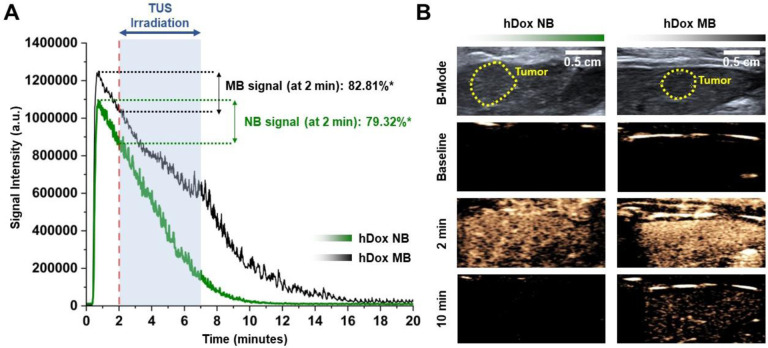
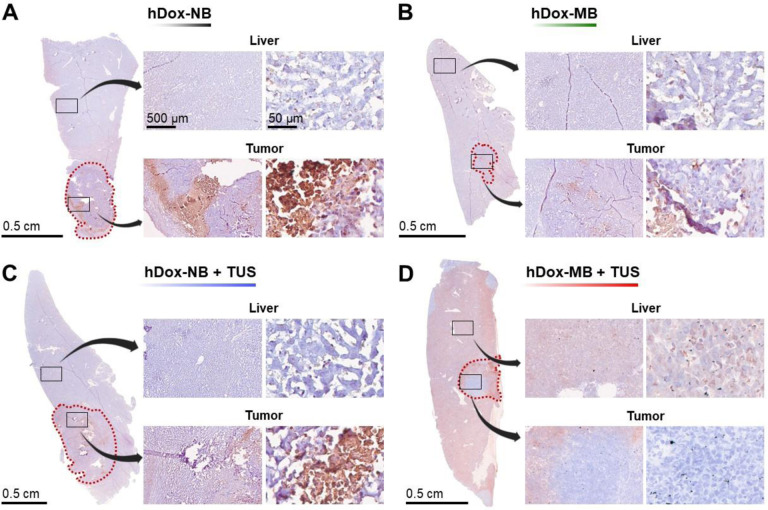
Liver metastasis is a major obstacle in treating aggressive cancers, and current therapeutic options often prove insufficient. To overcome these challenges, there has been growing interest in ultrasound-mediated drug delivery using lipid-shelled microbubbles (MBs) and nanobubbles (NBs) as promising strategies for enhancing drug delivery to tumors. Our previous work demonstrated the potential of Doxorubicin-loaded CF NBs (hDox-NB, 280 ± 123 nm) in improving cancer treatment in vitro using low-frequency ultrasound. In this study, we investigated the pharmacokinetics and biodistribution of sonicated hDox-NBs in orthotopic rat liver tumors. We compared their delivery and therapeutic efficiency with size-isolated MBs (hDox-MB, 1104 ± 373 nm). Results showed a similar accumulation of hDox in tumors treated with hDox-MBs and unfocused therapeutic ultrasound (hDox-MB+TUS) and hDox-NB+TUS. However, significantly increased apoptotic cell death in the tumor and fewer off-target apoptotic cells in the normal liver were found upon the treatment with hDox-NB+TUS. The tumor-to-liver apoptotic ratio was elevated 9.4-fold following treatment with hDox-NB+TUS compared to hDox-MB+TUS, suggesting that the therapeutic efficacy and specificity are significantly increased when using hDox-NB+TUS. These findings highlight the potential of this approach as a viable treatment modality for liver tumors. By elucidating the behavior of drug-loaded bubbles , we aim to contribute to developing more effective liver cancer treatments that could ultimately improve patient outcomes and decrease off-target side effects.
肝转移是治疗侵袭性癌症的主要障碍,目前的治疗方案往往效果不佳。为了克服这些挑战,利用脂质包裹的微泡(MBs)和纳米泡(NBs)进行超声介导的药物递送作为增强肿瘤药物递送的有前景策略,受到越来越多的关注。我们之前的工作证明了负载阿霉素的CF纳米泡(hDox-NB,280±123纳米)在使用低频超声改善体外癌症治疗方面的潜力。在本研究中,我们研究了超声处理的hDox-NBs在原位大鼠肝肿瘤中的药代动力学和生物分布。我们将它们的递送和治疗效率与尺寸分离的微泡(hDox-MB,1104±373纳米)进行了比较。结果显示,用hDox-MBs和非聚焦治疗超声(hDox-MB+TUS)以及hDox-NB+TUS治疗的肿瘤中,hDox的积累情况相似。然而,在用hDox-NB+TUS治疗后,肿瘤中的凋亡细胞死亡显著增加,而正常肝脏中的脱靶凋亡细胞减少。与hDox-MB+TUS相比,hDox-NB+TUS治疗后肿瘤与肝脏的凋亡率提高了9.4倍,这表明使用hDox-NB+TUS时治疗效果和特异性显著提高。这些发现突出了这种方法作为肝肿瘤可行治疗方式的潜力。通过阐明载药气泡的行为,我们旨在为开发更有效的肝癌治疗方法做出贡献,最终改善患者预后并减少脱靶副作用。