Milligan Joshua J, Saha Soumen
Department of Biomedical Engineering, Duke University, Durham, NC 277018, USA.
Cancers (Basel). 2022 Mar 29;14(7):1741. doi: 10.3390/cancers14071741.
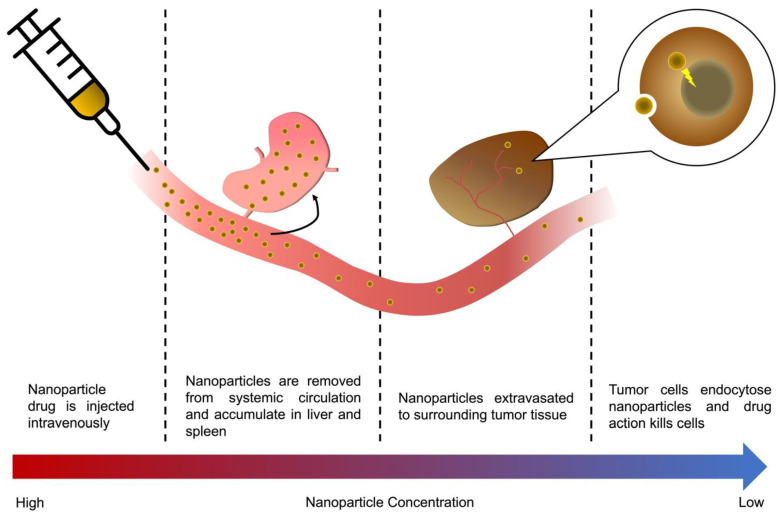
Nanomedicines represent the cutting edge of today's cancer therapeutics. Seminal research decades ago has begun to pay dividends in the clinic, allowing for the delivery of cancer drugs with enhanced systemic circulation while also minimizing off-target toxicity. Despite the advantages of delivering cancer drugs using nanoparticles, micelles, or other nanostructures, only a small fraction of the injected dose reaches the tumor, creating a narrow therapeutic window for an otherwise potent drug. First-pass metabolism of nanoparticles by the reticuloendothelial system (RES) has been identified as a major culprit for the depletion of nanoparticles in circulation before they reach the tumor site. To overcome this, new strategies, materials, and functionalization with stealth polymers have been developed to improve nanoparticle circulation and uptake at the tumor site. This review summarizes the strategies undertaken to evade RES uptake of nanomedicines and improve the passive and active targeting of nanoparticle drugs to solid tumors. We also outline the limitations of current strategies and the future directions we believe will be explored to yield significant benefits to patients and make nanomedicine a promising treatment modality for cancer.
纳米药物代表了当今癌症治疗的前沿领域。几十年前的开创性研究已开始在临床上取得成效,使得癌症药物能够在增强全身循环的同时,将脱靶毒性降至最低。尽管使用纳米颗粒、胶束或其他纳米结构递送癌症药物具有诸多优势,但注射剂量中只有一小部分能够到达肿瘤部位,这使得原本强效的药物治疗窗口变窄。网状内皮系统(RES)对纳米颗粒的首过代谢已被确定为纳米颗粒在到达肿瘤部位之前在循环中耗竭的主要原因。为克服这一问题,人们已开发出新的策略、材料以及用隐形聚合物进行功能化修饰,以改善纳米颗粒在肿瘤部位的循环和摄取。本综述总结了为避免RES摄取纳米药物以及改善纳米颗粒药物对实体瘤的被动和主动靶向所采取的策略。我们还概述了当前策略的局限性以及我们认为未来将探索的方向,以期为患者带来显著益处,并使纳米药物成为一种有前景的癌症治疗方式。