Tenhunen Annelie Barrueta, van der Heijden Jaap, Skorup Paul, Maccarana Marco, Larsson Anders, Larsson Anders, Perchiazzi Gaetano, Tenhunen Jyrki
Department of Surgical Sciences, Division of Anaesthesiology and Intensive Care, Uppsala University, Uppsala, Sweden.
Department of Medical Sciences, Division of Infectious Diseases, Uppsala University, Uppsala, Sweden.
Intensive Care Med Exp. 2023 Sep 21;11(1):63. doi: 10.1186/s40635-023-00548-w.
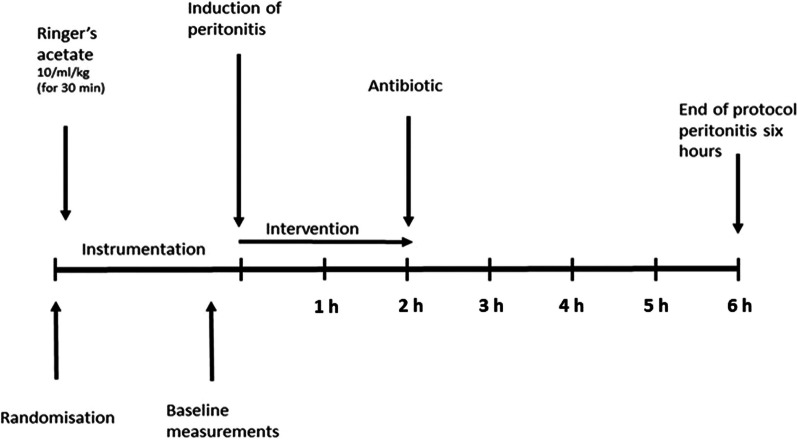
Sepsis is a condition with high morbidity and mortality. Prompt recognition and initiation of treatment is essential. Despite forming an integral part of sepsis management, fluid resuscitation may also lead to volume overload, which in turn is associated with increased mortality. The optimal fluid strategy in sepsis resuscitation is yet to be defined. Hyaluronan, an endogenous glycosaminoglycan with high affinity to water is an important constituent of the endothelial glycocalyx. We hypothesized that exogenously administered hyaluronan would counteract intravascular volume depletion and contribute to endothelial glycocalyx integrity in a fluid restrictive model of peritonitis. In a prospective, blinded model of porcine peritonitis sepsis, we randomized animals to intervention with hyaluronan (n = 8) or 0.9% saline (n = 8). The animals received an infusion of 0.1% hyaluronan 6 ml/kg/h, or the same volume of saline, during the first 2 h of peritonitis. Stroke volume variation and hemoconcentration were comparable in the two groups throughout the experiment. Cardiac output was higher in the intervention group during the infusion of hyaluronan (3.2 ± 0.5 l/min in intervention group vs 2.7 ± 0.2 l/min in the control group) (p = 0.039). The increase in lactate was more pronounced in the intervention group (3.2 ± 1.0 mmol/l in the intervention group and 1.7 ± 0.7 mmol/l in the control group) at the end of the experiment (p < 0.001). Concentrations of surrogate markers of glycocalyx damage; syndecan 1 (0.6 ± 0.2 ng/ml vs 0.5 ± 0.2 ng/ml, p = 0.292), heparan sulphate (1.23 ± 0.2 vs 1.4 ± 0.3 ng/ml, p = 0.211) and vascular adhesion protein 1 (7.0 ± 4.1 vs 8.2 ± 2.3 ng/ml, p = 0.492) were comparable in the two groups at the end of the experiment. In conclusion, hyaluronan did not counteract intravascular volume depletion in early peritonitis sepsis. However, this finding is hampered by the short observation period and a beneficial effect of HMW-HA in peritonitis sepsis cannot be discarded based on the results of the present study.
脓毒症是一种发病率和死亡率都很高的病症。迅速识别并开始治疗至关重要。尽管液体复苏是脓毒症管理的一个重要组成部分,但它也可能导致容量超负荷,而这又与死亡率增加相关。脓毒症复苏中的最佳液体策略尚未确定。透明质酸是一种对水具有高亲和力的内源性糖胺聚糖,是内皮糖萼的重要组成部分。我们假设,在腹膜炎的液体限制模型中,外源性给予透明质酸将抵消血管内容量耗竭,并有助于维持内皮糖萼的完整性。在一个前瞻性、盲法猪腹膜炎脓毒症模型中,我们将动物随机分为接受透明质酸干预组(n = 8)和0.9%生理盐水组(n = 8)。在腹膜炎的最初2小时内,动物接受以6 ml/kg/h的速度输注0.1%透明质酸或相同体积的生理盐水。在整个实验过程中,两组的每搏输出量变异和血液浓缩情况相当。在输注透明质酸期间,干预组的心输出量较高(干预组为3.2±0.5 l/min,对照组为2.7±0.2 l/min)(p = 0.039)。在实验结束时,干预组的乳酸增加更为明显(干预组为3.2±1.0 mmol/l,对照组为1.7±0.7 mmol/l)(p < 0.001)。实验结束时,两组中糖萼损伤替代标志物的浓度;多配体蛋白聚糖1(0.6±0.2 ng/ml对0.5±0.2 ng/ml,p = 0.292)、硫酸乙酰肝素(1.23±0.2对1.4±0.3 ng/ml,p = 0.211)和血管黏附蛋白1(7.0±4.1对8.2±2.3 ng/ml,p = 0.492)相当。总之,透明质酸在早期腹膜炎脓毒症中并未抵消血管内容量耗竭。然而,这一发现受到观察期较短的影响,基于本研究结果不能排除高分子量透明质酸在腹膜炎脓毒症中的有益作用。