Department of Emergency Medicine and Center for Vascular Biology Research, Beth Israel Deaconess Medical Center, 1 Deaconess Road, CC2-W, Boston, MA, 02215, USA.
Department of Emergency Medicine, Brigham and Women's Hospital, Boston, MA, USA.
Crit Care. 2018 Nov 20;22(1):308. doi: 10.1186/s13054-018-2240-5.
We sought to determine the effects of alternative resuscitation strategies on microcirculatory perfusion and examine any association between microcirculatory perfusion and mortality in sepsis.
This was a prospective, formally designed substudy of participants in the Protocolized Care in Early Septic Shock (ProCESS) trial. We recruited from six sites with the equipment and training to perform these study procedures. All subjects were adults with septic shock, and each was assigned to alternative resuscitation strategies. The two main analyses assessed (1) the impact of resuscitation strategies on microcirculatory perfusion parameters and (2) the association of microcirculatory perfusion with 60-day in-hospital mortality. We measured sublingual microcirculatory perfusion using sidestream dark field in vivo video microscopy at the completion of the 6-h ProCESS resuscitation protocol and then again at 24 and 72 h.
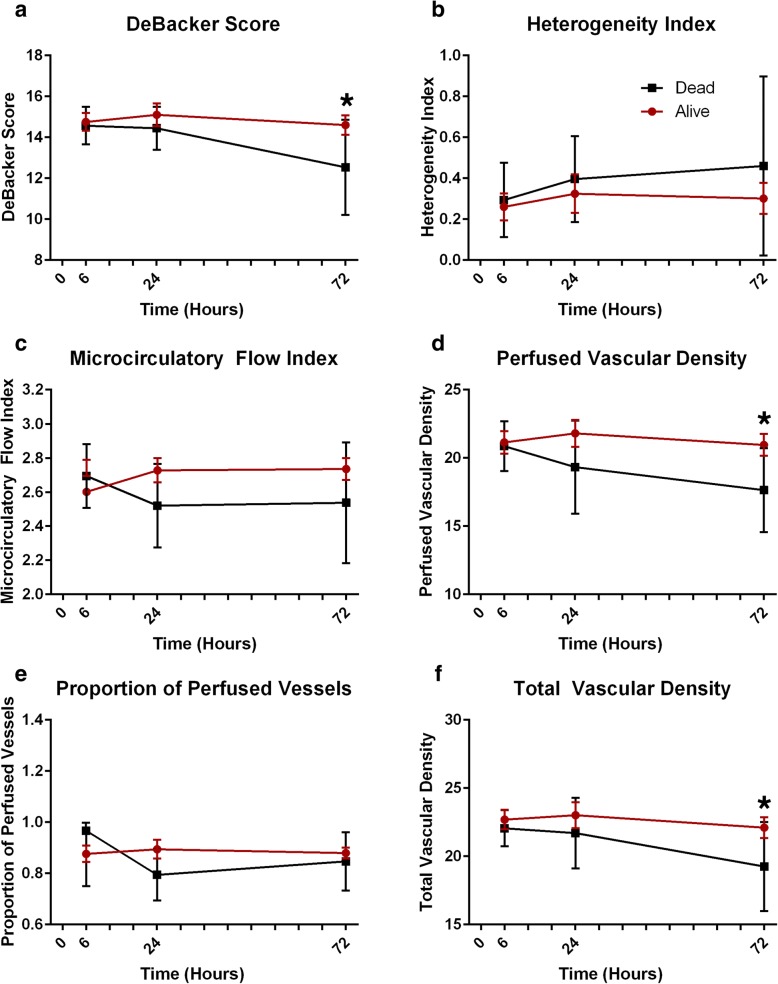
We enrolled 207 subjects (demographics were similar to the overall ProCESS cohort) and observed 40 (19.3%) deaths. There were no differences in average perfusion characteristics between treatment arms. Analyzing the relationship between microcirculatory perfusion and mortality, we found an association between vascular density parameters and mortality. Total vascular density (beta = 0.006, p < 0.003), perfused vascular density (beta = 0.005, p < 0.04), and De Backer score (beta = 0.009, p < 0.01) were higher overall in survivors in a generalized estimating equation model, and this association was significant at the 72-h time point (p < 0.05 for each parameter).
Microcirculatory perfusion did not differ between three early septic shock treatment arms. We found an association between microcirculatory perfusion parameters of vascular density at 72 h and mortality.
ClinicalTrials.gov, NCT00510835 . Registered on August 2, 2007.
我们旨在确定替代复苏策略对微循环灌注的影响,并研究脓毒症中微循环灌注与死亡率之间的任何关联。
这是 Protocolized Care in Early Septic Shock (ProCESS) 试验中参与者的前瞻性、正式设计的子研究。我们从具有执行这些研究程序所需设备和培训的六个地点招募参与者。所有受试者均为脓毒性休克的成年人,并且每个受试者都被分配到替代复苏策略中。两项主要分析评估了(1)复苏策略对微循环灌注参数的影响,以及(2)微循环灌注与 60 天院内死亡率的关联。我们在完成 6 小时 ProCESS 复苏方案后,使用 sidestream dark field 体内视频显微镜测量舌下微循环灌注,并在 24 小时和 72 小时再次测量。
我们招募了 207 名受试者(人口统计学特征与整体 ProCESS 队列相似),并观察到 40 名(19.3%)死亡。在治疗组之间,平均灌注特征没有差异。分析微循环灌注与死亡率之间的关系,我们发现血管密度参数与死亡率之间存在关联。在广义估计方程模型中,总血管密度(beta = 0.006,p < 0.003)、灌注血管密度(beta = 0.005,p < 0.04)和 De Backer 评分(beta = 0.009,p < 0.01)在总体上在幸存者中更高,并且这种关联在 72 小时时间点显著(每个参数的 p < 0.05)。
在三种早期脓毒性休克治疗组之间,微循环灌注没有差异。我们发现,72 小时时血管密度的微循环灌注参数与死亡率之间存在关联。
ClinicalTrials.gov,NCT00510835。于 2007 年 8 月 2 日注册。