Comprehensive Pain and Addiction Center, University of Arizona Health Sciences, Tucson, AZ, United States.
Arizona Center for Rural Health, Mel and Enid Zuckerman College of Public Health, University of Arizona, Tucson, AZ, United States.
Pain. 2024 Mar 1;165(3):666-673. doi: 10.1097/j.pain.0000000000003056. Epub 2023 Sep 21.
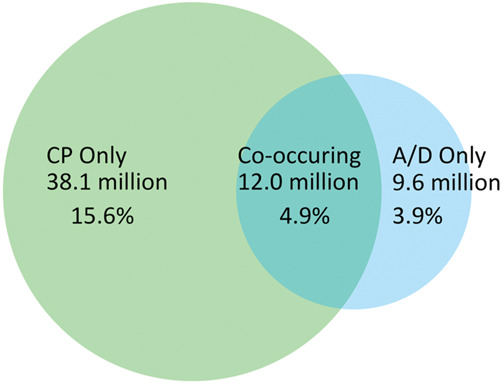
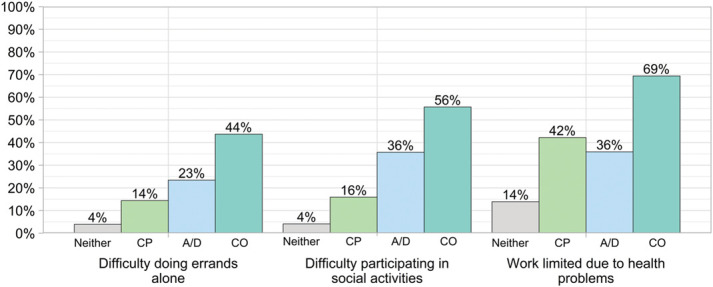
Co-occurrence of chronic pain and clinically significant symptoms of anxiety and/or depression is regularly noted in the literature. Yet, little is known empirically about population prevalence of co-occurring symptoms, nor whether people with co-occurring symptoms constitute a distinct subpopulation within US adults living with chronic pain or US adults living with anxiety and/or depression symptoms (A/D). To address this gap, this study analyzes data from the 2019 National Health Interview Survey, a representative annual survey of self-reported health status and treatment use in the United States (n = 31,997). Approximately 12 million US adults, or 4.9% of the adult population, have co-occurring chronic pain and A/D symptoms. Unremitted A/D symptoms co-occurred in 23.9% of US adults with chronic pain, compared with an A/D prevalence of 4.9% among those without chronic pain. Conversely, chronic pain co-occurred in the majority (55.6%) of US adults with unremitted A/D symptoms, compared with a chronic pain prevalence of 17.1% among those without A/D symptoms. The likelihood of experiencing functional limitations in daily life was highest among those experiencing co-occurring symptoms, compared with those experiencing chronic pain alone or A/D symptoms alone. Among those with co-occurring symptoms, 69.4% reported that work was limited due to a health problem, 43.7% reported difficulty doing errands alone, and 55.7% reported difficulty participating in social activities. These data point to the need for targeted investment in improving functional outcomes for the nearly 1 in 20 US adults living with co-occurring chronic pain and clinically significant A/D symptoms.
慢性疼痛与临床上显著的焦虑和/或抑郁症状同时存在的情况在文献中经常被提及。然而,人们对这些同时存在的症状在人群中的普遍程度知之甚少,也不知道同时存在这些症状的人是否构成了美国慢性疼痛患者或美国有焦虑和/或抑郁症状的成年人(A/D)中的一个独特亚群体。为了填补这一空白,本研究分析了 2019 年全国健康访谈调查(NHIS)的数据,该调查是一项针对美国自我报告健康状况和治疗使用情况的代表性年度调查(n = 31997)。约有 1200 万美国成年人,即成年人的 4.9%,同时患有慢性疼痛和 A/D 症状。在患有慢性疼痛的美国成年人中,未缓解的 A/D 症状与慢性疼痛同时存在的比例为 23.9%,而无慢性疼痛的成年人中 A/D 的患病率为 4.9%。相反,在有未缓解的 A/D 症状的美国成年人中,大多数(55.6%)同时患有慢性疼痛,而无 A/D 症状的成年人中慢性疼痛的患病率为 17.1%。与仅患有慢性疼痛或 A/D 症状的成年人相比,同时患有这两种疾病的成年人在日常生活中出现功能障碍的可能性最高。在同时患有这两种疾病的成年人中,69.4%的人报告因健康问题而限制工作,43.7%的人报告独自办事困难,55.7%的人报告难以参与社会活动。这些数据表明,需要有针对性地投资改善近 1/20 的同时患有慢性疼痛和临床上显著的 A/D 症状的美国成年人的功能结局。