Institute for Health Policy, Management, and Evaluation, University of Toronto, Toronto, ON, Canada.
Department of Health & Society, University of Toronto, Scarborough, ON, Canada.
PLoS One. 2023 Sep 21;18(9):e0291683. doi: 10.1371/journal.pone.0291683. eCollection 2023.
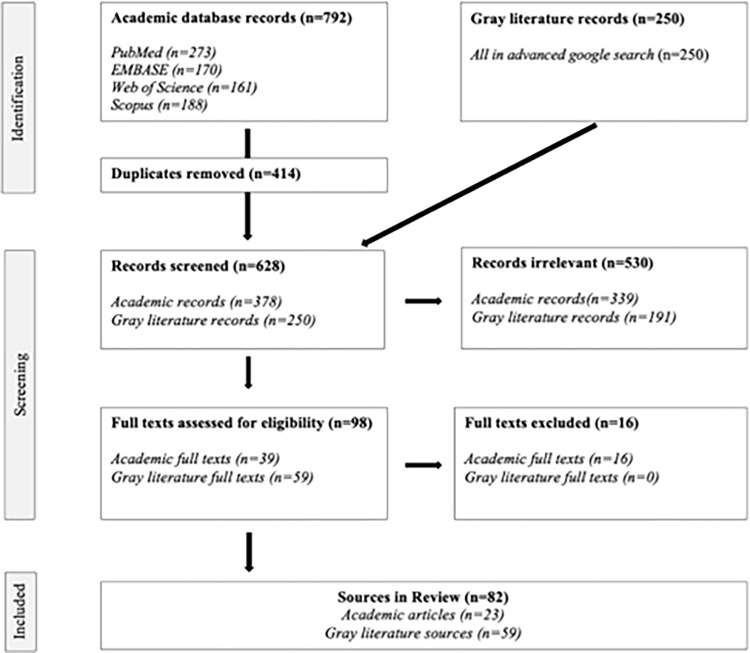
Retirement from sport is a life transition that has significant implications for athletes' physical and mental health, as well as their social and professional development. Although extensive work has been done to review the retirement experiences of athletes, relatively less work has been done to examine and reflect on this expansive body of literature with a pragmatic aim of deciding what needs to happen to better support retiring athletes. This study used scoping review methodology to review current academic reviews, gray literature articles, and support programs on athletic retirement. This review followed the Joanna Briggs Institute reviewer's manual guide on scoping reviews and adhered to the PRISMA-ScR checklist. Academic articles were identified from PubMed, Embase, Web of Science and Scopus. Gray literature articles and support programs were identified using advanced Google searches. This study identified 23 academic reviews, 44 gray literature articles, and 15 support programs. Generally, the results suggest that athletic retirement encompasses a drastic shift in identity, a loss of social networks, a lack of career ambitions, and potential risks to physical and mental health. While there was a gap in the academic literature regarding practical strategies to support retiring athletes, the gray literature suggests many creative ideas. Stepwise programming may be beneficial to help athletes: (a) make sense of their athletic experience and see retirement as an ongoing process; (b) develop a well-rounded sense of self identity and understand how to apply their unique skills and strengths in new ways; (3) gain control over their retirement transition by establishing a clear plan and adjusting to new routines and opportunities; and (4) normalize the transition experience by "living in the next" and building confidence in new life directions. Future research may benefit from developing and evaluating more programming to support athletes through the retirement transition.
运动员退役是一个生活的转变,对他们的身心健康以及社会和职业发展都有重大影响。尽管已经有大量的工作来回顾运动员的退役经历,但相对而言,对于这一广泛的文献,用务实的目的来审视和反思退役问题的工作却相对较少,即确定需要做些什么来更好地支持退役运动员。本研究使用范围综述方法来回顾关于运动员退役的当前学术综述、灰色文献文章和支持计划。本综述遵循乔安娜·布里格斯研究所综述手册指南进行范围综述,并遵守 PRISMA-ScR 清单。学术文章是从 PubMed、Embase、Web of Science 和 Scopus 中确定的。灰色文献文章和支持计划是通过高级谷歌搜索确定的。本研究确定了 23 篇学术综述、44 篇灰色文献文章和 15 个支持计划。一般来说,结果表明,运动员退役包括身份的急剧转变、社交网络的丧失、职业抱负的缺乏以及身心健康的潜在风险。虽然学术文献中缺乏支持退役运动员的实际策略,但灰色文献中提出了许多富有创意的想法。逐步规划可能有助于帮助运动员:(a) 理解他们的运动经历,并将退休视为一个持续的过程;(b) 发展全面的自我认同,并了解如何以新的方式应用他们独特的技能和优势;(3) 通过制定明确的计划并适应新的日常生活和机会来控制退休过渡;(4) 通过“活在当下”和对新的生活方向建立信心,使过渡经历正常化。未来的研究可能受益于开发和评估更多的项目,以支持运动员完成退休过渡。