Group of Precision Medicine in Chronic Diseases, University Hospital Arnau de Vilanova and Santa María, University of Lleida, IRBLleida, Lleida, Spain.
Centro de Investigación Biomédica en Red de Enfermedades Respiratorias (CIBERES), Instituto de Salud Carlos III, Madrid, Spain.
Eur Respir J. 2023 Dec 7;62(6). doi: 10.1183/13993003.00828-2023. Print 2023 Dec.
Hypoxic burden (HB) has emerged as a strong predictor of cardiovascular risk in obstructive sleep apnoea (OSA). We aimed to assess the potential of HB to predict the cardiovascular benefit of treating OSA with continuous positive airway pressure (CPAP).
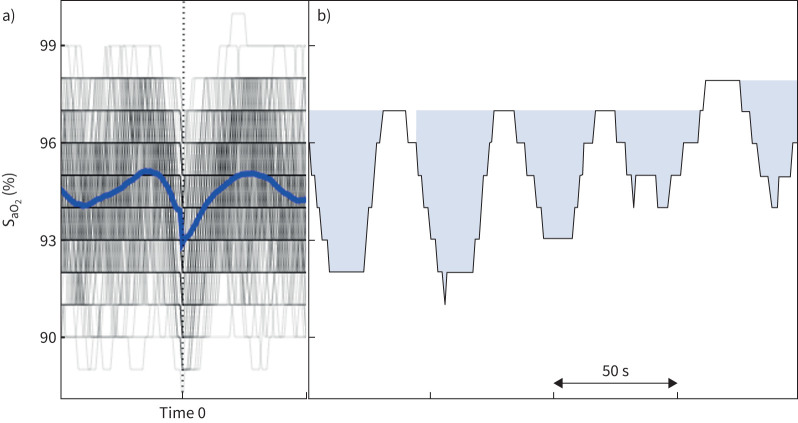
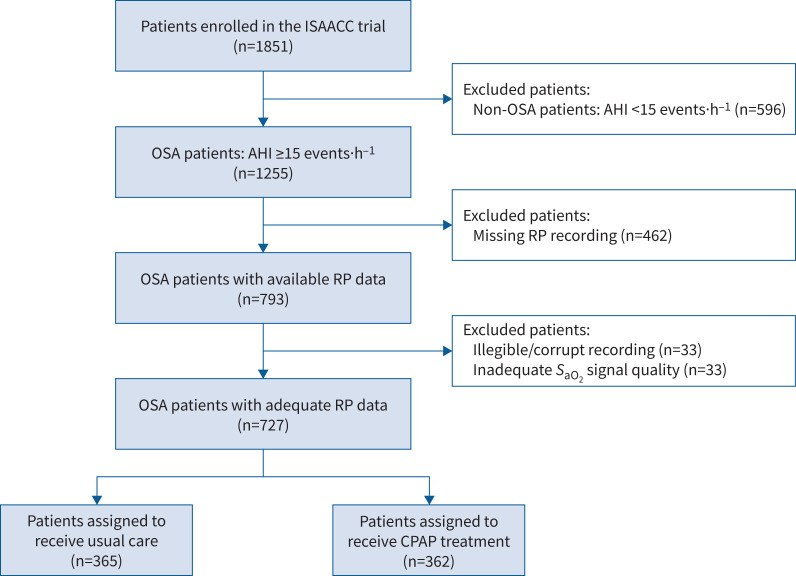
This was a analysis of the ISAACC trial (ClinicalTrials.gov: NCT01335087) including non-sleepy patients with acute coronary syndrome (ACS) diagnosed with OSA (apnoea-hypopnoea index ≥15 events·h) by respiratory polygraphy. Patients were randomised to CPAP or usual care and followed for a minimum of 1 year. HB was calculated as the total area under all automatically identified desaturations divided by total sleep time. Patients were categorised as having high or low baseline HB according to the median value (73.1%min·h). Multivariable Cox regression models were used to assess whether the effect of CPAP on the incidence of cardiovascular outcomes was dependent on the baseline HB level.
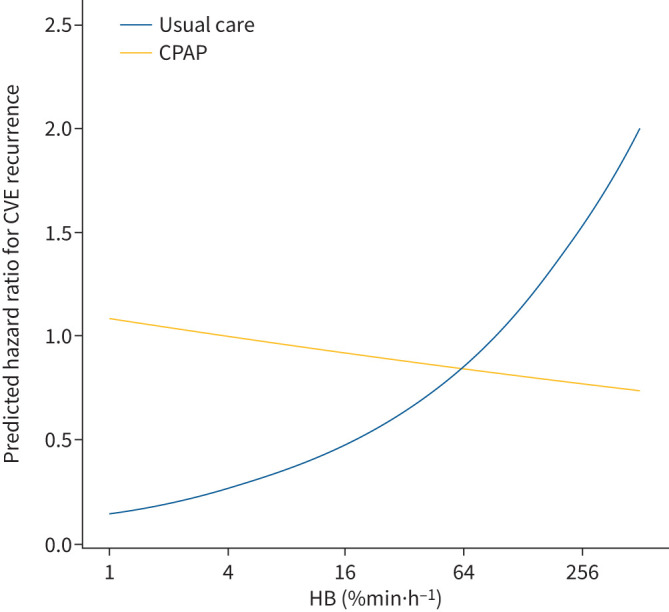
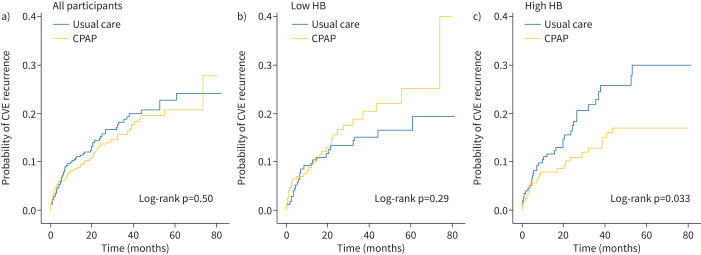
The population (362 patients assigned to CPAP and 365 patients assigned to usual care) was middle-aged (mean age 59.7 years), overweight/obese and mostly male (84.5%). A significant interaction was found between the treatment arm and the HB categories. In the high HB group, CPAP treatment was associated with a significant reduction in the incidence of cardiovascular events (HR 0.57, 95% CI 0.34-0.96). In the low HB group, CPAP-treated patients exhibited a trend toward a higher risk of cardiovascular outcomes than those receiving usual care (HR 1.33, 95% CI 0.79-2.25). The differential effect of the treatment depending on the baseline HB level followed a dose-response relationship.
In non-sleepy ACS patients with OSA, high HB levels were associated with a long-term protective effect of CPAP on cardiovascular prognosis.
低氧负荷(HB)已成为阻塞性睡眠呼吸暂停(OSA)心血管风险的强有力预测因子。我们旨在评估 HB 预测持续气道正压通气(CPAP)治疗 OSA 的心血管获益的潜力。
这是对 ISAACC 试验的 分析(ClinicalTrials.gov:NCT01335087),包括通过呼吸多导图诊断为 OSA(呼吸暂停-低通气指数≥15 次·h)的非嗜睡急性冠状动脉综合征(ACS)患者。患者被随机分配到 CPAP 组或常规护理组,并至少随访 1 年。HB 通过自动识别的所有脱氧事件的总面积除以总睡眠时间来计算。根据中位数(73.1%min·h)将患者分为高基线 HB 或低基线 HB。多变量 Cox 回归模型用于评估 CPAP 对心血管结局发生率的影响是否依赖于基线 HB 水平。
人群(CPAP 组 362 例,常规护理组 365 例)年龄中等(平均年龄 59.7 岁),超重/肥胖,且主要为男性(84.5%)。发现治疗臂和 HB 类别之间存在显著交互作用。在高 HB 组中,CPAP 治疗与心血管事件发生率显著降低相关(HR 0.57,95%CI 0.34-0.96)。在低 HB 组中,CPAP 治疗的患者心血管结局的风险较接受常规护理的患者呈上升趋势(HR 1.33,95%CI 0.79-2.25)。治疗效果取决于基线 HB 水平,呈现出剂量-反应关系。
在患有 OSA 的非嗜睡性 ACS 患者中,高 HB 水平与 CPAP 对心血管预后的长期保护作用相关。