Department of Histology and Embryology, Faculty of Medical Sciences, Medical University of Silesia, 18 Medyków St, 40-752, Katowice, Poland.
Center for Reproductive Medicine Bocian, 26 Akademicka St, 15-267, Białystok, Poland.
Biomed Eng Online. 2023 Sep 21;22(1):92. doi: 10.1186/s12938-023-01153-4.
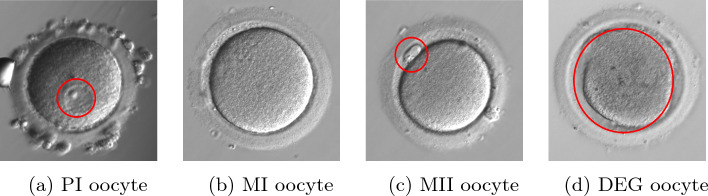
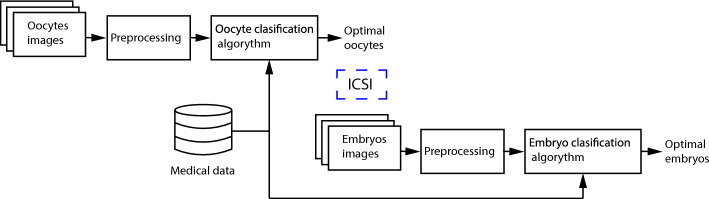
The effectiveness of in vitro fertilization depends on the assessment and selection of oocytes and embryos with the highest developmental potential. One of the tasks in the ICSI (intracytoplasmic sperm injection) procedure is the classification of oocytes according to the stages of their meiotic maturity. Oocytes classification traditionally is done manually during their observation under the light microscope. The paper is part of the bigger task, the development of the system for optimal oocyte and embryos selection. In the hereby work, we present the method for the automatic classification of oocytes based on their images, that employs DNN algorithms.
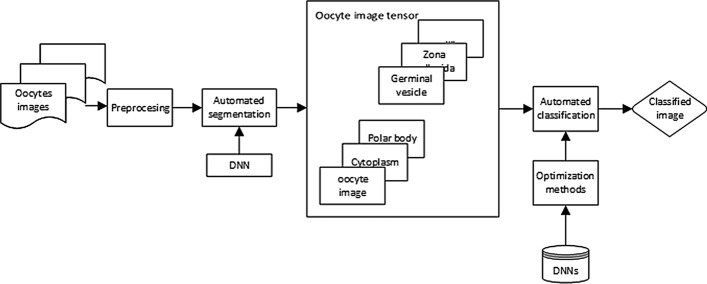
For the purpose of oocyte class determination, two structures based on deep neural networks were applied. DeepLabV3Plus was responsible for the analysis of oocyte images in order to extract specific regions of oocyte images. Then extracted components were transferred to the network, inspired by the SqueezeNet architecture, for the purpose of oocyte type classification. The structure of this network was refined by a genetic algorithm in order to improve generalization abilities as well as reduce the network's FLOPs thus minimizing inference time. As a result, [Formula: see text] at the level of 0.964 was obtained at the level of the validation set and 0.957 at the level of the test set. Generated neural networks as well as code that allows running the processing pipe were made publicly available.
In this paper, the complete pipeline was proposed that is able to automatically classify human oocytes into three classes MI, MII, and PI based on the oocytes' microscopic image.
体外受精的有效性取决于对具有最高发育潜能的卵子和胚胎的评估和选择。ICSI(胞浆内单精子注射)程序的任务之一是根据其减数分裂成熟阶段对卵子进行分类。卵子的传统分类是在其在光学显微镜下观察时手动完成的。本文是更大任务的一部分,即开发最佳卵子和胚胎选择系统。在本工作中,我们提出了一种基于其图像的自动卵子分类方法,该方法采用 DNN 算法。
为了确定卵子的类别,应用了两种基于深度神经网络的结构。DeepLabV3Plus 负责分析卵子图像,以提取卵子图像的特定区域。然后将提取的组件传输到网络中,该网络受 SqueezeNet 架构的启发,用于卵子类型分类。通过遗传算法对网络结构进行了细化,以提高泛化能力并减少网络的 FLOPs,从而最小化推断时间。因此,在验证集上获得了[公式:见文本]为 0.964,在测试集上获得了 0.957。生成的神经网络以及允许运行处理管道的代码已公开发布。
本文提出了一个完整的流水线,能够基于卵子的微观图像将人类卵子自动分为 MI、MII 和 PI 三类。