Parkatzidis Kostas, Truong Nghia P, Matyjaszewski Krzysztof, Anastasaki Athina
Laboratory of Polymeric Materials, Department of Materials, ETH Zurich, Vladimir-Prelog-Weg 5, Zurich 8093, Switzerland.
Department of Chemistry, Carnegie Mellon University, 4400 Fifth Avenue, Pittsburgh, Pennsylvania 15213, United States.
J Am Chem Soc. 2023 Oct 4;145(39):21146-21151. doi: 10.1021/jacs.3c05632. Epub 2023 Sep 22.
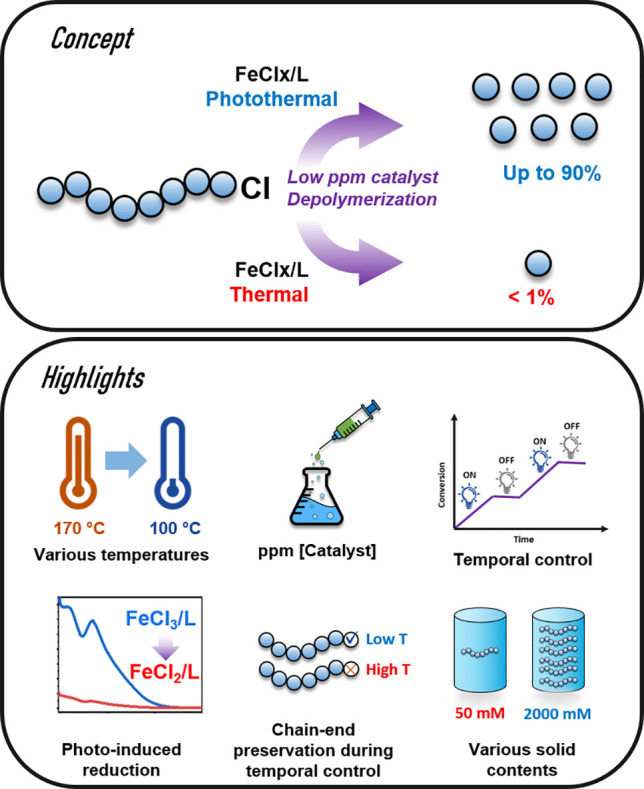
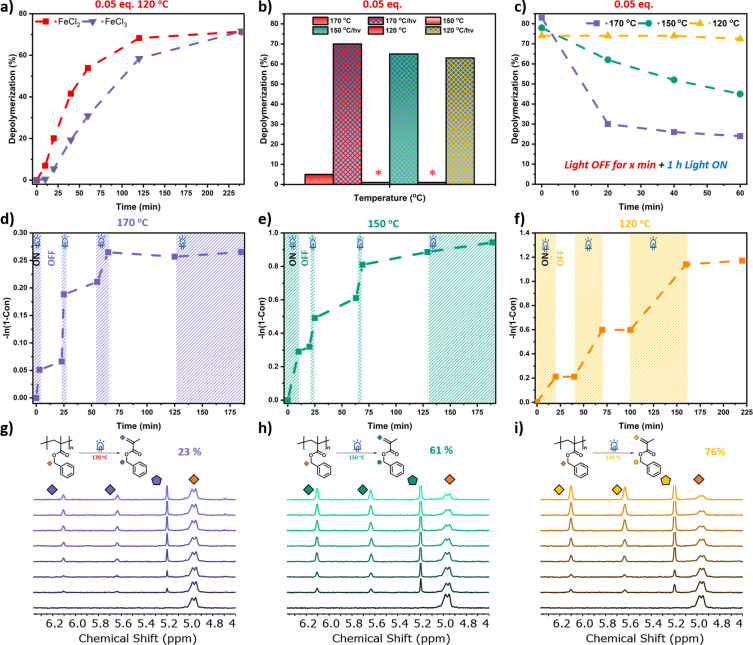
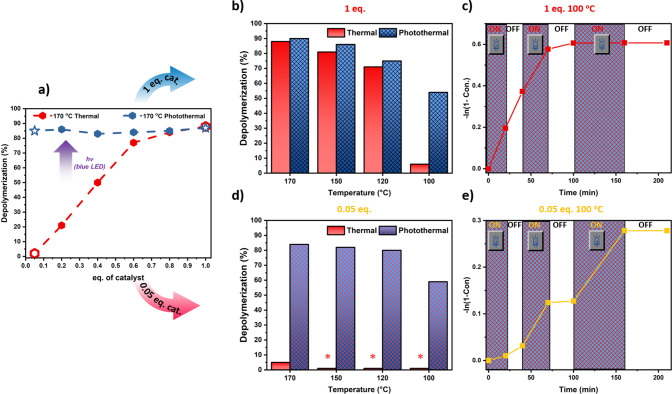
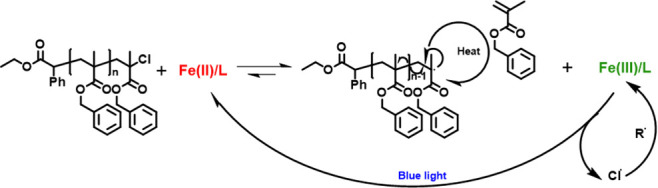
A photocatalytic ATRP depolymerization is introduced that significantly suppresses the reaction temperature from 170 to 100 °C while enabling temporal regulation. In the presence of low-toxicity iron-based catalysts and under visible light irradiation, near-quantitative monomer recovery could be achieved (up to 90%), albeit with minimal temporal control. By employing ppm concentrations of either FeCl or FeCl, the depolymerization during the dark periods could be completely eliminated, thus enabling temporal control and the possibility to modulate the rate by simply turning the light "on" and "off". Notably, our approach allowed preservation of the end-group fidelity throughout the reaction, could be carried out at high polymer loadings (up to 2M), and was compatible with various polymers and light sources. This methodology provides a facile, environmentally friendly, and temporally regulated route to chemically recycle ATRP-synthesized polymers, thus opening the door for further opportunities.
介绍了一种光催化原子转移自由基聚合(ATRP)解聚方法,该方法可将反应温度从170℃显著降低至100℃,同时实现时间调控。在低毒性铁基催化剂存在下且在可见光照射下,可实现接近定量的单体回收(高达90%),尽管时间控制有限。通过使用ppm浓度的FeCl或FeCl,可完全消除黑暗期的解聚,从而实现时间控制,并可通过简单地打开和关闭光源来调节速率。值得注意的是,我们的方法能够在整个反应过程中保持端基保真度,可在高聚合物负载量(高达2M)下进行,并且与各种聚合物和光源兼容。这种方法为化学回收ATRP合成的聚合物提供了一种简便、环境友好且受时间调控的途径,从而为进一步的应用创造了机会。