Department of Gastroenterology and Hepatology, Osaka University Graduate School of Medicine, 2-2 Yamadaoka, Suita, Osaka, Japan.
BMC Gastroenterol. 2023 Sep 22;23(1):326. doi: 10.1186/s12876-023-02944-8.
Autophagy plays an important role in carcinogenesis and tumor progression in many cancers, including gastric cancer. Cytotoxin-associated gene A (CagA) is a well-known virulent factor in Helicobacter pylori (H. pylori) infection that plays a critical role in gastric inflammation and gastric cancer development. However, its role in autophagy during these processes remains unclear. Therefore, we aimed to clarify the role of CagA in autophagy in CagA-related inflammation.
We evaluated the autophagic index of AGS cells infected with wild-type cagA-positive H. pylori (Hp-WT) and cagA-knockout H. pylori (Hp-ΔcagA) and rat gastric mucosal (RGM1) cells transfected with CagA genes. To identify the mechanisms underlying the down regulation of autophagy in AGS cells infected with H. pylori, we evaluated protein and mRNA expression levels of autophagy core proteins using western blotting and quantitative reverse transcription-polymerase chain reaction (RT-PCR). To determine whether autophagy induced the expression of the pro-inflammatory mediator, cyclooxygenase-2 (COX-2), we evaluated COX-2 expression in AGS cells treated with an autophagy inducer and inhibitor and infected with H. pylori. In addition, we evaluated whether COX-2 protein expression in AGS cells influenced beclin-1 (BECN1) expression with si-RNA transfection when infected with H. pylori.
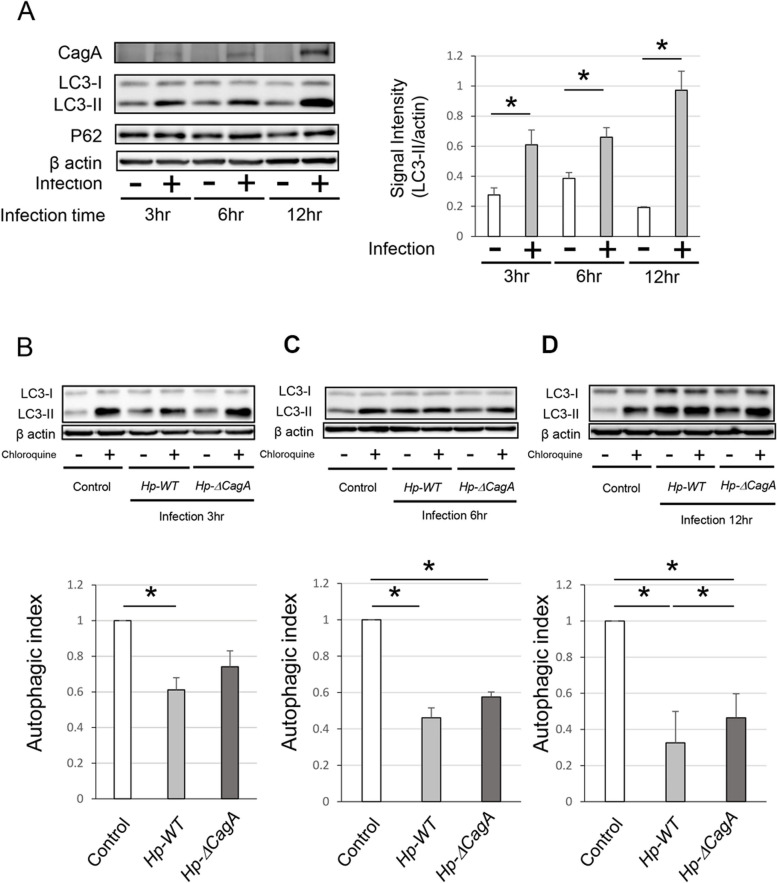
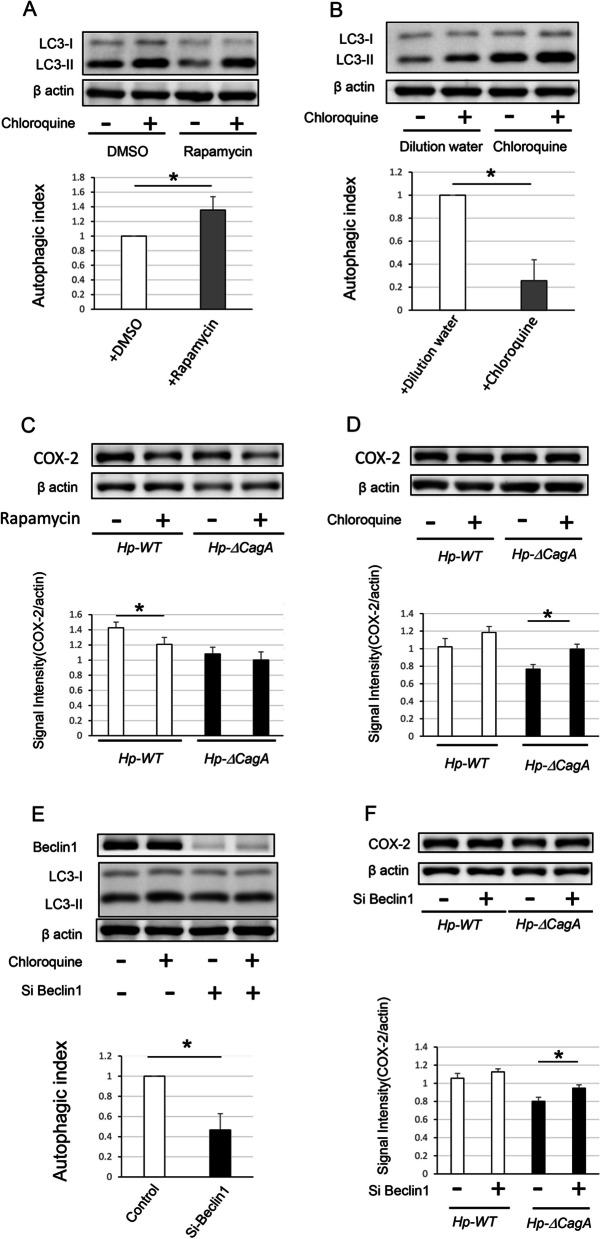
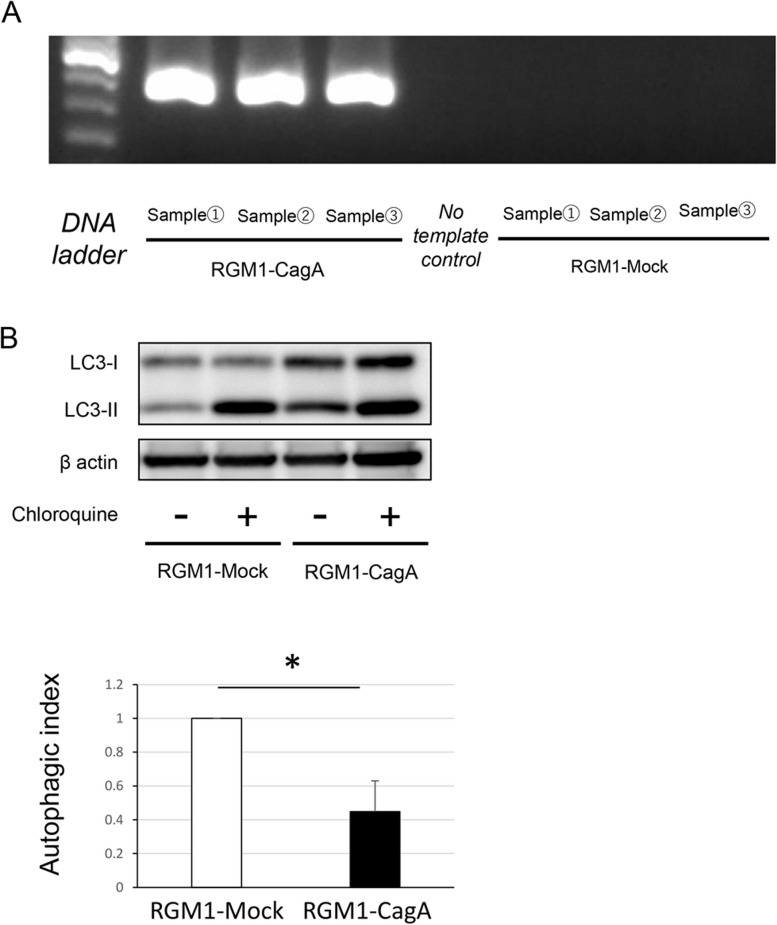
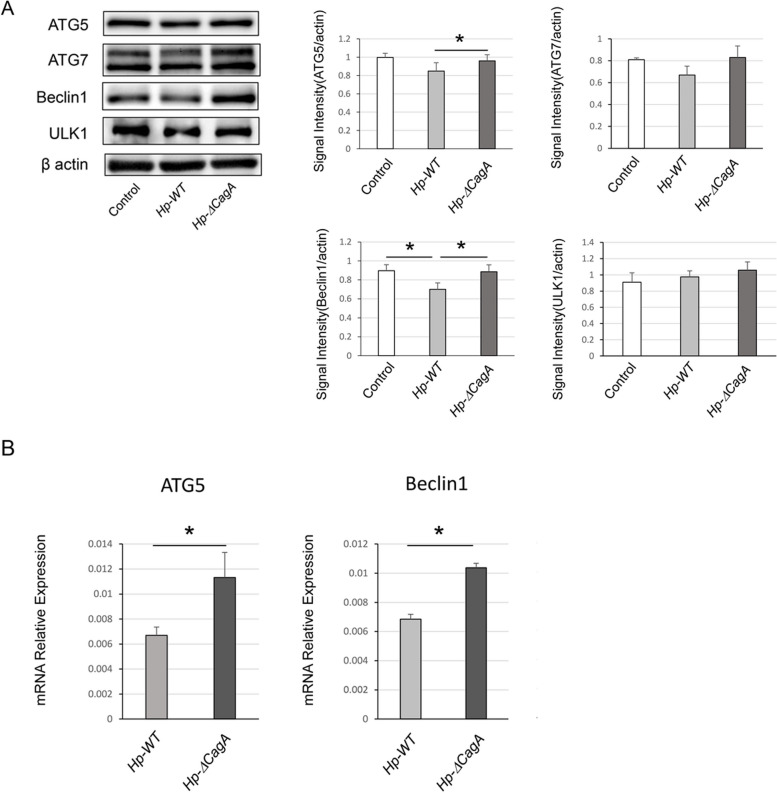
Autophagic flux assay using chloroquine showed that autophagy in AGS cells was significantly suppressed after H. pylori infection. The autophagic index of AGS cells infected with Hp-WT was decreased significantly when compared with that in AGS cells infected with Hp-ΔcagA. The autophagic index of RGM1 cells transfected with CagA was lower, suggesting that CagA inhibits autophagy. In addition, BECN1 expression levels in AGS cells infected with Hp-WT were reduced compared to those in AGS cells infected with Hp-ΔcagA. Furthermore, COX-2 expression in AGS cells infected with H. pylori was controlled in an autophagy-dependent manner. When AGS cells were transfected with small interfering RNA specific for BECN1 and infected with Hp-WT and Hp-ΔcagA, COX-2 was upregulated significantly in cells infected with Hp-ΔcagA.
In conclusion, the H. pylori CagA protein negatively regulated autophagy by downregulating BECN1. CagA-induced autophagy inhibition may be a causative factor in promoting pro-inflammatory mediator production in human gastric epithelial cells.
自噬在许多癌症的致癌作用和肿瘤进展中发挥重要作用,包括胃癌。细胞毒素相关基因 A(CagA)是幽门螺杆菌(H. pylori)感染中一种众所周知的毒力因子,在胃炎症和胃癌发展中起关键作用。然而,其在这些过程中的自噬作用尚不清楚。因此,我们旨在阐明 CagA 在与 CagA 相关的炎症中的自噬作用。
我们评估了野生型 cagA 阳性 H. pylori(Hp-WT)和 cagA 敲除 H. pylori(Hp-ΔcagA)感染 AGS 细胞以及转染 CagA 基因的大鼠胃黏膜(RGM1)细胞的自噬指数。为了确定 H. pylori 感染下调 AGS 细胞自噬的机制,我们使用 Western blot 和定量逆转录聚合酶链反应(RT-PCR)评估自噬核心蛋白的蛋白和 mRNA 表达水平。为了确定自噬是否诱导促炎介质环加氧酶-2(COX-2)的表达,我们评估了自噬诱导剂和抑制剂处理并感染 H. pylori 的 AGS 细胞中 COX-2 的表达。此外,我们评估了感染 H. pylori 时 AGS 细胞中 COX-2 蛋白表达对 beclin-1(BECN1)表达的影响用 si-RNA 转染。
使用氯喹进行的自噬通量测定表明,自噬在 H. pylori 感染后明显受到抑制。与感染 Hp-ΔcagA 的 AGS 细胞相比,感染 Hp-WT 的 AGS 细胞的自噬指数明显降低。转染 CagA 的 RGM1 细胞的自噬指数较低,提示 CagA 抑制自噬。此外,与感染 Hp-ΔcagA 的 AGS 细胞相比,感染 Hp-WT 的 AGS 细胞中 BECN1 的表达水平降低。此外,AGS 细胞中 COX-2 的表达受自噬依赖性控制。当 AGS 细胞用特异性针对 BECN1 的小干扰 RNA 转染并感染 Hp-WT 和 Hp-ΔcagA 时,感染 Hp-ΔcagA 的细胞中 COX-2 显著上调。
总之,H. pylori CagA 蛋白通过下调 BECN1 负调控自噬。CagA 诱导的自噬抑制可能是促进人胃上皮细胞中促炎介质产生的一个原因。