Department of Oncology, University of Oxford, Old Road Campus Research Building, Roosevelt Drive, Oxford, OX3 7DQ, UK.
Oxford University Hospitals NHS Foundation Trust, Oxford, OX3 7LE, UK.
BMC Cancer. 2023 Sep 23;23(1):896. doi: 10.1186/s12885-023-11228-z.
The dense stroma of pancreatic ductal adenocarcinomas is a major barrier to drug delivery. To increase the local drug diffusion gradient, high doses of chemotherapeutic agent doxorubicin can be released from thermally-sensitive liposomes (ThermoDox®) using ultrasound-mediated hyperthermia at the tumour target. PanDox is designed as a Phase 1 single centre study to investigate enhancing drug delivery to adult patients with non-operable pancreatic ductal adenocarcinomas. The study compares a single cycle of either conventional doxorubicin alone or ThermoDox® with focused ultrasound-induced hyperthermia for targeted drug release.
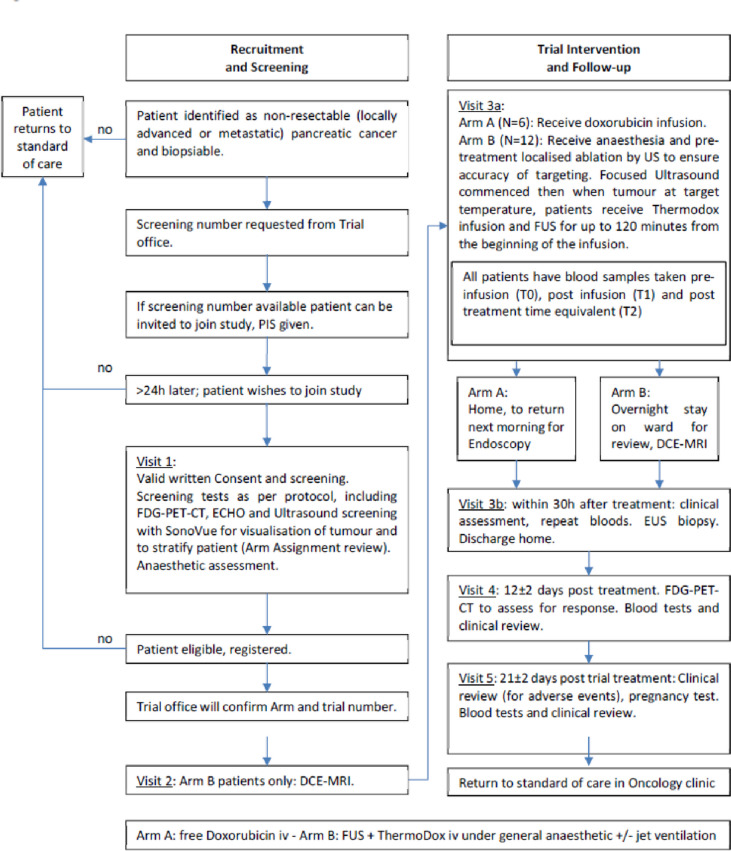
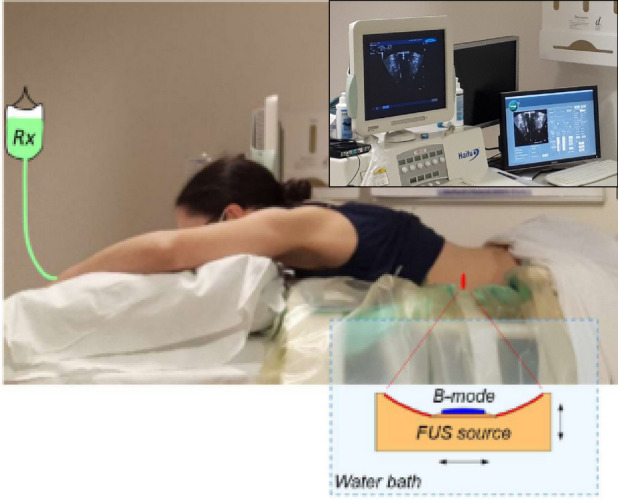
Adults with non-resectable pancreatic ductal adenocarcinoma are allocated to receive a single cycle of either doxorubicin alone (Arm A) or ThermoDox® with focused ultrasound-induced hyperthermia (Arm B), based on patient- and tumour-specific safety conditions. Participants in Arm B will undergo a general anaesthetic and pre-heating of the tumour by extra-corporal focused ultrasound (FUS). Rather than employing invasive thermometry, ultrasound parameters are derived from a patient-specific treatment planning model to reach the 41 °C target temperature for drug release. ThermoDox® is then concurrently infused with further ultrasound exposure. Tumour biopsies at the targeted site from all patients are analysed post-treatment using high performance liquid chromatography to quantify doxorubicin delivered to the tumour. The primary endpoint is defined as a statistically significant enhancement in concentration of total intra-tumoural doxorubicin, comparing samples from patients receiving liposomal drug with FUS to free drug alone. Participants are followed for 21 days post-treatment to assess secondary endpoints, including radiological assessment to measure changes in tumour activity by Positron Emission Tomography Response Criteria in Solid Tumours (PERCIST) criteria, adverse events and patient-reported symptoms.
This early phase study builds on previous work targeting tumours in the liver to investigate whether enhancement of chemotherapy delivery using ultrasound-mediated hyperthermia can be translated to the stroma-dense environment of pancreatic ductal adenocarcinoma. If successful, it could herald a new approach towards managing these difficult-to-treat tumours.
ClinicalTrials.gov Identifier: NCT04852367 . Registered 21 April 2022. EudraCT number: 2019-003950-10 (Registered 2019) Iras Project ID: 272253 (Registered 2019) Ethics Number: 20/EE/0284.
胰腺导管腺癌的密集基质是药物输送的主要障碍。为了增加局部药物扩散梯度,可以使用热疗在肿瘤靶区通过超声介导的热疗从热敏脂质体(ThermoDox®)中释放高剂量的化疗药物阿霉素。PanDox 是一项单中心的 1 期研究,旨在研究增强非手术治疗的成人胰腺导管腺癌患者的药物输送。该研究比较了单独使用传统阿霉素或 ThermoDox®联合聚焦超声诱导热疗靶向药物释放的单一周期。
患有不可切除的胰腺导管腺癌的成年人根据患者和肿瘤的具体安全条件,分配接受单独使用阿霉素(A 组)或 ThermoDox®联合聚焦超声诱导热疗(B 组)的单一周期。B 组的参与者将接受全身麻醉和通过体外聚焦超声(FUS)对肿瘤进行预热。该研究不是采用侵入性测温,而是根据特定于患者的治疗计划模型导出超声参数,以达到释放药物的 41°C 目标温度。然后同时输注 ThermoDox®并进行进一步的超声暴露。所有患者的靶向部位肿瘤活检在治疗后使用高效液相色谱法进行分析,以定量分析肿瘤内递送到肿瘤的阿霉素。主要终点定义为比较接受脂质体药物联合 FUS 治疗的患者和单独使用游离药物的患者的肿瘤内总阿霉素浓度的统计学显著增强。患者在治疗后 21 天内进行随访,以评估次要终点,包括通过实体瘤正电子发射断层扫描反应标准(PERCIST)标准测量肿瘤活性变化的放射学评估、不良事件和患者报告的症状。
这项早期阶段的研究基于以前针对肝脏肿瘤的工作,旨在研究使用超声介导的热疗增强化疗药物输送是否可以转化为胰腺导管腺癌的基质密集环境。如果成功,它可能预示着一种治疗这些难以治疗的肿瘤的新方法。
ClinicalTrials.gov 标识符:NCT04852367。注册于 2022 年 4 月 21 日。EudraCT 编号:2019-003950-10(注册于 2019 年)Iras 项目 ID:272253(注册于 2019 年)伦理编号:20/EE/0284。