Jin Joy Q, Hong Julie, Elhage Kareem G, Braun Mitchell, Spencer Riley K, Chung Mimi, Yeroushalmi Samuel, Hadeler Edward, Mosca Megan, Bartholomew Erin, Hakimi Marwa, Davis Mitchell S, Thibodeaux Quinn, Wu David, Kahlon Abhilash, Dhaliwal Paul, Mathes Erin F, Dhaliwal Navdeep, Bhutani Tina, Liao Wilson
School of Medicine, University of California, San Francisco, San Francisco, CA, United States.
Department of Dermatology, University of California, San Francisco, San Francisco, CA, United States.
Front Digit Health. 2023 Sep 6;5:1228503. doi: 10.3389/fdgth.2023.1228503. eCollection 2023.
In-person dermatology clinical research studies often face recruitment and participation challenges due to travel-, time-, and cost-associated barriers. Studies incorporating virtual/asynchronous formats can potentially enhance research subject participation and satisfaction, but few mobile health tools are available to enable remote study conduct. We developed SkinTracker, a patient-facing mobile app and researcher-facing web platform, that enables longitudinal collection of skin photos, patient reported outcomes, and biometric health and environmental data.
Eight design thinking sessions including dermatologists, clinical research staff, software engineers, and graphic designers were held to create the components of SkinTracker. Following iterative prototyping, SkinTracker was piloted across six adult and four pediatric subjects with atopic dermatitis (AD) of varying severity levels to test and provide feedback on SkinTracker for six months.
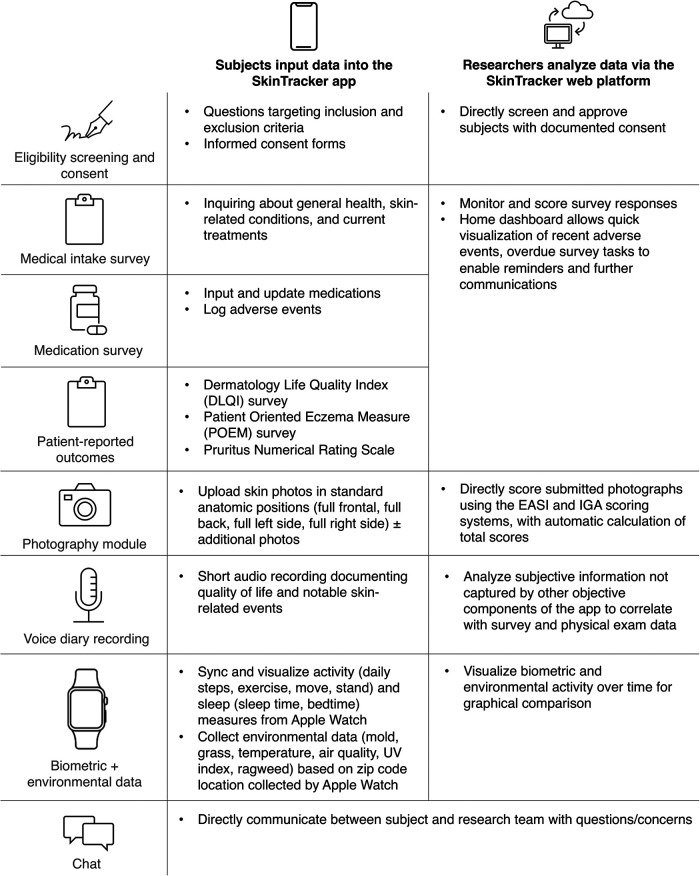
The SkinTracker app enables collection of informed consent for study participation, baseline medical history, standardized skin photographs, patient-reported outcomes (e.g., Patient Oriented Eczema Measure (POEM), Pruritus Numerical Rating Scale (NRS), Dermatology Life Quality Index (DLQI)), medication use, adverse events, voice diary to document qualitative experiences, chat function for communication with research team, environmental and biometric data such as exercise and sleep metrics through integration with an Apple Watch. The researcher web portal allows for management and visualization of subject enrollment, skin photographs for examination and severity scoring, survey completion, and other patient modules. The pilot study requested that subjects complete surveys and photographs on a weekly to monthly basis via the SkinTracker app. Afterwards, participants rated their experience in a 7-item user experience survey covering app function, design, and desire for participation in future studies using SkinTracker. Almost all subjects agreed or strongly agreed that SkinTracker enabled more convenient participation in skin research studies compared to an in-person format.
To our knowledge, SkinTracker is one of the first integrated app- and web-based platforms allowing collection and management of data commonly obtained in clinical research studies. SkinTracker enables detailed, frequent capture of data that may better reflect the fluctuating course of conditions such as AD, and can be modularly customized for different skin conditions to improve dermatologic research participation and patient access.
由于与出行、时间和成本相关的障碍,面对面的皮肤科临床研究往往面临招募和参与方面的挑战。采用虚拟/异步形式的研究可能会提高研究对象的参与度和满意度,但用于远程开展研究的移动健康工具却很少。我们开发了SkinTracker,这是一个面向患者的移动应用程序和面向研究人员的网络平台,可实现对皮肤照片、患者报告的结果以及生物特征健康和环境数据的纵向收集。
举办了八次设计思维研讨会,参会人员包括皮肤科医生、临床研究人员、软件工程师和平面设计师,以创建SkinTracker的各个组件。经过迭代原型设计后,SkinTracker在六名成人和四名患有不同严重程度特应性皮炎(AD)的儿科受试者中进行了试点,为期六个月,以测试SkinTracker并收集反馈。
SkinTracker应用程序能够收集研究参与的知情同意书、基线病史、标准化皮肤照片、患者报告的结果(例如,患者导向性湿疹量表(POEM)、瘙痒数字评定量表(NRS)、皮肤病生活质量指数(DLQI))、用药情况、不良事件、用于记录定性体验的语音日记、与研究团队沟通的聊天功能,以及通过与苹果手表集成获取的运动和睡眠指标等环境和生物特征数据。研究人员网络门户允许对受试者招募、用于检查和严重程度评分的皮肤照片、调查完成情况及其他患者模块进行管理和可视化。试点研究要求受试者通过SkinTracker应用程序每周至每月完成一次调查和拍摄照片。之后,参与者在一项涵盖应用程序功能、设计以及参与未来使用SkinTracker研究的意愿的7项用户体验调查中对他们的体验进行评分。几乎所有受试者都同意或强烈同意,与面对面形式相比,SkinTracker使参与皮肤研究变得更加便捷。
据我们所知,SkinTracker是首批基于应用程序和网络的集成平台之一,允许收集和管理临床研究中常见的数据。SkinTracker能够详细、频繁地获取数据,这可能更好地反映AD等疾病的波动病程,并且可以针对不同的皮肤状况进行模块化定制,以提高皮肤科研究的参与度和患者的可及性。