Whangviboonkij Narisara, Pengsart Worakamol, Chen Zhenzhong, Han Seokgyu, Park Sungsu, Kulkeaw Kasem
Siriraj Integrative Center for Neglected Parasitic Diseases, Department of Parasitology, Faculty of Medicine Siriraj Hospital, Mahidol University, Bangkok, Thailand.
School of Mechanical Engineering, Sungkyunkwan University, Suwon, Republic of Korea.
Front Microbiol. 2023 Sep 5;14:1190530. doi: 10.3389/fmicb.2023.1190530. eCollection 2023.
The phenotypic screening of drugs against , a neuropathogenic amoeba, involves two simultaneous phases: an initial step to test amoebicidal activity followed by an assay for cytotoxicity to host cells. The emergence of three-dimensional (3D) cell cultures has provided a more physiologically relevant model than traditional 2D cell culture for studying the pathogenicity of . However, the measurement of ATP, a critical indicator of cell viability, is complicated by the overgrowth of in coculture with host cells during drug screening, making it challenging to differentiate between amoebicidal activity and drug toxicity to human cells.
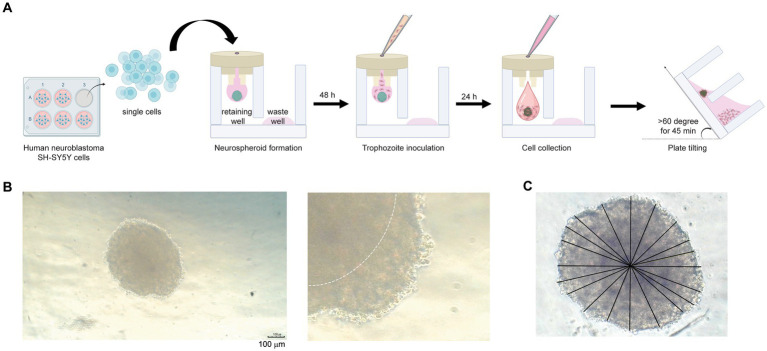
To address this limitation, we introduce a novel assay that utilizes three-dimensional hanging spheroid plates (3DHSPs) to evaluate both activities simultaneously on a single platform.
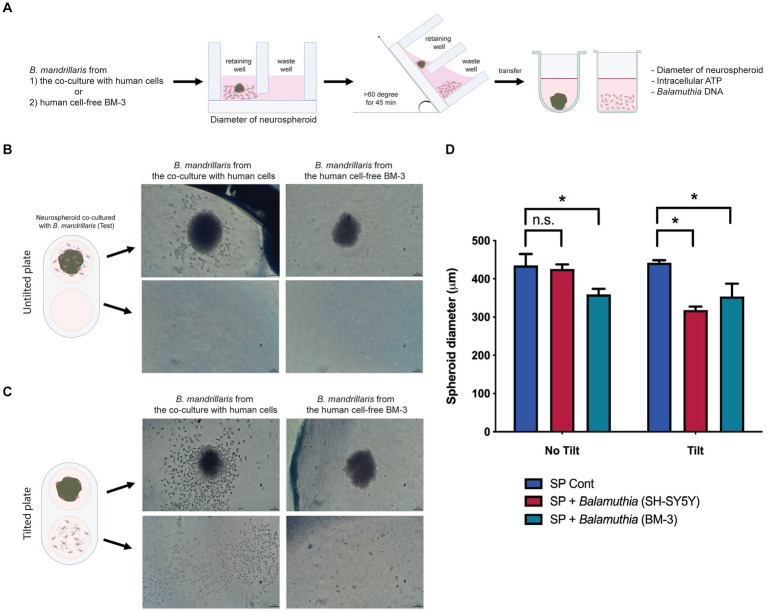
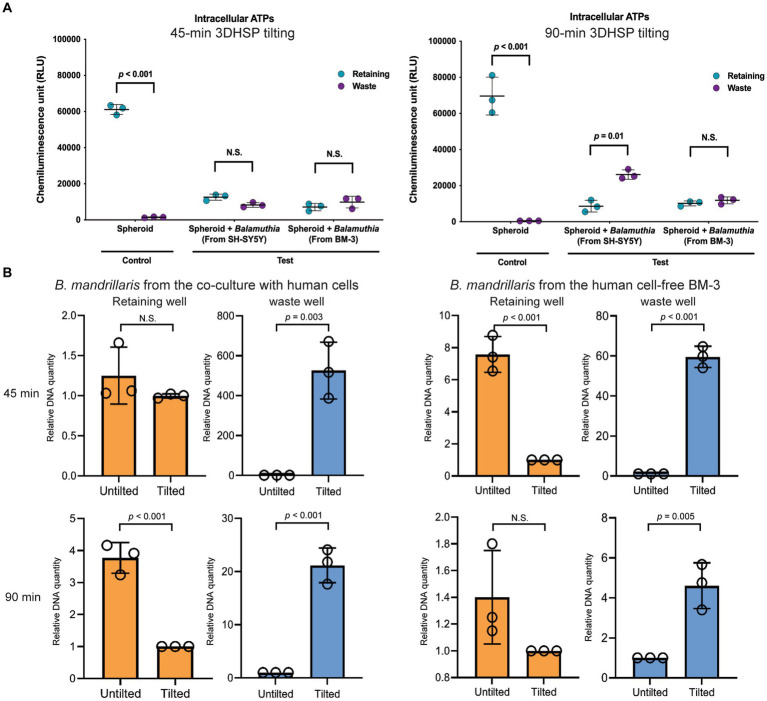
Our study showed that the incubation of neurospheroids with clinically isolated trophozoites resulted in a loss of neurospheroid integrity, while the ATP levels in the neurospheroids decreased over time, indicating decreased host cell viability. Conversely, ATP levels in isolated trophozoites increased, indicating active parasite metabolism. Our findings suggest that the 3DHSP-based assay can serve as an endpoint for the phenotypic screening of drugs against , providing a more efficient and accurate approach for evaluating both parasite cytotoxicity and viability.
针对神经致病性变形虫的药物表型筛选涉及两个同步阶段:第一步测试杀阿米巴活性,随后进行对宿主细胞的细胞毒性测定。三维(3D)细胞培养的出现为研究该变形虫的致病性提供了一个比传统二维细胞培养更具生理相关性的模型。然而,在药物筛选过程中,与宿主细胞共培养时该变形虫的过度生长使细胞活力的关键指标ATP的测量变得复杂,这使得区分杀阿米巴活性和药物对人类细胞的毒性具有挑战性。
为了解决这一局限性,我们引入了一种新的测定方法,该方法利用三维悬挂球体板(3DHSPs)在单个平台上同时评估这两种活性。
我们的研究表明,神经球与临床分离的滋养体孵育会导致神经球完整性丧失,而神经球中的ATP水平随时间下降,表明宿主细胞活力降低。相反,分离的滋养体中的ATP水平升高,表明寄生虫代谢活跃。我们的研究结果表明,基于3DHSP的测定方法可作为针对该变形虫药物表型筛选的终点,为评估寄生虫细胞毒性和活力提供一种更高效、准确的方法。