Shoureshi Pouria, Kabadi Rajiv, James Nicholas, Torrado Juan F, Airapetov Sergei, Hundley William, Kaszala Karoly, Ellenbogen Kenneth A, Tan Alex Y, Huizar Jose F
Department of Internal Medicine, Cardiology Division, Central Virginia VA Health Care System/McGuire Veterans Affairs Medical Center, Richmond, Virginia.
Department of Internal Medicine, Cardiology Division/Pauley Heart Center, Virginia Commonwealth University, Richmond, Virginia.
Heart Rhythm O2. 2023 Aug 4;4(9):556-564. doi: 10.1016/j.hroo.2023.07.008. eCollection 2023 Sep.
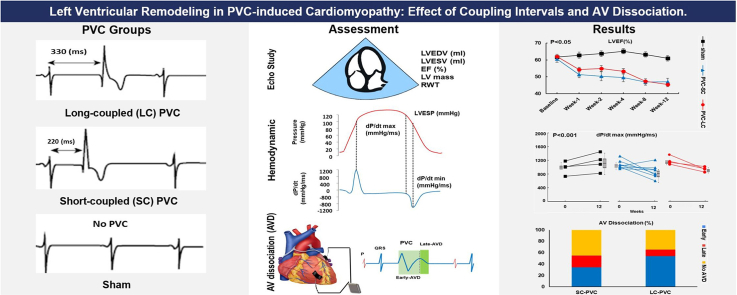
Left ventricular dyssynchrony (LVD) and postextrasystolic potentiation (PESP) associated with premature ventricular contractions (PVCs) may play a role in the development of premature ventricular contraction-induced cardiomyopathy (PVC-CM). Long-coupled (LC) PVCs have a greater LVD than short-coupled (SC) PVCs, whereas SC-PVCs have a stronger PESP than LC-PVCs.
The purpose of this study was to compare SC-PVCs and LC-PVCs to evaluate the roles of LVD, PESP, and atrioventricular dissociation (AVD) in the development of PVC-CM.
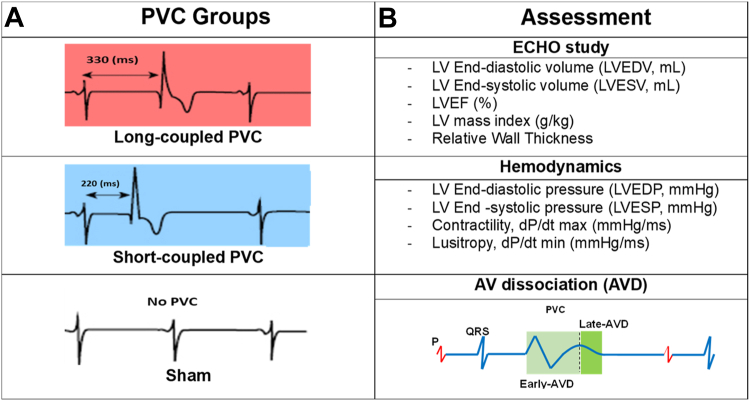
Thirty-six canines underwent pacemaker implantation to induce bigeminal right ventricular apical epicardial PVCs (50% burden) for 12 weeks. Telemetry assessed PVC burden and AVD. Animals were grouped as SC-PVC (coupling interval [CI] 200-220ms), LC-PVC (CI 330 ms), or sham (control). Echocardiographic changes, AVD, and hemodynamics were monitored for 12 weeks.
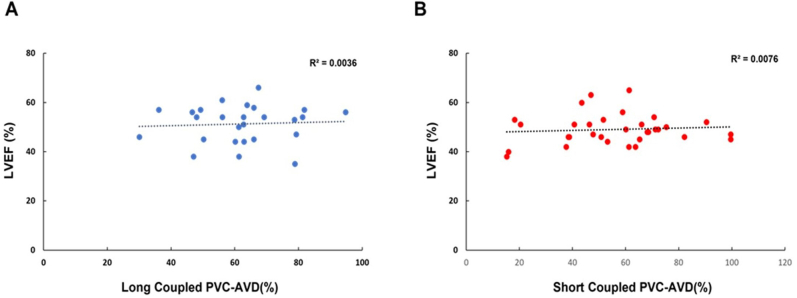
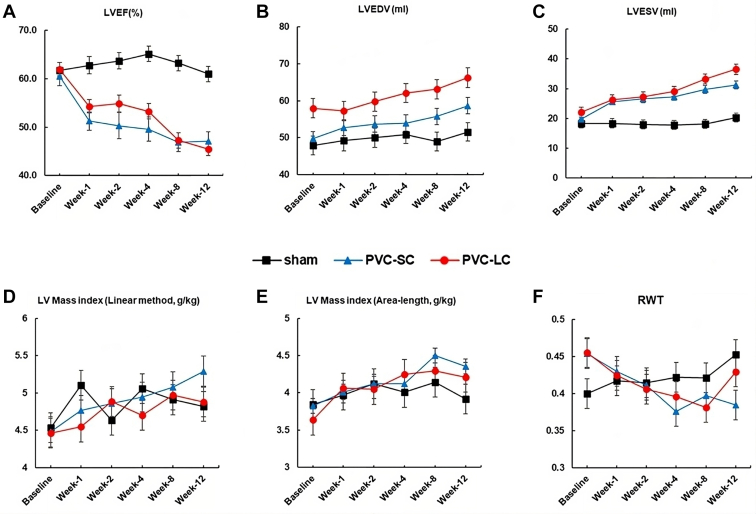
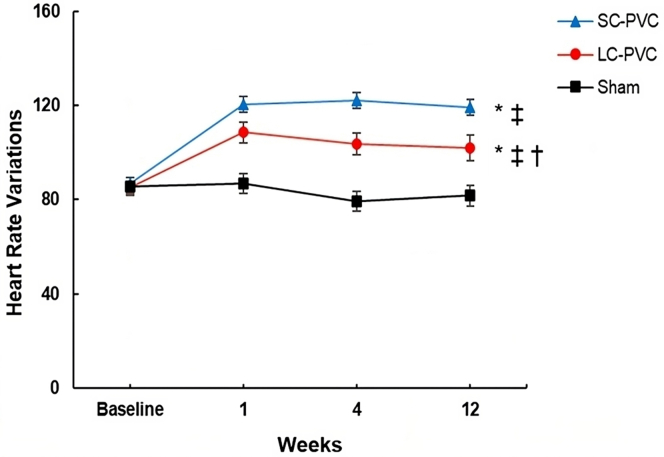
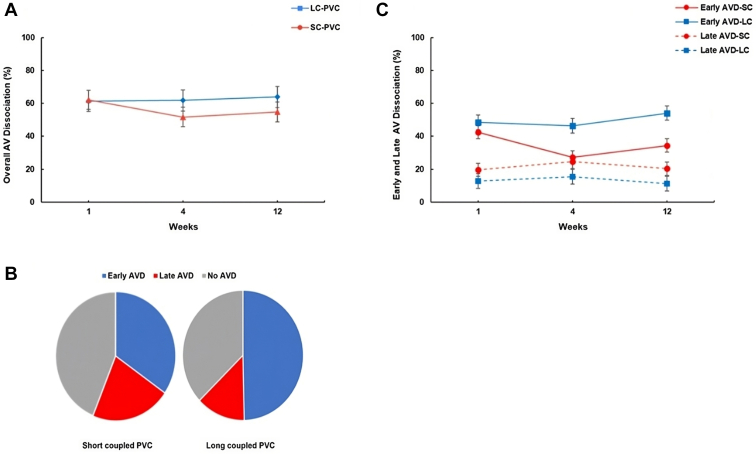
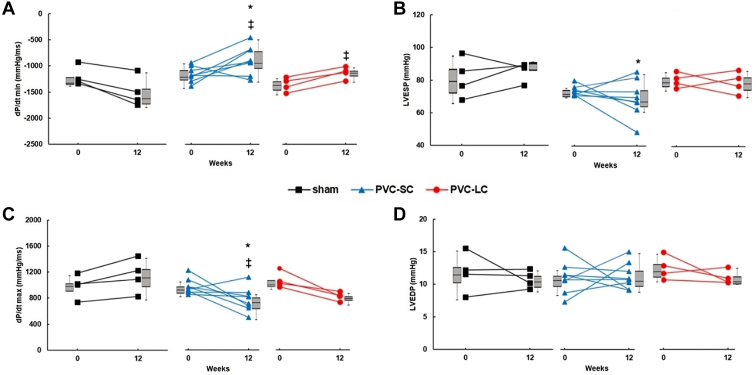
PVC burden was similar between SC-PVC and LC-PVC groups but was statistically higher in the SC-PVC group (50% vs 47.5%; = .028). After 12 weeks, left ventricular ejection fraction (LVEF) significantly decreased in both SC-PVC and LC-PVC groups (47.1% ± 1.4% and 45.5% ± 2%, respectively) compared to sham group (61% ± 1.6%; <.001). Overall AVD was similar between SC-PVC and LC-PVC groups, and there was no significant correlation between AVD and reduction in LVEF at 12 weeks (r = 0.09, = .5; and r = 0.06, = .8, respectively). Additionally, both SC-PVC and LC-PVC groups experienced substantial declines in max and min dP/dt after 12 weeks compared to baseline.
Neither PVC CI nor AVD played an independent role in the development or severity of PVC-CM. LVD and PESP make equal relative contributions to the development of PVC-CM.
与室性早搏(PVC)相关的左心室不同步(LVD)和早搏后增强(PESP)可能在室性早搏诱发的心肌病(PVC-CM)的发展中起作用。长联律(LC)PVC比短联律(SC)PVC具有更大的LVD,而SC-PVC比LC-PVC具有更强的PESP。
本研究的目的是比较SC-PVC和LC-PVC,以评估LVD、PESP和房室分离(AVD)在PVC-CM发展中的作用。
36只犬接受起搏器植入,以诱发右心室心尖部成对室性早搏(负荷50%),持续12周。遥测评估PVC负荷和AVD。动物分为SC-PVC组(联律间期[CI]200-220ms)、LC-PVC组(CI 330ms)或假手术组(对照组)。监测12周内心脏超声变化、AVD和血流动力学。
SC-PVC组和LC-PVC组的PVC负荷相似,但SC-PVC组在统计学上更高(50%对47.5%;P = 0.028)。12周后,与假手术组(61%±1.6%)相比,SC-PVC组和LC-PVC组的左心室射血分数(LVEF)均显著降低(分别为47.1%±1.4%和45.5%±2%;P < 0.001)。SC-PVC组和LC-PVC组的总体AVD相似,且12周时AVD与LVEF降低之间无显著相关性(r = 0.09,P = 0.5;r = 0.06,P = 0.8)。此外,与基线相比,12周后SC-PVC组和LC-PVC组的最大和最小dP/dt均大幅下降。
PVC的CI和AVD在PVC-CM的发展或严重程度中均未发挥独立作用。LVD和PESP对PVC-CM的发展贡献相当。