Mondal Agastya, C Héctor M Sánchez, Marshall John M
Divisions of Epidemiology and Biostatistics, School of Public Health, University of California, Berkeley, CA, 94720, USA.
bioRxiv. 2023 Sep 12:2023.09.09.556958. doi: 10.1101/2023.09.09.556958.
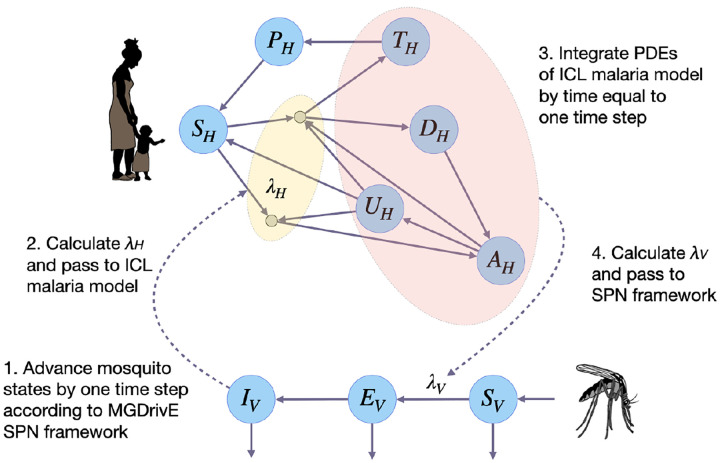
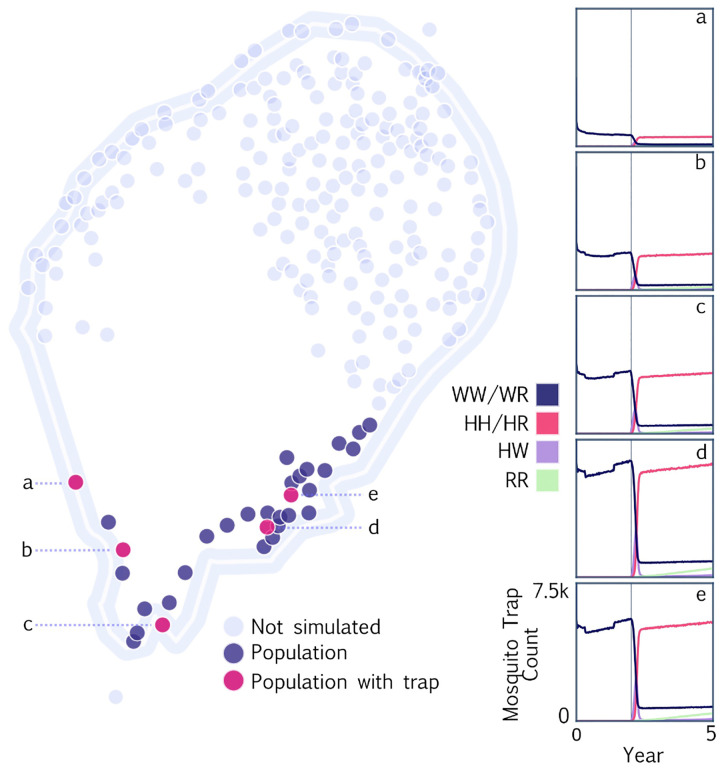
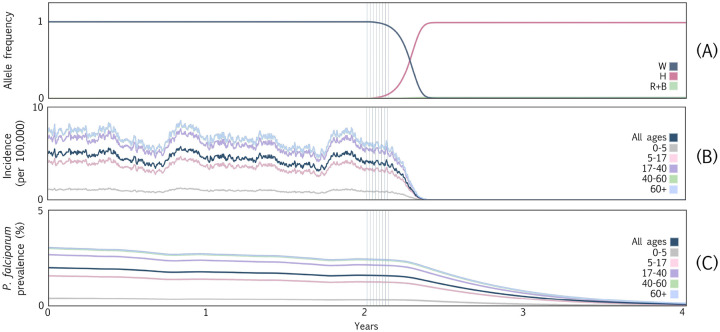
Novel mosquito genetic control tools, such as CRISPR-based gene drives, hold great promise in reducing the global burden of vector-borne diseases. As these technologies advance through the research and development pipeline, there is a growing need for modeling frameworks incorporating increasing levels of entomological and epidemiological detail in order to address questions regarding logistics and biosafety. Epidemiological predictions are becoming increasingly relevant to the development of target product profiles and the design of field trials and interventions, while entomological surveillance is becoming increasingly important to regulation and biosafety. We present MGDrivE 3 (Mosquito Gene Drive Explorer 3), a new version of a previously-developed framework, MGDrivE 2, that investigates the spatial population dynamics of mosquito genetic control systems and their epidemiological implications. The new framework incorporates three major developments: i) a decoupled sampling algorithm allowing the vector portion of the MGDrivE framework to be paired with a more detailed epidemiological framework, ii) a version of the Imperial College London malaria transmission model, which incorporates age structure, various forms of immunity, and human and vector interventions, and iii) a surveillance module that tracks mosquitoes captured by traps throughout the simulation. Example MGDrivE 3 simulations are presented demonstrating the application of the framework to a CRISPR-based homing gene drive linked to dual disease-refractory genes and their potential to interrupt local malaria transmission. Simulations are also presented demonstrating surveillance of such a system by a network of mosquito traps. MGDrivE 3 is freely available as an open-source R package on CRAN (https://cran.r-project.org/package=MGDrivE2) (version 2.1.0), and extensive examples and vignettes are provided. We intend the software to aid in understanding of human health impacts and biosafety of mosquito genetic control tools, and continue to iterate per feedback from the genetic control community.
新型蚊虫基因控制工具,如基于CRISPR的基因驱动技术,在减轻全球媒介传播疾病负担方面具有巨大潜力。随着这些技术在研发流程中不断推进,越来越需要构建包含日益详细的昆虫学和流行病学细节的建模框架,以解决有关后勤和生物安全的问题。流行病学预测对于目标产品概况的制定以及现场试验和干预措施的设计变得越来越重要,而昆虫学监测对于监管和生物安全也变得越来越重要。我们展示了MGDrivE 3(蚊虫基因驱动探索器3),它是之前开发的框架MGDrivE 2的新版本,用于研究蚊虫基因控制系统的空间种群动态及其流行病学影响。新框架包含三项主要进展:i)一种解耦采样算法,使MGDrivE框架的媒介部分能够与更详细的流行病学框架相结合;ii)伦敦帝国理工学院疟疾传播模型的一个版本,该模型纳入了年龄结构、各种免疫形式以及人类和媒介干预措施;iii)一个监测模块,在整个模拟过程中跟踪陷阱捕获的蚊虫。展示了MGDrivE 3的示例模拟,证明了该框架在与双重疾病抗性基因相关的基于CRISPR的归巢基因驱动中的应用,以及它们中断当地疟疾传播的潜力。还展示了通过蚊虫陷阱网络对这种系统进行监测的模拟。MGDrivE 3作为一个开源R包在CRAN(https://cran.r-project.org/package=MGDrivE2)(版本2.1.0)上免费提供,并提供了大量示例和 vignette。我们希望该软件有助于理解蚊虫基因控制工具对人类健康的影响和生物安全,并根据基因控制领域的反馈不断迭代。