Isotani Shuji, Ka-Fung Chiu Peter, Ashizawa Takeshi, Fung Yan-Ho, Ieda Takeshi, China Toshiyuki, Kawano Haruna, Shimizu Fumitaka, Nagata Masayoshi, Nakagawa Yuki, Muto Satoru, Wong Ka-Leung, Ng Chi-Fai, Horie Shigeo
Department of Urology, Juntendo University Graduate School of Medicine, Tokyo, Japan.
SH Ho Urology Centre, Division of Urology, Department of Surgery, The Chinese University of Hong Kong, Hong Kong SAR, China.
Prostate Int. 2023 Sep;11(3):180-185. doi: 10.1016/j.prnil.2023.07.003. Epub 2023 Jul 20.
To investigate the role of urine spermine and spermine risk score in predicting prostate cancer (PCa) diagnoses in combination with multiparametric magnetic resonance imaging (mpMRI).
Three hundred forty seven consecutive men with elevated prostate-specific antigen (PSA) with mpMRI examination were prospectively enrolled in this study. In 265 patients with PSA levels between 4 and20 ng/ml, pre-biopsy urine samples were analyzed for spermine levels with ultra-high performance liquid chromatography (UPLC-MS/MS). Transperineal image-guided prostate biopsies with 16-18 cores were performed. Logistic regressions were used to form different models for the prediction of the PCa, and the performances were compared using the area under the curve (AUC).
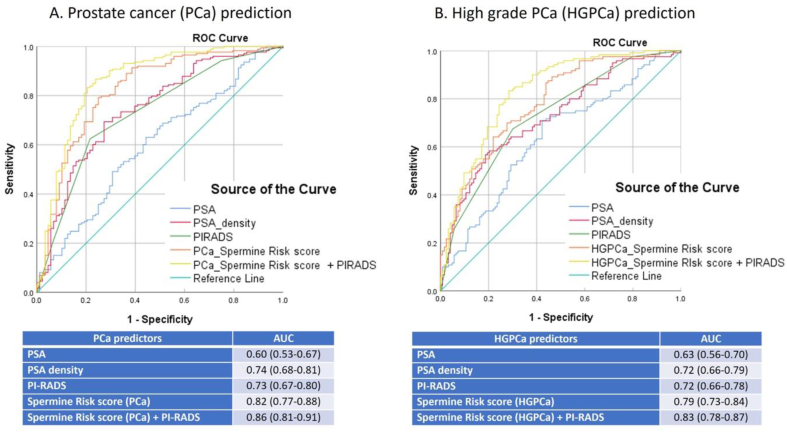
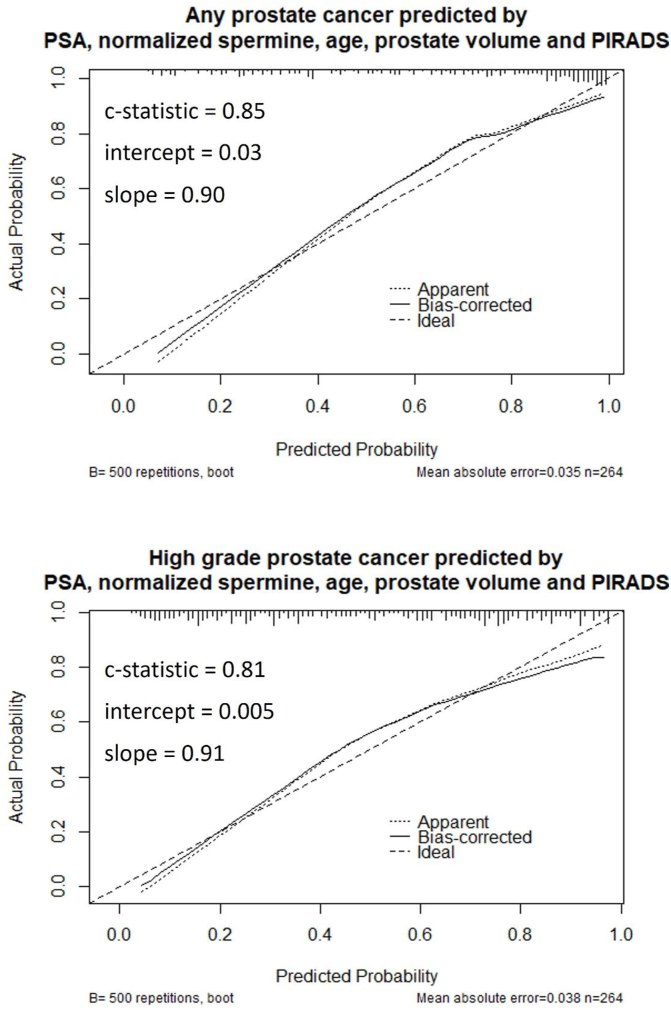
The median serum PSA level and prostate volume were 7.4 ng/mL and 33.9 mL, respectively. PCa and high-grade PCa (ISUP group ≥2, HGPCa) were diagnosed in 66.0% (175/265) and 132/265 (49.8%) cases, respectively. The urine spermine levels were significantly lower in men with PCa (0.87 vs. 2.20, < 0.001). Multivariate analyses showed that age, PSA, PV, urine spermine level, and Prostate Imaging Reporting and Data System (PI-RADS) findings were independent predictors for PCa. The Spermine Risk Score is a multivariable model including PSA, age, prostate volume, and urine spermine. Adding the Spermine Risk Score to PI-RADS improved the AUC from 0.73 to 0.86 in PCa and from 0.72 to 0.83 in high grade PCa (HGPCa) prediction (both < 0.001). At 90% sensitivity for HGPCa prediction using Spermine Risk Score, 31.1% of unnecessary biopsies could be avoided. In men with equivocal MRI PI-RADS score 3, the AUC for HGPCa prediction was 0.58, 0.79, and 0.87 for PSA, PSA density, and Spermine Risk Score, respectively.
Urine Spermine Risk Score, including mpMRI could accurately identify men at high risk of HGPCa and reduce unnecessary prostate biopsies. Spermine Risk Score could more accurately predict HGPCa than PSA density in men with MRI showing equivocal PI-RADS 3 lesions.
探讨尿精胺和精胺风险评分在联合多参数磁共振成像(mpMRI)预测前列腺癌(PCa)诊断中的作用。
前瞻性纳入347例连续接受mpMRI检查且前列腺特异性抗原(PSA)升高的男性。在265例PSA水平介于4至20 ng/ml之间的患者中,采用超高效液相色谱法(UPLC-MS/MS)分析活检前尿液样本中的精胺水平。进行经会阴图像引导下的前列腺穿刺活检,穿刺16 - 18针。采用逻辑回归建立不同的PCa预测模型,并使用曲线下面积(AUC)比较各模型的性能。
血清PSA水平中位数和前列腺体积分别为7.4 ng/mL和33.9 mL。PCa和高级别PCa(国际泌尿病理学会[ISUP]分组≥2,HGPCa)的诊断率分别为66.0%(175/265)和132/265(49.8%)。PCa患者的尿精胺水平显著较低(0.87 vs. 2.20,<0.001)。多因素分析显示,年龄、PSA、前列腺体积、尿精胺水平和前列腺影像报告和数据系统(PI-RADS)结果是PCa的独立预测因素。精胺风险评分是一个多变量模型,包括PSA、年龄、前列腺体积和尿精胺。在PCa预测中,将精胺风险评分加入PI-RADS后,AUC从0.73提高到0.86;在高级别PCa(HGPCa)预测中,AUC从0.72提高到0.83(均<0.001)。在使用精胺风险评分预测HGPCa的敏感度为90%时,可避免31.1%的不必要活检。在MRI的PI-RADS评分为3的可疑男性中,PSA、PSA密度和精胺风险评分预测HGPCa的AUC分别为0.58、0.79和0.87。
包括mpMRI的尿精胺风险评分能够准确识别HGPCa高危男性,并减少不必要的前列腺活检。在MRI显示PI-RADS 3类可疑病变的男性中,精胺风险评分比PSA密度能更准确地预测HGPCa。