Fernández-Ruiz Mario, Almendro-Vázquez Patricia, Redondo Natalia, Ruiz-Merlo Tamara, Abella Sandra, Somoza Adán, López-Medrano Francisco, San Juan Rafael, Loinaz Carmelo, Andrés Amado, Paz-Artal Estela, Aguado José María
Unit of Infectious Diseases, Hospital Universitario "12 de Octubre," Instituto de Investigación Hospital "12 de Octubre" (imas12), Madrid, Spain.
Centro de Investigación Biomédica en Red de Enfermedades Infecciosas (CIBERINFEC), Instituto de Salud Carlos III (ISCIII), Madrid, Spain.
Transplant Direct. 2023 Sep 20;9(10):e1536. doi: 10.1097/TXD.0000000000001536. eCollection 2023 Oct.
The immunogenicity elicited by the Omicron BA.4/BA.5-adapted bivalent booster vaccine after solid organ transplantation (SOT) has not been characterized.
We assessed cell-mediated and neutralizing IgG antibody responses against the BA.4/BA.5 spike receptor-binding domain at baseline and 2 wk after the administration of an mRNA-based bivalent (ancestral strain and BA.4/BA.5 subvariants) vaccine among 30 SOT recipients who had received ≥3 monovalent vaccine doses. Previous coronavirus disease 2019 history was present in 46.7% of them. We also recruited a control group of 19 nontransplant healthy individuals. Cell-mediated immunity was measured by fluorescent ELISpot assay for interferon (IFN)-γ secretion, whereas the neutralizing IgG antibody response against the BA.4/BA.5 spike receptor-binding domain was quantified with a competitive ELISA.
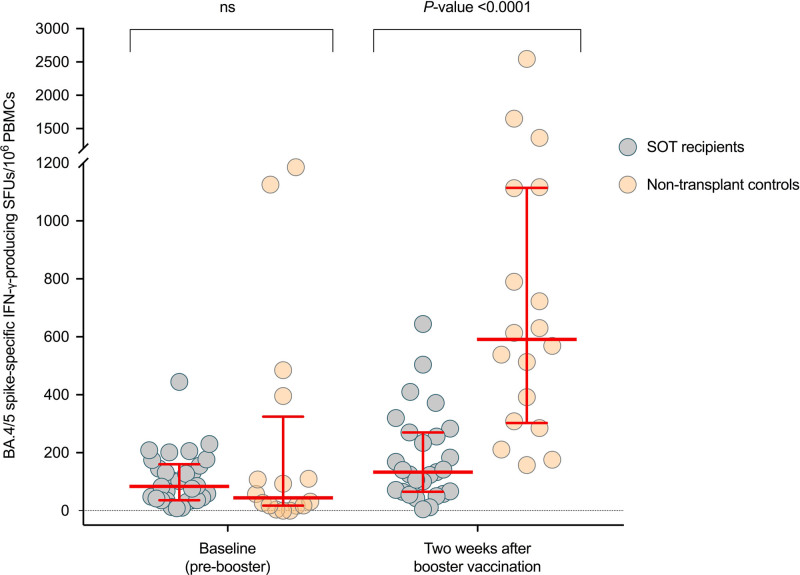
The median number of BA.4/BA.5 spike-specific IFN-γ-producing spot-forming units (SFUs) increased from baseline to 2 wk postbooster (83.8 versus 133.0 SFUs/10 peripheral blood mononuclear cells; = 0.0017). Seropositivity rate also increased (46.7%-83.3%; = 0.001), as well as serum neutralizing activity (4.2%-78.3%; < 0.0001). Patients with no prior coronavirus disease 2019 history experienced higher improvements in cell-mediated and neutralizing responses after booster vaccination. There was no correlation between BA.4/BA.5 spike-specific IFN-γ-producing SFUs and neutralizing activity. Nontransplant controls showed more robust postbooster cell-mediated immunity than SOT recipients (591.1 versus 133.0 IFN-γ-producing SFUs/10 peripheral blood mononuclear cells; < 0.0001), although no differences were observed for antibody responses in terms of postbooster seropositivity rates or neutralizing activity.
Booster with the BA.4/BA.5-adapted bivalent vaccine generated strong subvariant-specific responses among SOT recipients. Booster-induced cell-mediated immunity, however, remained lower than in immunocompetent individuals.
实体器官移植(SOT)后,奥密克戎BA.4/BA.5适配的二价加强疫苗所引发的免疫原性尚未得到明确。
我们评估了30名接受过≥3剂单价疫苗的SOT受者在基线时以及接种基于mRNA的二价(原始毒株和BA.4/BA.5亚变体)疫苗2周后,针对BA.4/BA.5刺突受体结合域的细胞介导免疫和中和性IgG抗体反应。其中46.7%的受者有既往2019冠状病毒病病史。我们还招募了19名非移植健康个体作为对照组。通过荧光酶联免疫斑点试验检测干扰素(IFN)-γ分泌来测量细胞介导免疫,而通过竞争性酶联免疫吸附测定法定量针对BA.4/BA.5刺突受体结合域的中和性IgG抗体反应。
从基线到加强接种后2周,BA.4/BA.5刺突特异性产生IFN-γ的斑点形成单位(SFU)中位数增加(83.8对133.0 SFU/10个外周血单个核细胞;P = 0.0017)。血清阳性率也增加了(46.7% - 83.3%;P = 0.001),血清中和活性同样增加(4.2% - 78.3%;P < 0.0001)。既往无2019冠状病毒病病史的患者在加强疫苗接种后,细胞介导免疫和中和反应的改善更为明显。BA.4/BA.5刺突特异性产生IFN-γ的SFU与中和活性之间无相关性。非移植对照组在加强接种后的细胞介导免疫比SOT受者更强(591.1对133.0产生IFN-γ的SFU/10个外周血单个核细胞;P < 0.0001),不过在加强接种后的血清阳性率或中和活性方面,抗体反应未观察到差异。
接种BA.4/BA.5适配的二价疫苗加强针在SOT受者中产生了强烈的亚变体特异性反应。然而,加强针诱导的细胞介导免疫仍低于免疫功能正常的个体。