From the Division of Infectious Diseases, Carver College of Medicine, University of Iowa, Iowa City (P.W.); Vaccine Research and Development, Pfizer, Hurley, United Kingdom (J. Gayed, O.D., S.L., N.K.); East-West Medical Research Institute, Honolulu (D.F.-P.); the State University of New York, Upstate Medical University, Syracuse (S.J.T.), and Vaccine Research and Development, Pfizer, Pearl River (Y.Z., C.L., S.B., I.L.S., D.C., K.K., K.U.J., K.A.S., W.C.G.) - both in New York; Vaccine Research and Development, Pfizer, Collegeville, PA (X. Xu, V.B., J. Ginis); CenExel RCA, Hollywood (H.I.S.), and Indago Research and Health Center, Hialeah (J.F.C.) - both in Florida; Clinical Trials of Texas, San Antonio (D.D.), and the University of Texas Medical Branch, Galveston (J.Z., X. Xie, P.-Y.S.) - both in Texas; CNS Healthcare, Memphis, TN (L.U.); and BioNTech, Mainz, Germany (F.J.M., Ö.T., U.Ş.).
N Engl J Med. 2023 Jan 19;388(3):214-227. doi: 10.1056/NEJMoa2213082.
The emergence of immune-escape variants of severe acute respiratory syndrome coronavirus 2 warrants the use of sequence-adapted vaccines to provide protection against coronavirus disease 2019.
In an ongoing phase 3 trial, adults older than 55 years who had previously received three 30-μg doses of the BNT162b2 vaccine were randomly assigned to receive 30 μg or 60 μg of BNT162b2, 30 μg or 60 μg of monovalent B.1.1.529 (omicron) BA.1-adapted BNT162b2 (monovalent BA.1), or 30 μg (15 μg of BNT162b2 + 15 μg of monovalent BA.1) or 60 μg (30 μg of BNT162b2 + 30 μg of monovalent BA.1) of BA.1-adapted BNT162b2 (bivalent BA.1). Primary objectives were to determine superiority (with respect to 50% neutralizing titer [NT] against BA.1) and noninferiority (with respect to seroresponse) of the BA.1-adapted vaccines to BNT162b2 (30 μg). A secondary objective was to determine noninferiority of bivalent BA.1 to BNT162b2 (30 μg) with respect to neutralizing activity against the ancestral strain. Exploratory analyses assessed immune responses against omicron BA.4, BA.5, and BA.2.75 subvariants.
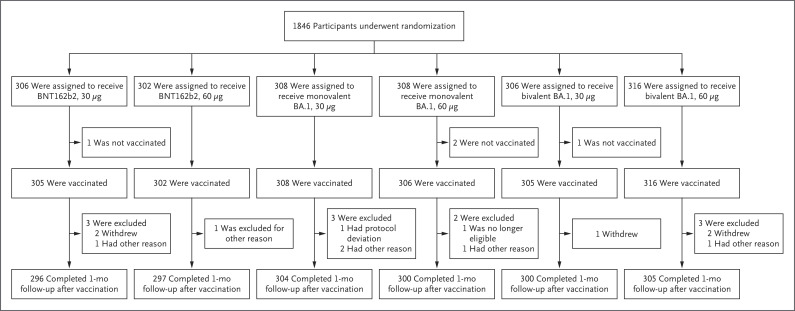
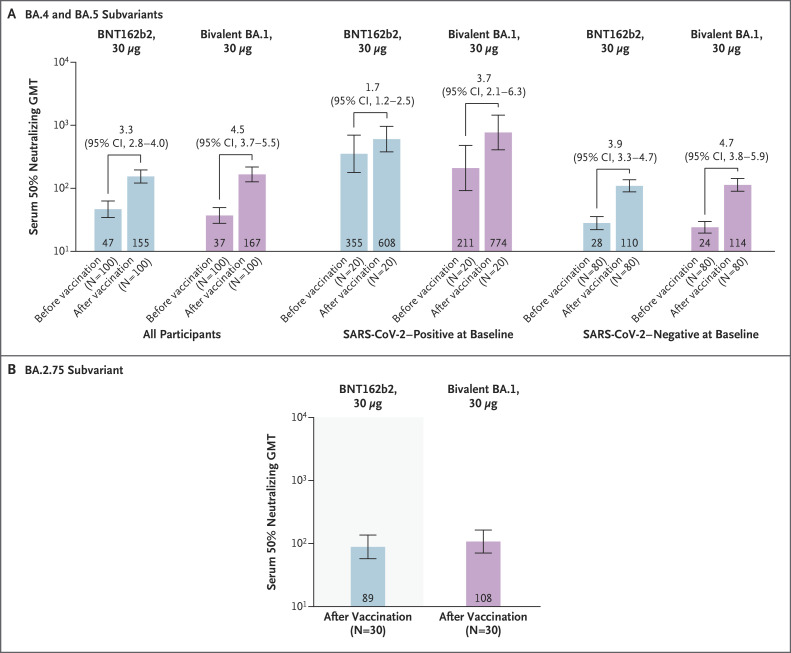
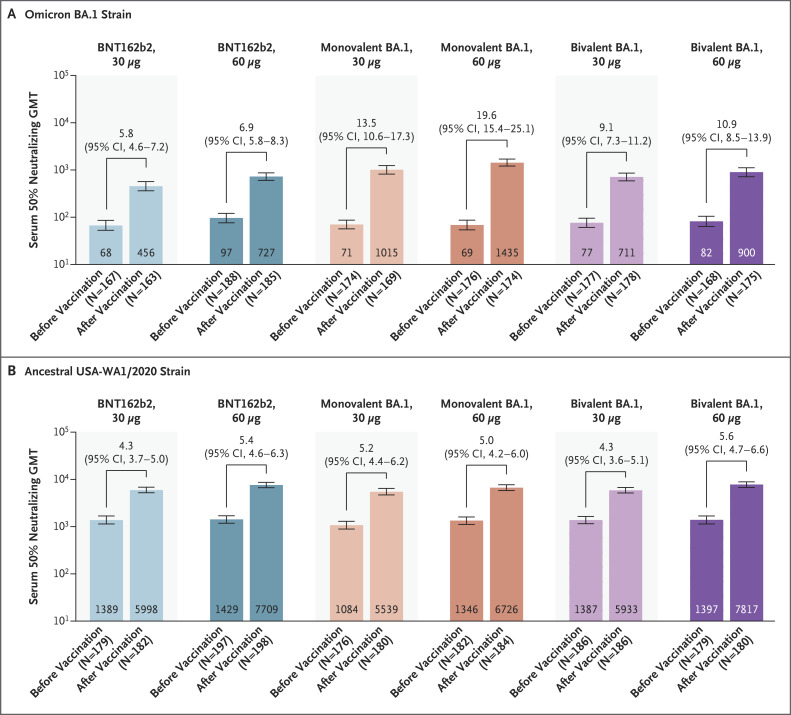
A total of 1846 participants underwent randomization. At 1 month after vaccination, bivalent BA.1 (30 μg and 60 μg) and monovalent BA.1 (60 μg) showed neutralizing activity against BA.1 superior to that of BNT162b2 (30 μg), with NT geometric mean ratios (GMRs) of 1.56 (95% confidence interval [CI], 1.17 to 2.08), 1.97 (95% CI, 1.45 to 2.68), and 3.15 (95% CI, 2.38 to 4.16), respectively. Bivalent BA.1 (both doses) and monovalent BA.1 (60 μg) were also noninferior to BNT162b2 (30 μg) with respect to seroresponse against BA.1; between-group differences ranged from 10.9 to 29.1 percentage points. Bivalent BA.1 (either dose) was noninferior to BNT162b2 (30 μg) with respect to neutralizing activity against the ancestral strain, with NT GMRs of 0.99 (95% CI, 0.82 to 1.20) and 1.30 (95% CI, 1.07 to 1.58), respectively. BA.4-BA.5 and BA.2.75 neutralizing titers were numerically higher with 30-μg bivalent BA.1 than with 30-μg BNT162b2. The safety profile of either dose of monovalent or bivalent BA.1 was similar to that of BNT162b2 (30 μg). Adverse events were more common in the 30-μg monovalent-BA.1 (8.5%) and 60-μg bivalent-BA.1 (10.4%) groups than in the other groups (3.6 to 6.6%).
The candidate monovalent or bivalent omicron BA.1-adapted vaccines had a safety profile similar to that of BNT162b2 (30 μg), induced substantial neutralizing responses against ancestral and omicron BA.1 strains, and, to a lesser extent, neutralized BA.4, BA.5, and BA.2.75 strains. (Funded by BioNTech and Pfizer; ClinicalTrials.gov number, NCT04955626.).
严重急性呼吸系统综合征冠状病毒 2 的免疫逃逸变体的出现,要求使用序列适应性疫苗来提供对 2019 年冠状病毒病的保护。
在一项正在进行的 3 期试验中,55 岁以上的成年人此前已接受 3 剂 30μg 的 BNT162b2 疫苗,随机分为接受 30μg 或 60μg 的 BNT162b2、30μg 或 60μg 的单价 B.1.1.529(奥密克戎)BA.1 适应型 BNT162b2(单价 BA.1),或 30μg(15μg 的 BNT162b2+15μg 的单价 BA.1)或 60μg(30μg 的 BNT162b2+30μg 的单价 BA.1)的 BA.1 适应型 BNT162b2(双价 BA.1)。主要目的是确定 BA.1 适应型疫苗相对于 BNT162b2(30μg)在中和滴度(针对 BA.1 的 50%)和血清反应方面的优越性(血清反应)。次要目标是确定双价 BA.1 在针对原始株的中和活性方面相对于 BNT162b2(30μg)的非劣效性。探索性分析评估了针对奥密克戎 BA.4、BA.5 和 BA.2.75 亚变种的免疫反应。
共有 1846 名参与者接受了随机分组。在接种后 1 个月,双价 BA.1(30μg 和 60μg)和单价 BA.1(60μg)在针对 BA.1 的中和活性方面优于 BNT162b2(30μg),中和抗体几何平均比(GMR)分别为 1.56(95%置信区间[CI],1.17 至 2.08)、1.97(95%CI,1.45 至 2.68)和 3.15(95%CI,2.38 至 4.16)。双价 BA.1(两种剂量)和单价 BA.1(60μg)在针对 BA.1 的血清反应方面也不劣于 BNT162b2(30μg),组间差异为 10.9 至 29.1 个百分点。双价 BA.1(任一剂量)在针对原始株的中和活性方面与 BNT162b2(30μg)也不劣效,中和抗体 GMR 分别为 0.99(95%CI,0.82 至 1.20)和 1.30(95%CI,1.07 至 1.58)。针对 BA.4-BA.5 和 BA.2.75 的中和滴度,用 30μg 双价 BA.1 比用 30μg BNT162b2 数值更高。单价或双价 BA.1 的任一剂量的安全性与 BNT162b2(30μg)相似。在 30μg 单价-BA.1(8.5%)和 60μg 双价-BA.1(10.4%)组中,不良事件比其他组(3.6%至 6.6%)更为常见。
候选单价或双价奥密克戎 BA.1 适应型疫苗具有与 BNT162b2(30μg)相似的安全性,对原始和奥密克戎 BA.1 株诱导了大量的中和反应,对 BA.4、BA.5 和 BA.2.75 株的中和反应程度较小。(由 BioNTech 和辉瑞资助;临床试验编号,NCT04955626)。