Department of Medicine II (Gastroenterology, Hepatology, Endocrinology and Infectious Diseases), Freiburg University Medical Center, Faculty of Medicine, University of Freiburg, Freiburg, Germany; IMM-PACT, Faculty of Medicine, University of Freiburg, Freiburg, Germany.
Department of Medicine II (Gastroenterology, Hepatology, Endocrinology and Infectious Diseases), Freiburg University Medical Center, Faculty of Medicine, University of Freiburg, Freiburg, Germany.
J Hepatol. 2023 May;78(5):1017-1027. doi: 10.1016/j.jhep.2023.02.007. Epub 2023 Feb 18.
BACKGROUND & AIMS: Liver transplant recipients (LTRs) demonstrate a reduced response to COVID-19 mRNA vaccination; however, a detailed understanding of the interplay between humoral and cellular immunity, especially after a third (and fourth) vaccine dose, is lacking.
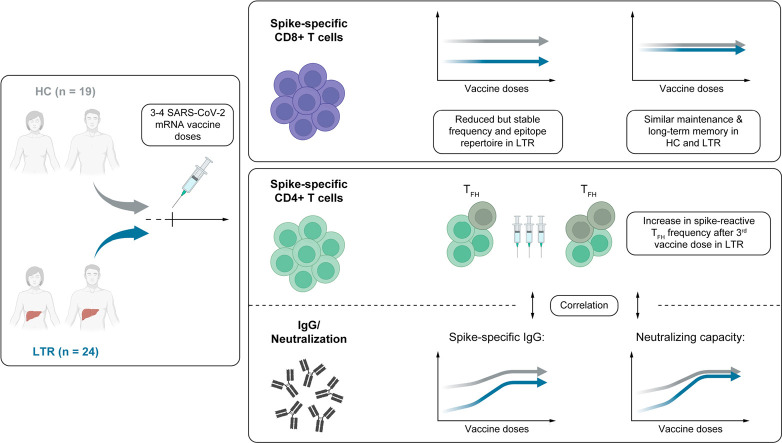
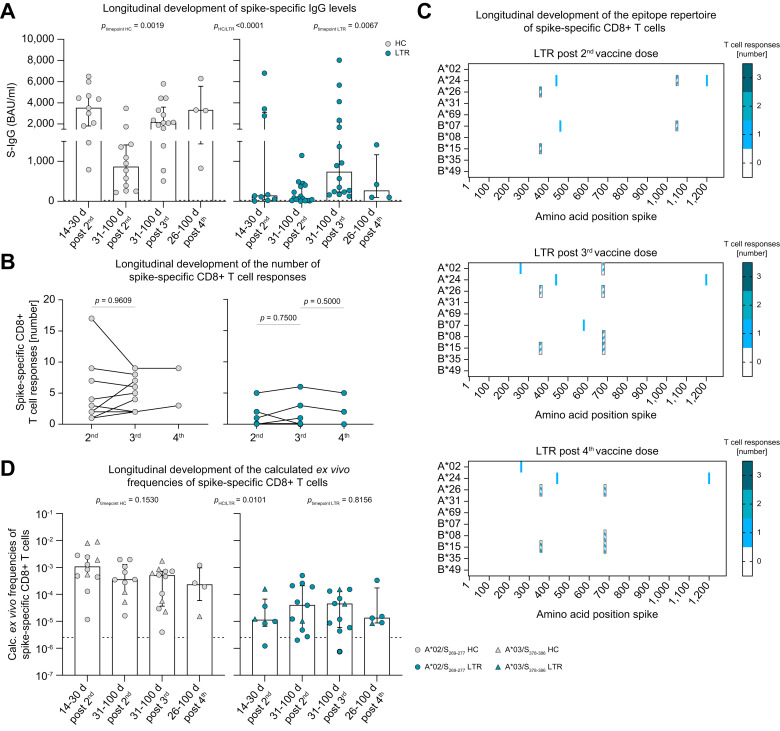
We longitudinally compared the humoral, as well as CD4+ and CD8+ T-cell, responses between LTRs (n = 24) and healthy controls (n = 19) after three (LTRs: n = 9 to 16; healthy controls: n = 9 to 14 per experiment) to four (LTRs: n = 4; healthy controls: n = 4) vaccine doses, including in-depth phenotypical and functional characterization.
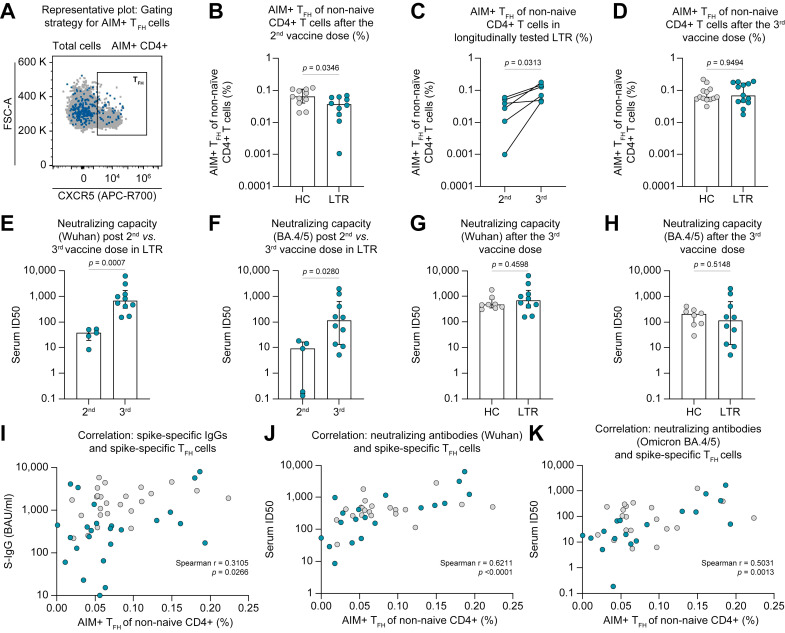
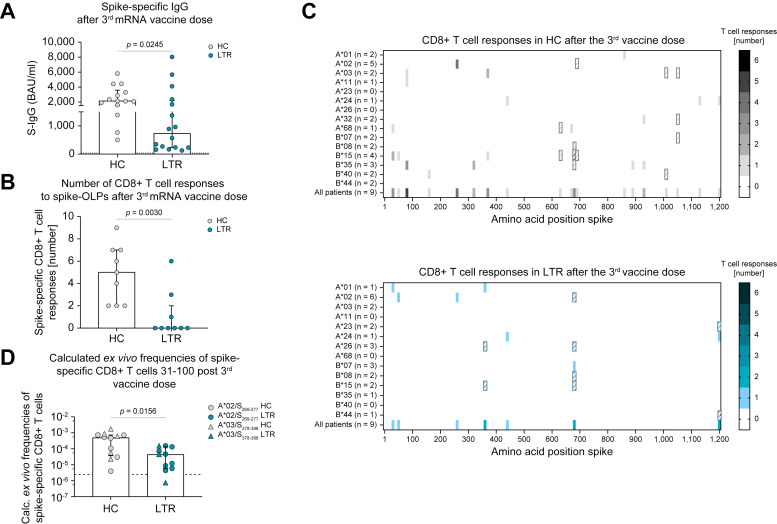
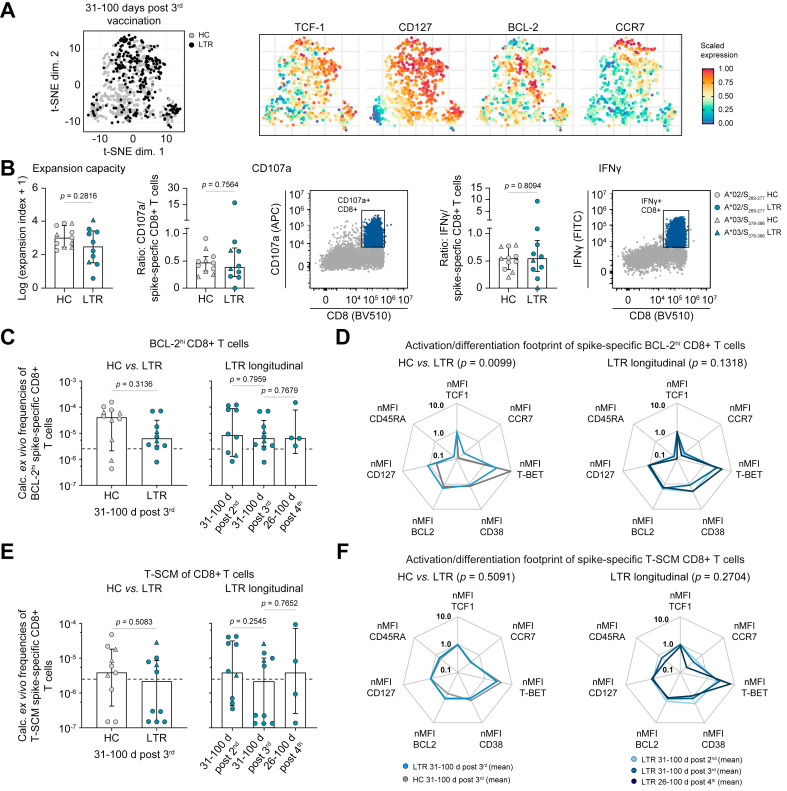
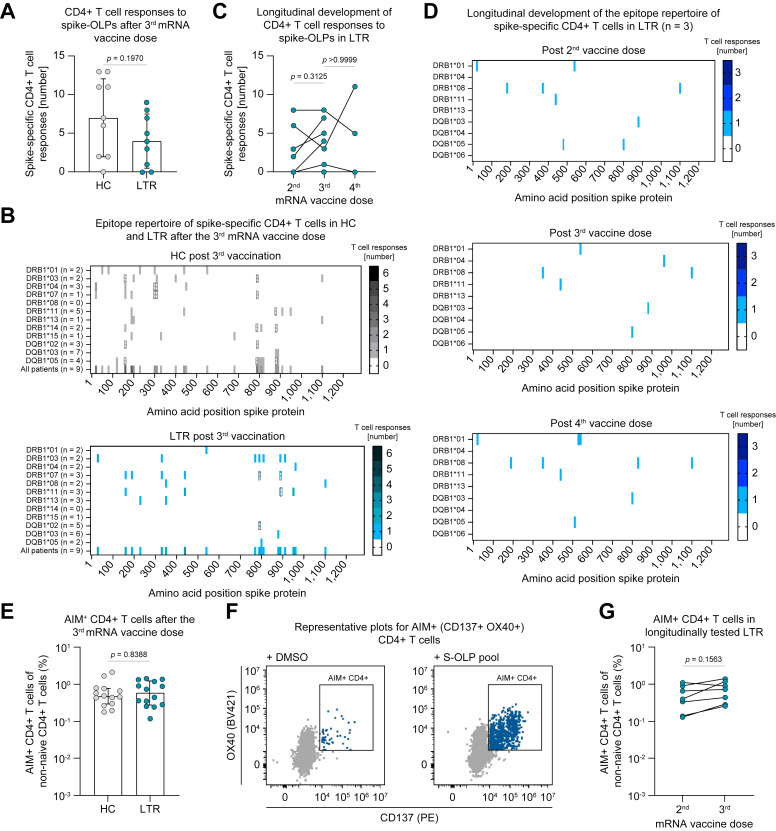
Compared to healthy controls, development of high antibody titers required a third vaccine dose in most LTRs, while spike-specific CD8+ T cells with robust recall capacity plateaued after the second vaccine dose, albeit with a reduced frequency and epitope repertoire compared to healthy controls. This overall attenuated vaccine response was linked to a reduced frequency of spike-reactive follicular T helper cells in LTRs.
Three doses of a COVID-19 mRNA vaccine induce an overall robust humoral and cellular memory response in most LTRs. Decisions regarding additional booster doses may thus be based on individual vaccine responses as well as evolution of novel variants of concern.
Due to immunosuppressive medication, liver transplant recipients (LTR) display reduced antibody titers upon COVID-19 mRNA vaccination, but the impact on long-term immune memory is not clear. Herein, we demonstrate that after three vaccine doses, the majority of LTRs not only exhibit substantial antibody titers, but also a robust memory T-cell response. Additional booster vaccine doses may be of special benefit for a small subset of LTRs with inferior vaccine response and may provide superior protection against evolving novel viral variants. These findings will help physicians to guide LTRs regarding the benefit of booster vaccinations.
肝移植受者(LTR)对 COVID-19 mRNA 疫苗的反应减弱;然而,对于体液免疫和细胞免疫之间的相互作用,特别是在接种第三(和第四)剂疫苗后,我们还缺乏详细的了解。
我们对 24 名 LTR 与 19 名健康对照者在接种三剂(LTR:n=9 至 16;健康对照:n=9 至 14 次实验)和四剂(LTR:n=4;健康对照:n=4)疫苗后的体液免疫,以及 CD4+和 CD8+T 细胞反应进行了纵向比较,包括深入的表型和功能特征分析。
与健康对照组相比,大多数 LTR 患者需要接种第三剂疫苗才能产生高抗体滴度,而具有强大记忆能力的刺突特异性 CD8+T 细胞在接种第二剂疫苗后达到峰值,尽管与健康对照组相比,其频率和表位谱较低。这种整体减弱的疫苗反应与 LTR 中刺突反应性滤泡辅助 T 细胞的频率降低有关。
三剂 COVID-19 mRNA 疫苗可在大多数 LTR 中诱导出整体强大的体液和细胞记忆反应。因此,关于额外加强剂量的决定可以基于个体疫苗反应以及新关注变异体的演变。
由于免疫抑制药物的使用,肝移植受者(LTR)在接受 COVID-19 mRNA 疫苗接种后抗体滴度降低,但对长期免疫记忆的影响尚不清楚。在此,我们证明,在接种三剂疫苗后,大多数 LTR 不仅产生了大量的抗体滴度,而且还产生了强大的记忆 T 细胞反应。对于疫苗反应较差的一小部分 LTR,额外的加强疫苗剂量可能特别有益,并可提供对新出现的病毒变异体的更好保护。这些发现将有助于医生指导 LTR 考虑加强疫苗接种的益处。