Department of Occupational Medicine, Hacettepe University Faculty of Medicine, Ankara, Turkey.
Department of Chest Disease, Ankara Ataturk Sanatorium Training and Research Hospital, Keçiören/Ankara, Turkey.
Medicine (Baltimore). 2023 Sep 22;102(38):e35176. doi: 10.1097/MD.0000000000035176.
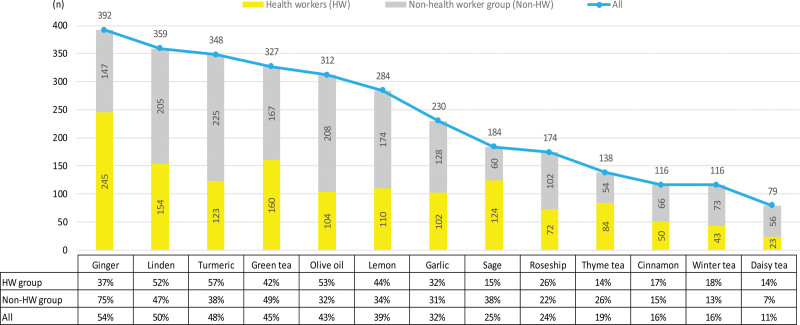
The coronavirus disease 2019 (COVID-19) pandemic has adversely affected working life all over the world, and the employees with the highest risk of transmission have been those in the health sector. Since there are currently no effective treatments for COVID-19, there have been numerous attempts to find alternative treatments for both the spread of the infection and its treatment. These efforts have included the use of herbal extracts to boost immunity and reduce the likelihood of contracting the infection. This study explored the attitudes of healthcare workers toward the consumption of COVID-19 herbal medicine (HM) products. This is an online, cross-sectional observational study. In total, 1335 participants were reached. It was observed that 722 (54%) of them preferred herbal treatments during the pandemic period. The attitudes of HM toward 327 (45.3%) healthcare workers and 395 (54.7%) general population participants were examined. Both groups had high rates of use of HM as a COVID-19 preventive measure (68.8 percent and 67.1 percent, respectively). While its use was higher among healthcare workers during infection (OR: 2.00, 95% CI: 1.32-3.03), its use was higher in the non-healthcare group for post-COVID problems (OR: 0.51, 95% CI: 0.35-0.74). The opinion of healthcare professionals was that HM was more efficient (OR: 1.59, 95% CI: 1.19-21.15). All participants' main incentive to utilize HM was family advice (n = 194, 26.9%). A total of 90 (12.4%) participants reported side effects. Vomiting-nausea were the most typical adverse effects (38.9%). The herb most frequently utilized was ginger (54%). Healthcare workers use HM at rates that are the same as those of the general population. Both its use during infections and the idea that it is effective are more common among healthcare professionals than in the general population.
新型冠状病毒病(COVID-19)大流行已对全世界的工作生活产生了不利影响,而感染风险最高的员工是卫生部门的员工。由于目前尚无有效的 COVID-19 治疗方法,因此人们一直在尝试寻找感染传播和治疗的替代方法。这些努力包括使用草药提取物来增强免疫力并降低感染的可能性。本研究探讨了医护人员对 COVID-19 草药(HM)产品消费的态度。这是一项在线的横断面观察性研究。共联系到 1335 名参与者。结果发现,在大流行期间,有 722 名(54%)参与者更喜欢草药治疗。检查了 327 名(45.3%)医护人员和 395 名(54.7%)一般人群参与者对 HM 的态度。两组均将 HM 用作 COVID-19 预防措施的使用率较高(分别为 68.8%和 67.1%)。在感染期间,医护人员的使用率更高(OR:2.00,95%CI:1.32-3.03),而在非医护人员中,用于 COVID-19 后问题的使用率更高(OR:0.51,95%CI:0.35-0.74)。医护人员的意见是 HM 更有效(OR:1.59,95%CI:1.19-21.15)。所有参与者使用 HM 的主要动机是家庭建议(n=194,26.9%)。共有 90 名(12.4%)参与者报告了副作用。呕吐-恶心是最典型的不良反应(38.9%)。最常用的草药是生姜(54%)。医护人员的 HM 使用率与普通人群相同。在感染期间使用 HM 及其有效的想法在医护人员中比在普通人群中更为普遍。