Center for Gerontology and Rehabilitation, School of Medicine, St Finbarr's Hospital, University College Cork, Block 13, Douglas Road, The Bungalow, Cork, Ireland.
Rehabilitation Department, College of Health and Rehabilitation Sciences, Princess Nourah bint Abdulrahman University, Riyadh, Saudi Arabia.
BMC Geriatr. 2023 Sep 25;23(1):595. doi: 10.1186/s12877-023-04323-0.
Falls are the most common health problem affecting older people in long-term care facilities (LTCFs), with well-recognised adverse psychological and physical resident outcomes, and high staff burden and financial cost. LTCF staff knowledge and skills can play a vital role in providing and promoting fall prevention care.
A descriptive cross-sectional survey study was conducted across 13 LTCF sites in the Southwest of Ireland; a sampling frame facilitated inclusion of a range of provider types and facility sizes. An existing questionnaire, based on fall prevention guidance, and examining staff knowledge, skills and attitudes, was distributed in physical and online formats.
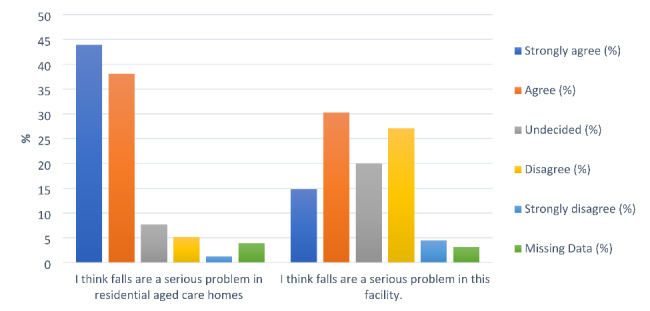
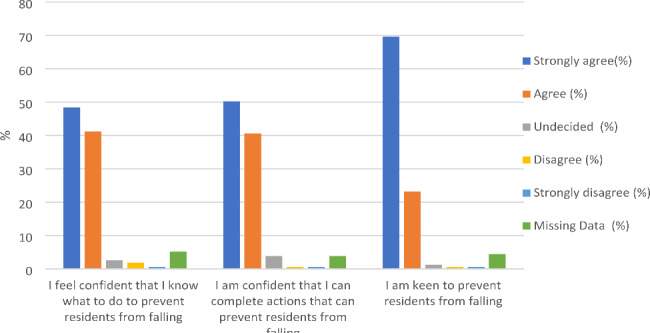
The response rate was 15% (n = 155), predominantly healthcare assistants, staff nurses and senior nurses. Almost 90% expressed high confidence levels for delivering fall prevention interventions and being aware of how falls affect LTCFs. However, over half underestimated the fall rate in LTCFs, and only 60% had adequate knowledge. Longer experience in working with older people in healthcare services was associated with greater knowledge (p = .001) and confidence in fall prevention interventions (p = .01), while senior nurses had more knowledge than others (p = .01). LTCF staff had lowest knowledge about "identification systems for residents at high risk of falling", "keeping confused residents near nursing stations", "the effect of using antipsychotic medicine on falls", "using a toileting regimen" and "staff responsibility regarding fall prevention efforts". Despite their knowledge gaps, nearly 50% thought they had enough fall prevention training; their main preference for any further fall education training was face-to-face education.
The results, with the caveat of a low response rate, show the need for interdisciplinary fall prevention training that is tailored to both the perceived learning needs and actual knowledge gap of LTCF staff and their preferences for learning delivery, as part of an overall approach to reducing fall-related adverse outcomes.
在长期护理机构(LTCF)中,老年人最常见的健康问题是跌倒,这会对老年人产生可识别的不良心理和身体影响,也会给员工带来沉重负担和增加财务成本。LTCF 员工的知识和技能在提供和促进预防跌倒护理方面可以发挥至关重要的作用。
在爱尔兰西南部的 13 个 LTCF 站点进行了一项描述性的横断面调查研究;抽样框架方便了包括各种提供者类型和设施规模的纳入。使用基于预防跌倒指南的现有问卷,调查了员工的知识、技能和态度,以纸质和在线两种形式发放问卷。
应答率为 15%(n=155),主要是保健助理、护士和高级护士。近 90%的人对提供预防跌倒干预措施和了解跌倒如何影响 LTCF 表示高度自信。然而,超过一半的人低估了 LTCF 的跌倒率,只有 60%的人有足够的知识。在医疗保健服务中与老年人一起工作的经验越丰富,知识越丰富(p=0.001),对预防跌倒干预措施的信心越大(p=0.01),而高级护士的知识比其他人更丰富(p=0.01)。LTCF 员工对“识别有高跌倒风险的居民的识别系统”、“将意识不清的居民留在护士站附近”、“使用抗精神病药物对跌倒的影响”、“使用导尿方案”和“员工对预防跌倒措施的责任”方面的知识最少。尽管存在知识差距,但近 50%的人认为他们有足够的预防跌倒培训;他们对任何进一步的跌倒教育培训的主要偏好是面对面教育。
鉴于低应答率的情况,结果表明需要进行跨学科的预防跌倒培训,培训内容应根据 LTCF 员工的感知学习需求和实际知识差距进行定制,并根据他们的学习交付偏好进行调整,这是减少与跌倒相关的不良后果的整体方法的一部分。