Department of Critical Care Medicine, State Key Laboratory of Complex Severe and Rare Diseases, Peking Union Medical College Hospital, Peking Union Medical College and Chinese Academy of Medical Sciences, Beijing, 100730, China.
Department of Medical Administration, National Health Commission of the People's Republic of China, Beijing, 100044, China.
Eur J Med Res. 2023 Sep 25;28(1):372. doi: 10.1186/s40001-023-01341-x.
Septic shock is a global public health burden. In addition to the improvement of the level of individual care, the improvement of the overall hospital quality control management is also an essential key aspect of the Surviving Sepsis Campaign (SSC). Using of antibiotics is a cornerstone in the treatment of septic shock, so we conducted this study to investigate the influence of antibiotics and pathogenic bacteria on the mortality of septic shock at the level of overall hospital in China.
This was an observational database study in 2021 enrolled the data of 787 hospitals from 31 provinces/municipalities/autonomous regions of Mainland China collected in a survey from January 1, 2021 to December 31, 2021.
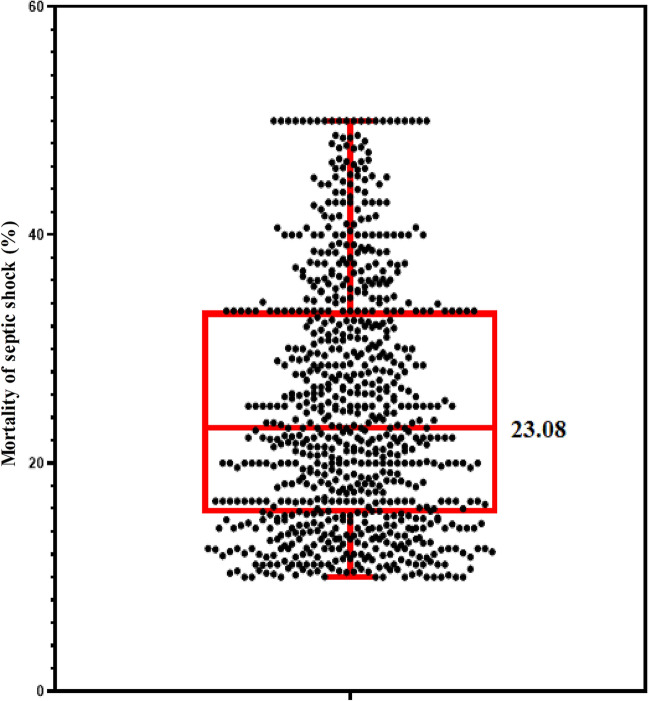
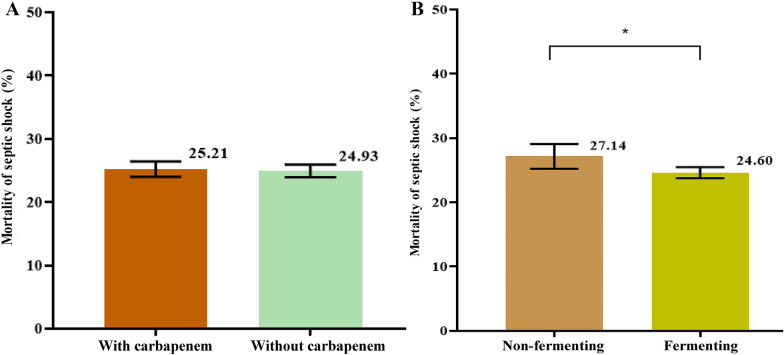
The proportion of ICU patients with septic shock was 3.55%, while the patient mortality of septic shock was 23.08%. While carbapenem was the most preferred antibiotic medication used in 459 of the 782 hospitals, the preference for carbapenem did not show significant effect on the patient mortality in the treatment of septic shock (p-value 0.59). Compared with patients with fermenting bacteria as the most common pathogenic bacteria causing septic shock, patients with non-fermenting bacteria had a higher mortality (p-value 0.01).
Whether using carbapenem as the preferred antibiotic or not, did not show effect on the patient mortality of septic shock. Compared with patients with fermenting bacteria as the most common pathogenic bacteria, patients of septic shock with non-fermenting bacteria had a higher mortality.
脓毒症休克是一个全球性的公共卫生负担。除了提高个人护理水平外,提高医院整体质量控制管理也是拯救脓毒症运动(SSC)的关键方面。抗生素的使用是治疗脓毒症休克的基石,因此我们进行了这项研究,以调查抗生素和病原菌在中国医院整体水平上对脓毒症休克死亡率的影响。
这是一项 2021 年的观察性数据库研究,共纳入中国大陆 31 个省/市/自治区的 787 家医院的数据,这些数据是在 2021 年 1 月 1 日至 12 月 31 日期间的一项调查中收集的。
ICU 中脓毒症休克患者的比例为 3.55%,而脓毒症休克患者的死亡率为 23.08%。虽然 782 家医院中有 459 家使用碳青霉烯类药物作为首选抗生素,但在治疗脓毒症休克时,碳青霉烯类药物的使用偏好对患者死亡率没有显著影响(p 值为 0.59)。与发酵菌作为引起脓毒症休克的最常见病原菌的患者相比,非发酵菌患者的死亡率更高(p 值为 0.01)。
无论是否将碳青霉烯类药物作为首选抗生素,都不会对脓毒症休克患者的死亡率产生影响。与发酵菌作为最常见病原菌的患者相比,非发酵菌患者的脓毒症休克死亡率更高。