Yang Qing-Feng, Xie Rui-Bo, Zhang Rui, Ding Wan
Parent Education Research Center, Intelligent Laboratory of Child and Adolescent Mental Health and Crisis Intervention of Zhejiang Province, School of Psychology, Zhejiang Normal University, Jinhua 321004, China.
Behav Sci (Basel). 2023 Aug 30;13(9):725. doi: 10.3390/bs13090725.
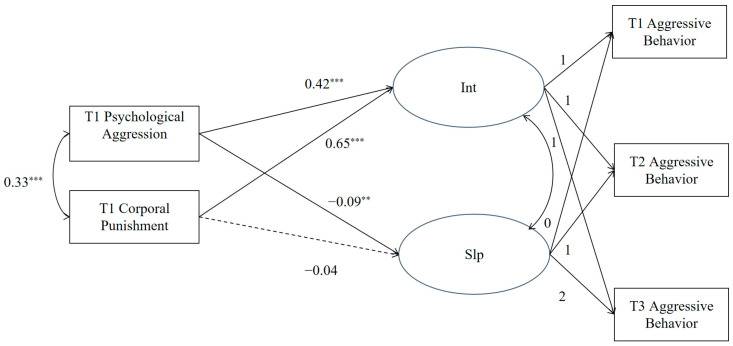
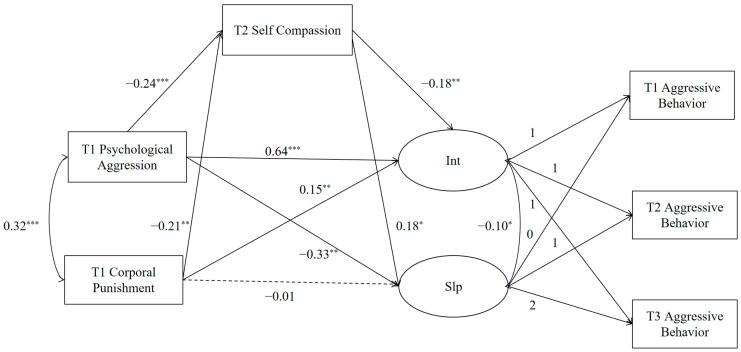
Harsh discipline during childhood (psychological aggression and corporal punishment) has been found to be an early risk factor for adolescent aggressive behavior. However, previous studies have mainly examined the relationship between harsh discipline as a whole and the level of adolescent aggressive behavior. This study investigates the effects of childhood psychological aggression and corporal punishment on the initial levels and rate of change in adolescent aggressive behavior, as well as the mediating role of self-compassion in this relationship. Using cluster sampling, a three-wave follow-up assessment was conducted on 1214 high-school students (60.7% boys; mean age at Wave 1 = 15.46 ± 0.71). The results showed that childhood psychological aggression and corporal punishment had a positive predictive effect on the development level of adolescent aggressive behavior. However, only childhood psychological aggression significantly directly attenuated the decline rate of adolescent aggressive behavior. In addition, both childhood psychological aggression and corporal punishment indirectly affected the initial levels and growth rate of adolescent aggressive behavior through self-compassion. These findings could provide potential targets for prevention and intervention programs aimed at improving aggressive behavior in Chinese adolescents.
童年时期的严厉管教(心理攻击和体罚)已被发现是青少年攻击行为的早期风险因素。然而,以往的研究主要考察的是整体严厉管教与青少年攻击行为水平之间的关系。本研究调查了童年时期的心理攻击和体罚对青少年攻击行为的初始水平和变化率的影响,以及自我同情在这种关系中的中介作用。采用整群抽样法,对1214名高中生(男生占60.7%;第一波调查时的平均年龄为15.46±0.71岁)进行了三波随访评估。结果表明,童年时期的心理攻击和体罚对青少年攻击行为的发展水平具有正向预测作用。然而,只有童年时期的心理攻击显著直接减缓了青少年攻击行为的下降速度。此外,童年时期的心理攻击和体罚都通过自我同情间接影响青少年攻击行为的初始水平和增长率。这些发现可为旨在改善中国青少年攻击行为的预防和干预项目提供潜在靶点。