Maya Jesús, Arcos-Romero Ana Isabel, Rodríguez-Carrasco Carmen R, Hidalgo Victoria
Department of Psychology, Universidad Loyola Andalucía, Seville, Spain.
Department of Developmental and Educational Psychology, University of Seville, Seville, Spain.
Heliyon. 2024 Aug 14;10(16):e36331. doi: 10.1016/j.heliyon.2024.e36331. eCollection 2024 Aug 30.
Self-compassion, individual's ability to treat oneself kindly, is important for mental well-being. The Self-Compassion Scale (SCS) is the most used instrument to measure self-compassion, but the short form does not have validity evidence in adolescents.
We examined the psychometric properties of the SCS-SF (12 items) in 955 Spanish adolescents (M = 13.95) using Confirmatory Factor Analysis (CFA) and reliability tests. The life satisfaction, family satisfaction, and reactive-proactive aggression were used for convergent validity.
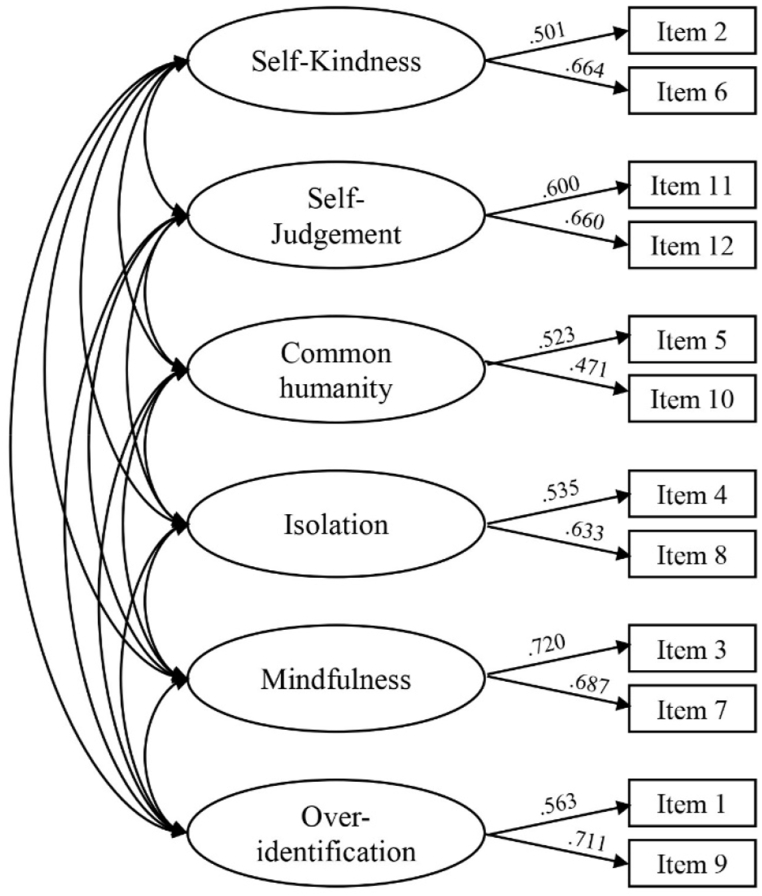
Cronbach's alpha reliability value for the total scale was .723. CFA confirmed that the six-factor model showed good fit indices with three positive dimensions: self-kindness, common humanity, and mindfulness; and three negative components: self-judgment, isolation, and over-identification (χ = 114.730; CFI = .966; GFI = .98; RMSEA = .045). The bifactorial model also showed an adequate fit, although with weaker values than the six-factor (ꭓ = 247.108; CFI = .914; GFI = .95; RMSEA = .06). The unifactorial model showed an inadequate fit. Total SCS score correlated positively with family satisfaction ( = .43; < .001) and life satisfaction ( = .48; < .001) and negatively with reactive aggressiveness ( = -.27; < .001) and with proactive aggressiveness ( = -.18; < .001). Self-kindness, common humanity, and mindfulness were associated with higher family and life satisfaction ( < .001) Self-judgment, isolation, and over-identification were associated with lower family and life satisfaction ( < .001). Self-judgment and isolation positively correlated with both reactive and proactive aggression ( < .001), while mindfulness negatively correlated with both reactive and proactive aggression ( < .01).
The SCS-SF is a valid and reliable instrument for assessing self-compassion in Spanish adolescents. Results suggest the six-factor model in its first validation in an adolescent population with convergent validity. The findings of this study corroborate the significance of self-compassion for the mental health of adolescents, particularly in relation to their family and life satisfaction.
自我同情,即个体善待自己的能力,对心理健康很重要。自我同情量表(SCS)是测量自我同情最常用的工具,但简版在青少年群体中缺乏效度证据。
我们采用验证性因素分析(CFA)和信度检验,对955名西班牙青少年(M = 13.95)的SCS - SF(12项)量表的心理测量特性进行了研究。使用生活满意度、家庭满意度以及反应性 - 主动性攻击行为来检验聚合效度。
总量表的Cronbach's alpha信度值为0.723。CFA证实,六因素模型显示出良好的拟合指数,包含三个积极维度:自我友善、共通人性和正念;以及三个消极成分:自我评判、孤立和过度认同(χ = 114.730;CFI = 0.966;GFI = 0.98;RMSEA = 0.045)。双因素模型也显示出足够的拟合度,尽管其值比六因素模型弱(ꭓ = 247.108;CFI = 0.914;GFI = 0.95;RMSEA = 0.06)。单因素模型显示拟合不足。SCS总分与家庭满意度( = 0.43; < 0.001)和生活满意度( = 0.48; < 0.001)呈正相关,与反应性攻击行为( = -0.27; < 0.001)和主动性攻击行为( = -0.18; < 0.001)呈负相关。自我友善、共通人性和正念与更高的家庭和生活满意度相关( < 0.001)。自我评判、孤立和过度认同与更低的家庭和生活满意度相关( < 0.001)。自我评判和孤立与反应性和主动性攻击行为均呈正相关( < 0.001),而正念与反应性和主动性攻击行为均呈负相关( < 0.01)。
SCS - SF是评估西班牙青少年自我同情的有效且可靠的工具。结果表明六因素模型在青少年群体中的首次验证具有聚合效度。本研究结果证实了自我同情对青少年心理健康的重要性,特别是在与他们的家庭和生活满意度方面。