Hartbauer Manfred
Institute of Biology, University Graz, 8010 Graz, Austria.
J Imaging. 2023 Sep 18;9(9):185. doi: 10.3390/jimaging9090185.
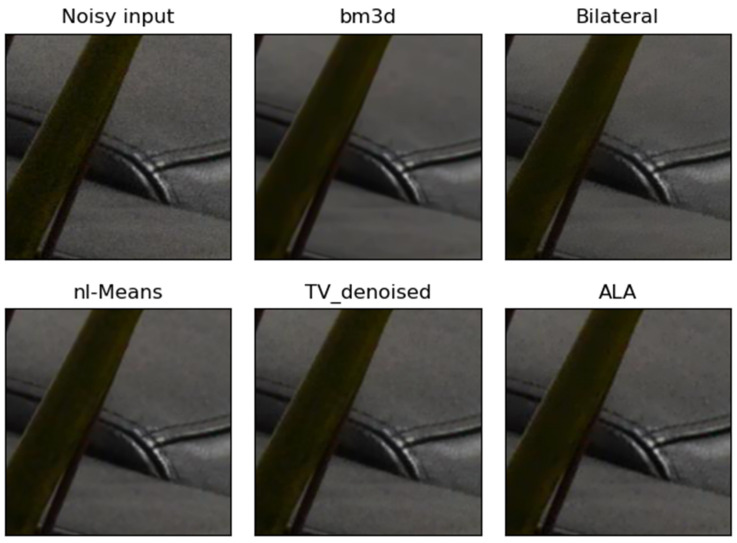
The noise statistics of real-world camera images are challenging for any denoising algorithm. Here, I describe a modified version of a bionic algorithm that improves the quality of real-word noisy camera images from a publicly available image dataset. In the first step, an adaptive local averaging filter was executed for each pixel to remove moderate sensor noise while preserving fine image details and object contours. In the second step, image sharpness was enhanced by means of an unsharp mask filter to generate output images that are close to ground-truth images (multiple averages of static camera images). The performance of this denoising algorithm was compared with five popular denoising methods: bm3d, wavelet, non-local means (NL-means), total variation (TV) denoising and bilateral filter. Results show that the two-step filter had a performance that was similar to NL-means and TV filtering. Bm3d had the best denoising performance but sometimes led to blurry images. This novel two-step filter only depends on a single parameter that can be obtained from global image statistics. To reduce computation time, denoising was restricted to the Y channel of YUV-transformed images and four image segments were simultaneously processed in parallel on a multi-core processor.
对于任何去噪算法而言,真实世界相机图像的噪声统计都是一项挑战。在此,我描述了一种仿生算法的改进版本,该算法可提高来自公开可用图像数据集的真实世界有噪声相机图像的质量。第一步,对每个像素执行自适应局部平均滤波器,以去除适度的传感器噪声,同时保留精细的图像细节和物体轮廓。第二步,通过非锐化掩模滤波器增强图像清晰度,以生成接近真实图像(静态相机图像的多个平均值)的输出图像。将这种去噪算法的性能与五种流行的去噪方法进行了比较:三维块匹配滤波(BM3D)、小波变换、非局部均值(NL-means)、全变分(TV)去噪和双边滤波器。结果表明,两步滤波器的性能与NL-means和TV滤波相似。BM3D具有最佳的去噪性能,但有时会导致图像模糊。这种新颖的两步滤波器仅依赖于一个可从全局图像统计中获得的参数。为了减少计算时间,去噪被限制在YUV变换图像的Y通道上,并且在多核处理器上同时并行处理四个图像段。