Michigan State University, East Lansing, MI, USA.
Université Laval, Québec, Canada.
Nat Commun. 2023 Sep 27;14(1):6043. doi: 10.1038/s41467-023-41321-7.
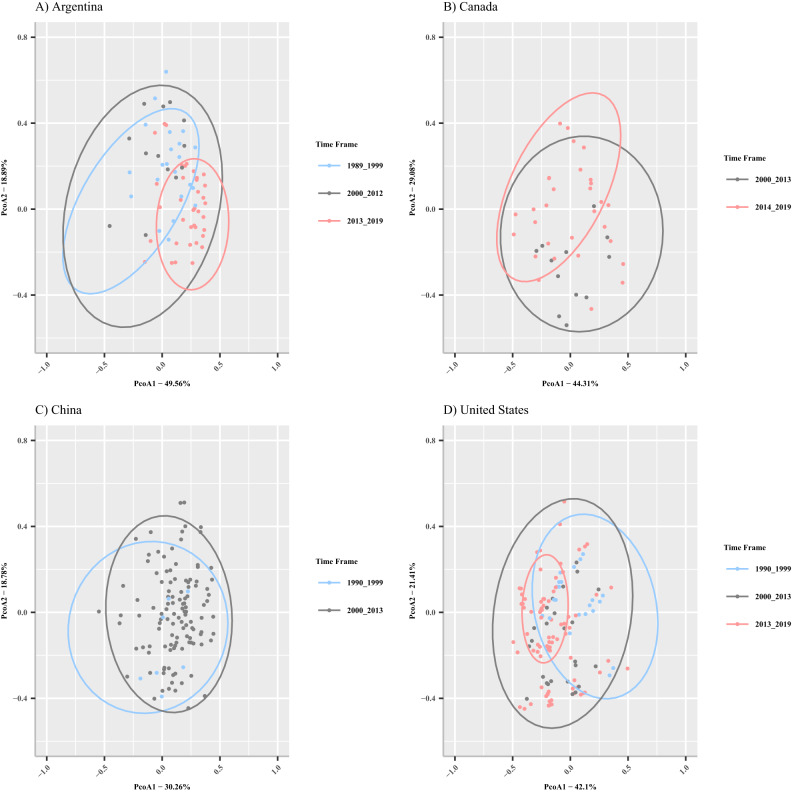
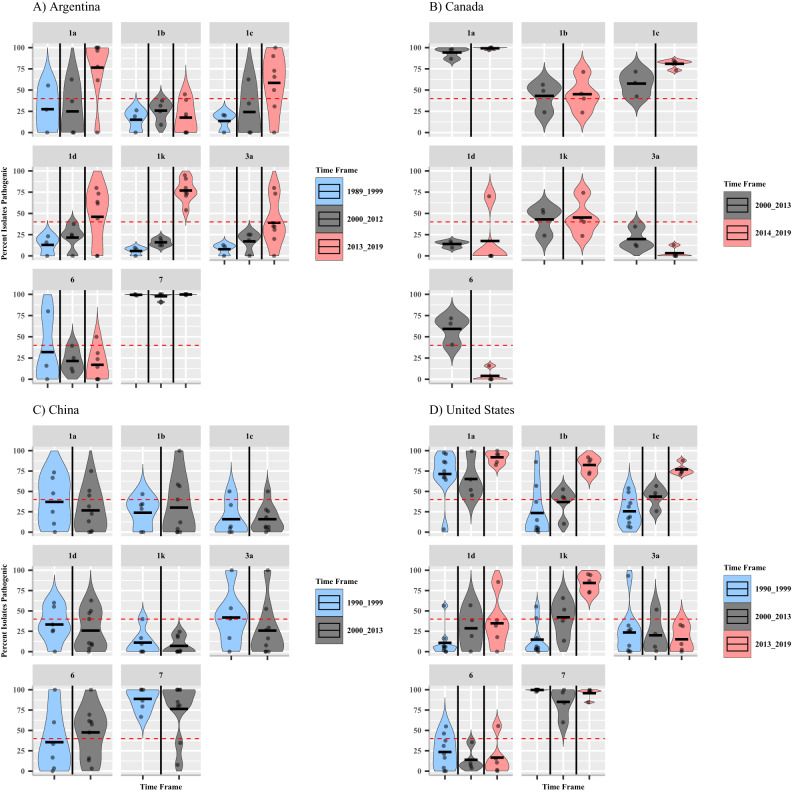
Plant disease resistance genes are widely used in agriculture to reduce disease outbreaks and epidemics and ensure global food security. In soybean, Rps (Resistance to Phytophthora sojae) genes are used to manage Phytophthora sojae, a major oomycete pathogen that causes Phytophthora stem and root rot (PRR) worldwide. This study aims to identify temporal changes in P. sojae pathotype complexity, diversity, and Rps gene efficacy. Pathotype data was collected from 5121 isolates of P. sojae, derived from 29 surveys conducted between 1990 and 2019 across the United States, Argentina, Canada, and China. This systematic review shows a loss of efficacy of specific Rps genes utilized for disease management and a significant increase in the pathotype diversity of isolates over time. This study finds that the most widely deployed Rps genes used to manage PRR globally, Rps1a, Rps1c and Rps1k, are no longer effective for PRR management in the United States, Argentina, and Canada. This systematic review emphasizes the need to widely introduce new sources of resistance to P. sojae, such as Rps3a, Rps6, or Rps11, into commercial cultivars to effectively manage PRR going forward.
植物疾病抗性基因在农业中被广泛用于减少疾病爆发和流行,以确保全球粮食安全。在大豆中,Rps(抗大豆疫霉)基因被用于管理大豆疫霉,这是一种主要的卵菌病原体,在全球范围内引起大豆茎基和根腐病(PRR)。本研究旨在鉴定大豆疫霉菌生理小种复杂性、多样性和 Rps 基因功效的时间变化。从 1990 年至 2019 年期间在美国、阿根廷、加拿大和中国进行的 29 项调查中,收集了来自 5121 个大豆疫霉菌分离物的生理小种数据。本系统综述表明,特定用于疾病管理的 Rps 基因的功效丧失,以及随着时间的推移,分离物的生理小种多样性显著增加。本研究发现,目前全球用于管理 PRR 的最广泛应用的 Rps 基因,如 Rps1a、Rps1c 和 Rps1k,在美国、阿根廷和加拿大已不再有效用于 PRR 管理。本系统综述强调需要广泛引入新的大豆疫霉菌抗性来源,如 Rps3a、Rps6 或 Rps11,以有效管理未来的 PRR。