Department of Plant, Soil and Microbial Sciences, Michigan State University, East Lansing, MI, 48824, USA.
Division of Plant Sciences and National Center for Soybean Biotechnology, University of Missouri-Columbia, Columbia, MO, 65211, USA.
Theor Appl Genet. 2022 Nov;135(11):3773-3872. doi: 10.1007/s00122-022-04101-3. Epub 2022 Jul 5.
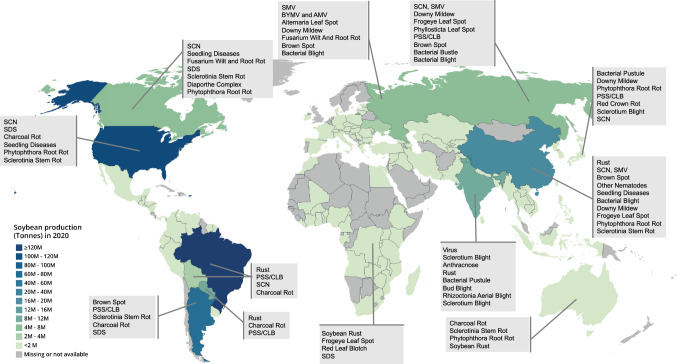
This review provides a comprehensive atlas of QTLs, genes, and alleles conferring resistance to 28 important diseases in all major soybean production regions in the world. Breeding disease-resistant soybean [Glycine max (L.) Merr.] varieties is a common goal for soybean breeding programs to ensure the sustainability and growth of soybean production worldwide. However, due to global climate change, soybean breeders are facing strong challenges to defeat diseases. Marker-assisted selection and genomic selection have been demonstrated to be successful methods in quickly integrating vertical resistance or horizontal resistance into improved soybean varieties, where vertical resistance refers to R genes and major effect QTLs, and horizontal resistance is a combination of major and minor effect genes or QTLs. This review summarized more than 800 resistant loci/alleles and their tightly linked markers for 28 soybean diseases worldwide, caused by nematodes, oomycetes, fungi, bacteria, and viruses. The major breakthroughs in the discovery of disease resistance gene atlas of soybean were also emphasized which include: (1) identification and characterization of vertical resistance genes reside rhg1 and Rhg4 for soybean cyst nematode, and exploration of the underlying regulation mechanisms through copy number variation and (2) map-based cloning and characterization of Rps11 conferring resistance to 80% isolates of Phytophthora sojae across the USA. In this review, we also highlight the validated QTLs in overlapping genomic regions from at least two studies and applied a consistent naming nomenclature for these QTLs. Our review provides a comprehensive summary of important resistant genes/QTLs and can be used as a toolbox for soybean improvement. Finally, the summarized genetic knowledge sheds light on future directions of accelerated soybean breeding and translational genomics studies.
本综述提供了一个全面的图谱,其中包含了在世界上所有主要大豆生产地区对 28 种重要疾病具有抗性的 QTL、基因和等位基因。培育抗病大豆[Glycine max(L.)Merr.]品种是大豆育种计划的共同目标,旨在确保全球大豆生产的可持续性和增长。然而,由于全球气候变化,大豆育种者在抗击疾病方面面临着巨大的挑战。标记辅助选择和基因组选择已被证明是将垂直抗性或水平抗性快速整合到改良大豆品种中的成功方法,其中垂直抗性是指 R 基因和主要效应 QTL,而水平抗性是主要和次要效应基因或 QTL 的组合。本综述总结了全球 28 种由线虫、卵菌、真菌、细菌和病毒引起的大豆病害的 800 多个抗性基因/等位基因及其紧密连锁标记。还强调了大豆抗病基因图谱发现的主要突破,包括:(1)鉴定和表征大豆胞囊线虫垂直抗性基因 rhg1 和 Rhg4,并通过拷贝数变异探索其潜在的调控机制;(2)基于图谱的克隆和表征 Rps11,对美国各地 80%的大豆疫霉分离株具有抗性。在本综述中,我们还突出了至少两个研究中重叠基因组区域中经过验证的 QTL,并为这些 QTL 应用了一致的命名命名法。我们的综述提供了一个重要抗性基因/QTL 的全面总结,可作为大豆改良的工具包。最后,总结的遗传知识为加速大豆育种和转化基因组学研究指明了未来的方向。