Choi Egan L, Taheri Negar, Tan Elijah, Matsumoto Kenjiro, Hayashi Yujiro
Enteric Neuroscience Program and Department of Physiology and Biomedical Engineering, Mayo Clinic College of Medicine and Science, Guggenheim 10, 200 1st Street SW, Rochester, MN 55905, USA.
Gastroenterology Research Unit, Mayo Clinic College of Medicine and Science, Rochester, MN 55905, USA.
Biomolecules. 2023 Sep 7;13(9):1358. doi: 10.3390/biom13091358.
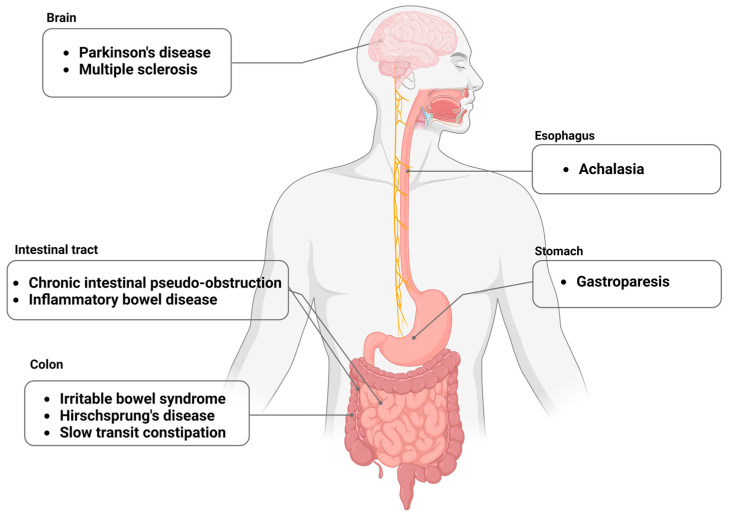
Neurointestinal diseases result from dysregulated interactions between the nervous system and the gastrointestinal (GI) tract, leading to conditions such as Hirschsprung's disease and irritable bowel syndrome. These disorders affect many people, significantly diminishing their quality of life and overall health. Central to GI motility are the interstitial cells of Cajal (ICC), which play a key role in muscle contractions and neuromuscular transmission. This review highlights the role of ICC in neurointestinal diseases, revealing their association with various GI ailments. Understanding the functions of the ICC could lead to innovative perspectives on the modulation of GI motility and introduce new therapeutic paradigms. These insights have the potential to enhance efforts to combat neurointestinal diseases and may lead to interventions that could alleviate or even reverse these conditions.
神经肠道疾病是由神经系统与胃肠道(GI)之间失调的相互作用引起的,导致诸如先天性巨结肠和肠易激综合征等病症。这些疾病影响着许多人,严重降低了他们的生活质量和整体健康水平。胃肠道蠕动的核心是 Cajal 间质细胞(ICC),它们在肌肉收缩和神经肌肉传递中起关键作用。本综述强调了 ICC 在神经肠道疾病中的作用,揭示了它们与各种胃肠道疾病的关联。了解 ICC 的功能可能会为胃肠道蠕动调节带来创新观点,并引入新的治疗模式。这些见解有可能加强对抗神经肠道疾病的努力,并可能导致能够缓解甚至逆转这些病症的干预措施。