Athanasiou Labrini V, Katsogiannou Eleni G, Tyrnenopoulou Panagiota, Gougoulis Dimitrios, Apostolidis Kosmas N, Papadakis Stavros M, Kokkinaki Kassiopi Christina G, Papatsiros Vasileios G, Tsokana Constantina N
Veterinary Faculty, University of Thessaly, 43100 Karditsa, Greece.
Biomolecules. 2023 Sep 11;13(9):1374. doi: 10.3390/biom13091374.
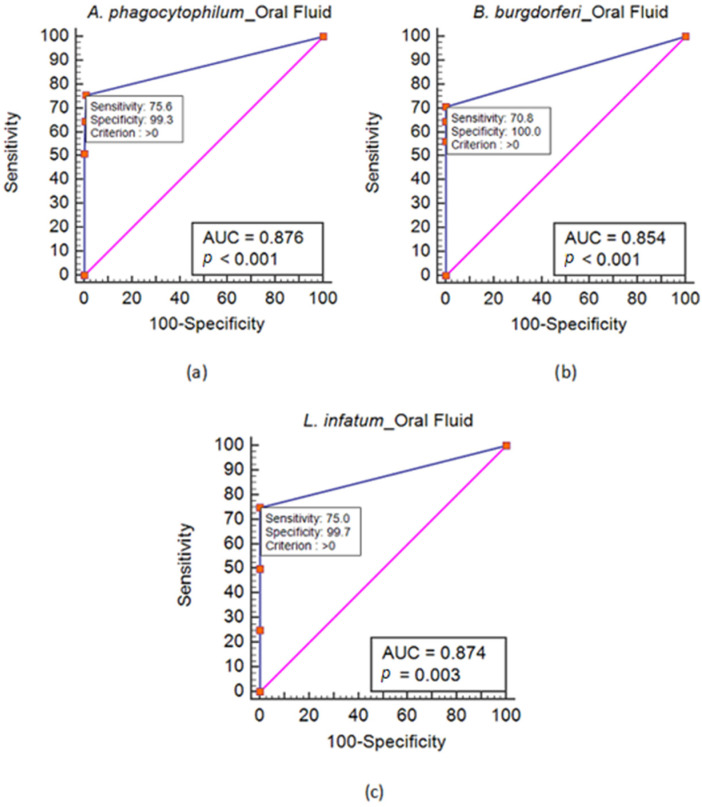
Among the various zoonotic pathogens that infect horses, spp. and spp. have gained scientific interest, and relevant molecular and serological studies in horses have been conducted worldwide. Moreover, human and veterinary medicine have extensively applied alternatives to serum diagnostic samples-such as saliva-for detecting pathogens or antibodies. In this study, we investigated the exposure of horses in Greece to , , and , and we assessed the diagnostic accuracy of saliva compared to serum in detecting IgG antibodies against the abovementioned pathogens. Paired saliva and serum samples were collected from 317 horses from different regions in Greece. The paired samples were examined using the indirect fluorescent antibody test (IFAT) for detecting IgG antibodies against , and Sensitivity, specificity, positive likelihood ratio (PLR), and negative likelihood ratio (NLR) were determined to assess the validity of saliva as an alternative to serum. The receiver operating characteristic (ROC) curve revealed that the optimal cut-off value for detecting antibodies against all the examined pathogens in saliva was 1/10. Higher seropositivity rates were found for (15.14%) and (14.19%) compared to (1.26%). The detection of IgG antibodies using IFAT in saliva samples had a good test performance compared to serum. The two sample types had a substantial to almost perfect agreement. Although the sensitivity was moderate (70.83-75.56%) in all cases, the specificity was almost perfect to perfect (99.63-100%). This study provides the first evidence that horses in Greece are exposed to and and confirms that the seroprevalence of in horses in Greece remains low. Our findings suggest that saliva sampling coupled with IFAT could be successfully applied for detecting IgG antibodies against these important zoonotic pathogens in large-scale epidemiological studies in horses, at the population level, as an alternative to serum.
在感染马匹的各种人畜共患病原体中,[具体病原体1]属和[具体病原体2]属已引起科学界的关注,世界各地都开展了有关马匹的相关分子和血清学研究。此外,人类医学和兽医学广泛应用血清诊断样本的替代物——如唾液——来检测病原体或抗体。在本研究中,我们调查了希腊马匹对[具体病原体1]、[具体病原体2]和[具体病原体3]的接触情况,并评估了与血清相比,唾液在检测针对上述病原体的IgG抗体时的诊断准确性。从希腊不同地区的317匹马中采集了配对的唾液和血清样本。使用间接荧光抗体试验(IFAT)检测针对[具体病原体1]、[具体病原体2]和[具体病原体3]的IgG抗体,并确定敏感性、特异性、阳性似然比(PLR)和阴性似然比(NLR),以评估唾液作为血清替代物的有效性。受试者工作特征(ROC)曲线显示,检测唾液中针对所有检测病原体的抗体的最佳临界值为1/10。与[具体病原体3](1.26%)相比,[具体病原体1](15.14%)和[具体病原体2](14.19%)的血清阳性率更高。与血清相比,使用IFAT检测唾液样本中的IgG抗体具有良好的检测性能。这两种样本类型具有高度一致到几乎完美的一致性。尽管在所有情况下敏感性中等(70.83 - 75.56%),但特异性几乎完美到完美(99.63 - 100%)。本研究提供了首个证据,表明希腊的马匹接触了[具体病原体1]和[具体病原体2],并证实希腊马匹中[具体病原体3]的血清阳性率仍然很低。我们的研究结果表明,在马匹的大规模流行病学研究中,在群体水平上,唾液采样结合IFAT可作为血清的替代方法,成功用于检测针对这些重要人畜共患病原体的IgG抗体。