Grigoraș Adriana, Amalinei Cornelia
Department of Morphofunctional Sciences I, "Grigore T. Popa" University of Medicine and Pharmacy, 700115 Iasi, Romania.
Department of Histopathology, Institute of Legal Medicine, 700455 Iasi, Romania.
Biomedicines. 2023 Aug 28;11(9):2401. doi: 10.3390/biomedicines11092401.
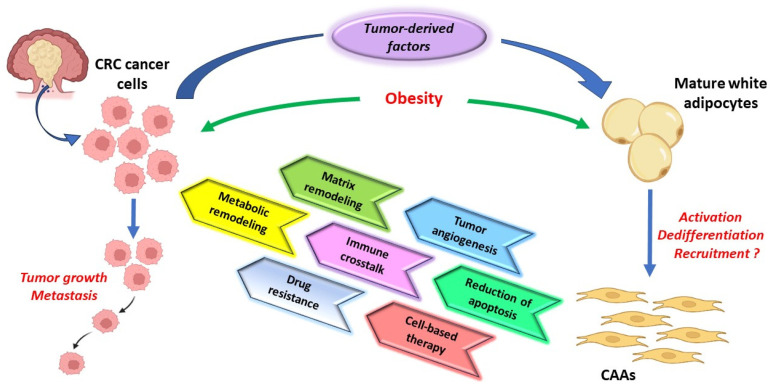
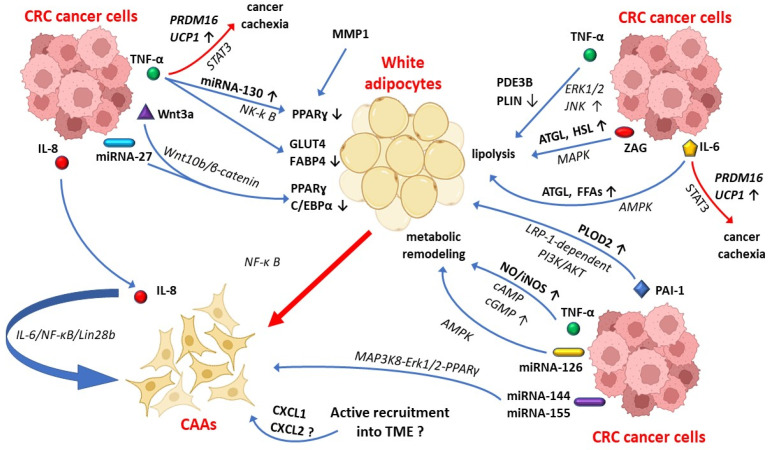
Colorectal cancer (CRC) is one of the most commonly diagnosed types of cancer, especially in obese patients, and the second cause of cancer-related death worldwide. Based on these data, extensive research has been performed over the last decades to decipher the pivotal role of the tumor microenvironment (TME) and its cellular and molecular components in CRC development and progression. In this regard, substantial progress has been made in the identification of cancer-associated adipocytes' (CAAs) characteristics, considering their active role in the CCR tumor niche, by releasing a panel of metabolites, growth factors, and inflammatory adipokines, which assist the cancer cells' development. Disposed in the tumor invasion front, CAAs exhibit a fibroblastic-like phenotype and establish a bidirectional molecular dialogue with colorectal tumor cells, which leads to functional changes in both cell types and contributes to tumor progression. CAAs also modulate the antitumor immune cells' response and promote metabolic reprogramming and chemotherapeutic resistance in colon cancer cells. This review aims to report recent cumulative data regarding the molecular mechanisms of CAAs' differentiation and their activity spectrum in the TME of CRC. A better understanding of CAAs and the molecular interplay between CAAs and tumor cells will provide insights into tumor biology and may open the perspective of new therapeutic opportunities in CRC patients.
结直肠癌(CRC)是最常被诊断出的癌症类型之一,尤其是在肥胖患者中,并且是全球癌症相关死亡的第二大原因。基于这些数据,在过去几十年中进行了广泛的研究,以阐明肿瘤微环境(TME)及其细胞和分子成分在CRC发生和发展中的关键作用。在这方面,在识别癌症相关脂肪细胞(CAA)的特征方面取得了重大进展,考虑到它们通过释放一组代谢物、生长因子和炎性脂肪因子在CCR肿瘤微环境中发挥的积极作用,这些物质有助于癌细胞的发展。CAA分布在肿瘤侵袭前沿,表现出成纤维细胞样表型,并与结直肠肿瘤细胞建立双向分子对话,这导致两种细胞类型发生功能变化并促进肿瘤进展。CAA还调节抗肿瘤免疫细胞的反应,并促进结肠癌细胞的代谢重编程和化疗耐药性。本综述旨在报告关于CAA分化的分子机制及其在CRC的TME中的活性谱的最新累积数据。更好地了解CAA以及CAA与肿瘤细胞之间的分子相互作用将为肿瘤生物学提供见解,并可能为CRC患者带来新的治疗机会。