Jun Hyungsun, Yoon Sang-Hoon, Ryu Myungseok, Chae Hyocheong, Chu Hongmin, Leem Jungtae, Kim Tae-Hun
Department of Diagnostics, College of Korean Medicine, Wonkwang University, Iksan 54538, Republic of Korea.
Chung-Yeon Korean Medicine Clinic, Seoul 06224, Republic of Korea.
Healthcare (Basel). 2023 Sep 18;11(18):2577. doi: 10.3390/healthcare11182577.
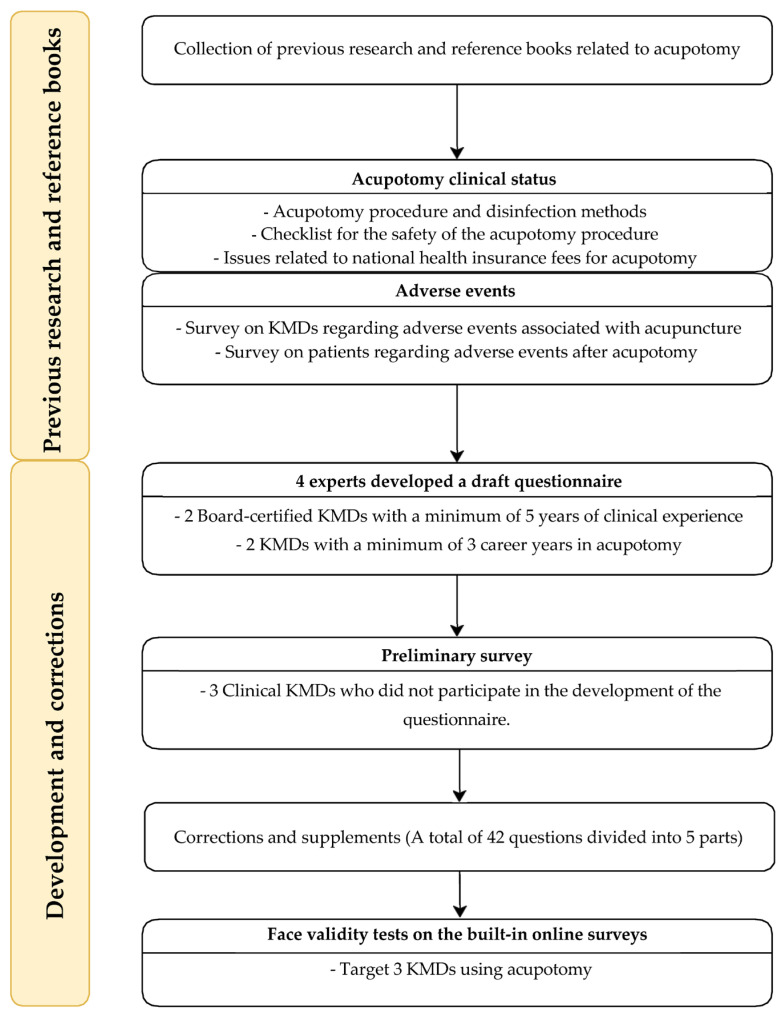
Acupotomy is a widely used medical intervention in traditional East Asian medicine, and efforts are being made to improve its effectiveness and safety. As a first step toward establishing more standardized procedural guidelines, a survey was conducted to explore the current clinical practice status and perceived adverse events (AEs) by Korean Medicine (KM) practitioners. The survey was developed via expert consensus and included information on clinical usage, perception, and the AEs experienced. The largest acupotomy society in Korea, which consists of 185 KM doctors, participated in an online survey conducted in September 2021. Of the 185 KM doctors, 107 (57.8%) responded. Musculoskeletal and connective tissue diseases accounted for 80.8% of suggested indications by KM doctors. Regarding the detailed procedure, there were considerable discrepancies between KM doctors. The most frequent acupotomy-related AEs observed by KM practitioners were bruises (77.3%), fatigue (57.7%), pain (51.8%), and hematoma (51.8%). Only 1.8% of the respondents answered that they had experienced severe AEs. Survey respondents answered that the use of imaging devices during acupotomy and the development of clinical practice guidelines are the most necessary policy requirements for promoting the use and ensuring the safety of acupotomy. To the best of our knowledge, this study marks the initial exploration into the KM physicians' clinical usage status, AEs experienced, and their requests for standardized guidelines and expanded health insurance coverage concerning acupotomy. Further research should include qualitative studies to assess patient experience and prospective observational studies to examine the effects of operator skills and treatment modalities on AEs and adherence.
针刀疗法是东亚传统医学中广泛应用的一种医学干预手段,目前正在努力提高其有效性和安全性。作为建立更标准化操作指南的第一步,我们开展了一项调查,以探究韩国传统医学(KM)从业者的当前临床实践状况以及他们所感知到的不良事件(AE)。该调查通过专家共识制定,涵盖了临床使用情况、认知以及所经历的不良事件等信息。韩国最大的针刀协会由185名韩医组成,他们参与了2021年9月进行的一项在线调查。在这185名韩医中,有107人(57.8%)做出了回应。肌肉骨骼和结缔组织疾病占韩医建议适应症的80.8%。关于具体操作流程,韩医之间存在相当大的差异。韩医从业者观察到的最常见的与针刀相关的不良事件是瘀伤(77.3%)、疲劳(57.7%)、疼痛(51.8%)和血肿(51.8%)。只有1.8%的受访者表示他们经历过严重不良事件。调查受访者表示,针刀治疗过程中使用成像设备以及制定临床实践指南是促进针刀疗法应用和确保其安全性最必要的政策要求。据我们所知,本研究标志着对韩医临床使用状况、所经历的不良事件以及他们对针刀标准化指南和扩大医疗保险覆盖范围的要求的初步探索。进一步的研究应包括评估患者体验的定性研究以及考察操作者技能和治疗方式对不良事件及依从性影响的前瞻性观察研究。