Zhang Yiting, Xing Hu, Bolotnikov Grigory, Krämer Markus, Gotzmann Nina, Knippschild Uwe, Kissmann Ann-Kathrin, Rosenau Frank
Institute of Pharmaceutical Biotechnology, Ulm University, Albert-Einstein-Allee 11, 89081 Ulm, Germany.
Department of General and Visceral Surgery, Surgery Center, Ulm University, Albert-Einstein-Allee 23, 89081 Ulm, Germany.
Microorganisms. 2023 Sep 9;11(9):2266. doi: 10.3390/microorganisms11092266.
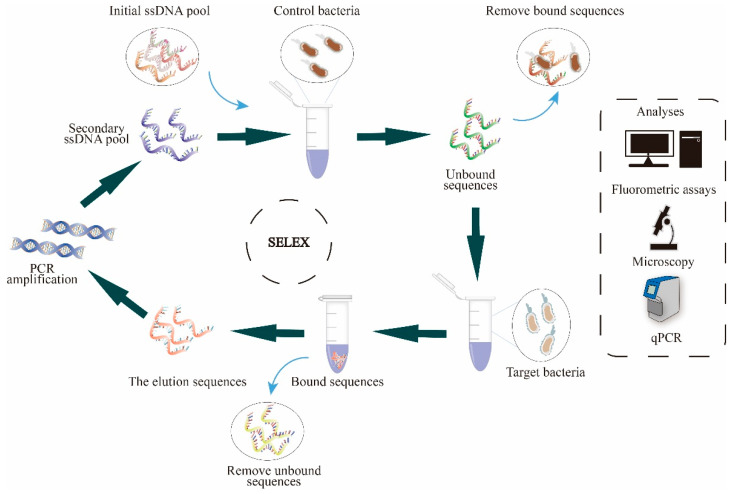
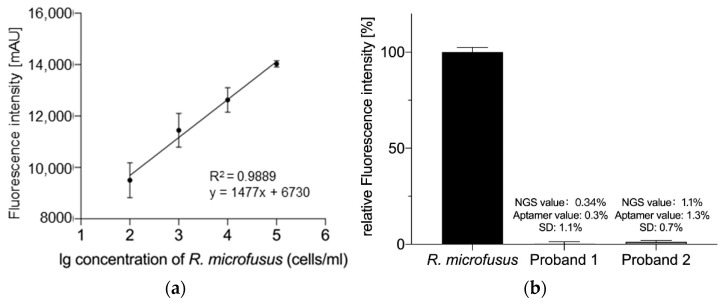
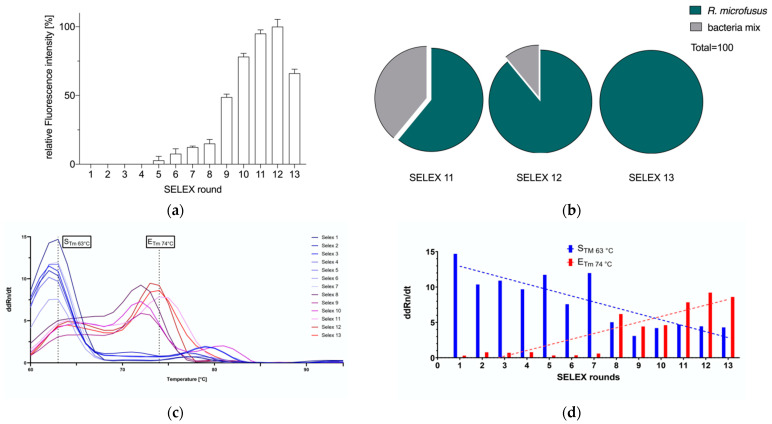
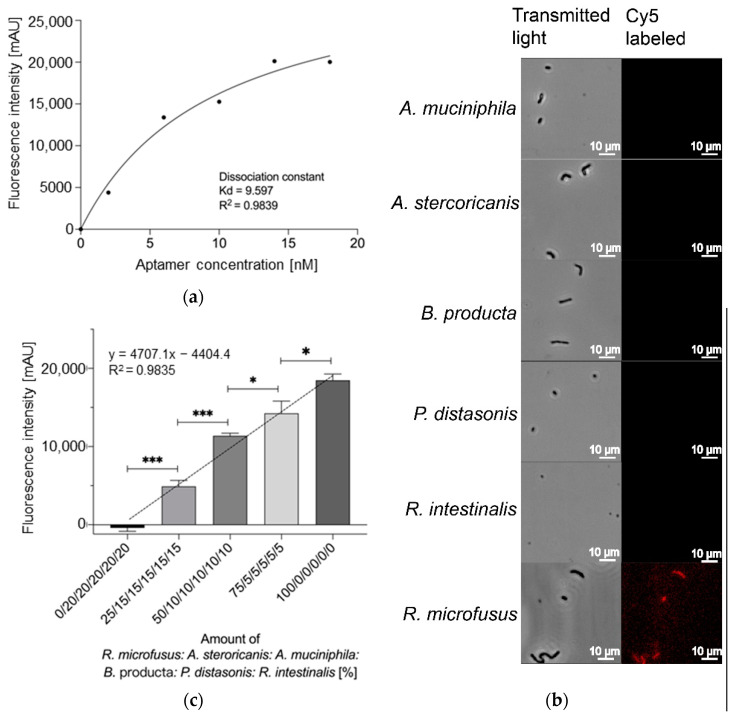
is an essential intestinal probiotic with great potential. The latest research shows that imbalance in the intestinal flora are related to the occurrence of various diseases, such as intestinal diseases, immune diseases, and metabolic diseases. may be a target or biomarker for some diseases, providing a new possibility for preventing and treating these diseases by monitoring and optimizing the abundance of in the intestine. However, the current monitoring methods have disadvantages, such as long detection times, complicated operations, and high costs, which seriously limit the possibility of clinical application of microbiome-based treatment options. Therefore, the intention of this study was to evolve an enriched aptamer library to be used for specific labeling of , allowing rapid and low-cost detection methods and, ultimately the construction of aptamer-based biosensors. In this study, we used as the target bacterium for an in vitro whole Cell-SELEX (Systematic Evolution of Ligands by EXponential Enrichment) to evolve and enrich specific DNA oligonucleotide aptamers. Five other prominent anaerobic gut bacteria were included in this process for counterselection and served as control cells. The aptamer library R.m-R13 was evolved with high specificity and strong affinity (K = 9.597 nM after 13 rounds of selection). With this enriched aptamer library, could efficiently be discriminated from the control bacteria in complex mixtures using different analysis techniques, including fluorescence microscopy or fluorometric suspension assays, and even in human stool samples. These preliminary results open new avenues toward the development of aptamer-based microbiome bio-sensing applications for fast and reliable monitoring of .
是一种具有巨大潜力的重要肠道益生菌。最新研究表明,肠道菌群失衡与多种疾病的发生有关,如肠道疾病、免疫疾病和代谢疾病。可能是某些疾病的靶点或生物标志物,通过监测和优化肠道中该菌的丰度为预防和治疗这些疾病提供了新的可能性。然而,目前的监测方法存在检测时间长、操作复杂、成本高等缺点,严重限制了基于微生物组的治疗方案的临床应用可能性。因此,本研究的目的是构建一个富集适配体文库用于该菌的特异性标记,从而实现快速且低成本的检测方法,并最终构建基于适配体的生物传感器。在本研究中,我们将该菌作为体外全细胞SELEX(指数富集配体系统进化技术)的靶细菌,以进化和富集特异性DNA寡核苷酸适配体。在此过程中纳入了另外五种突出的肠道厌氧细菌进行反选,并作为对照细胞。经过13轮筛选,进化得到了具有高特异性和强亲和力(K = 9.597 nM)的适配体文库R.m-R13。利用这个富集的适配体文库,通过包括荧光显微镜或荧光悬浮测定在内的不同分析技术,甚至在人类粪便样本中,都能够有效地将该菌与对照细菌区分开来。这些初步结果为开发基于适配体的微生物组生物传感应用以快速可靠地监测该菌开辟了新途径。