Nagasawa Norika, Kimura Ryusuke, Akagawa Mao, Shirai Tatsuya, Sada Mitsuru, Okayama Kaori, Sato-Fujimoto Yuka, Saito Makoto, Kondo Mayumi, Katayama Kazuhiko, Ryo Akihide, Kuroda Makoto, Kimura Hirokazu
Department of Health Science, Gunma Paz University Graduate School of Health Sciences, 1-7-1, Tonya-machi, Takasaki-shi 370-0006, Gunma, Japan.
Department of Medical Technology, Gunma Paz University School of Medical Science and Technology, 1-7-1, Tonya-machi, Takasaki-shi 370-0006, Gunma, Japan.
Microorganisms. 2023 Sep 18;11(9):2336. doi: 10.3390/microorganisms11092336.
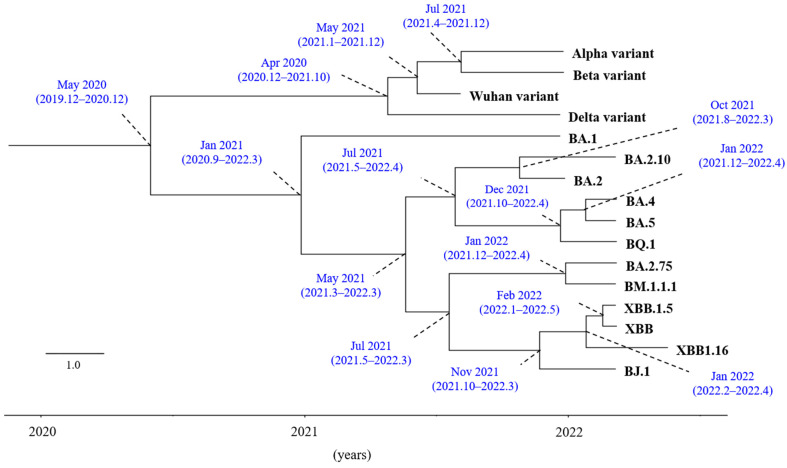
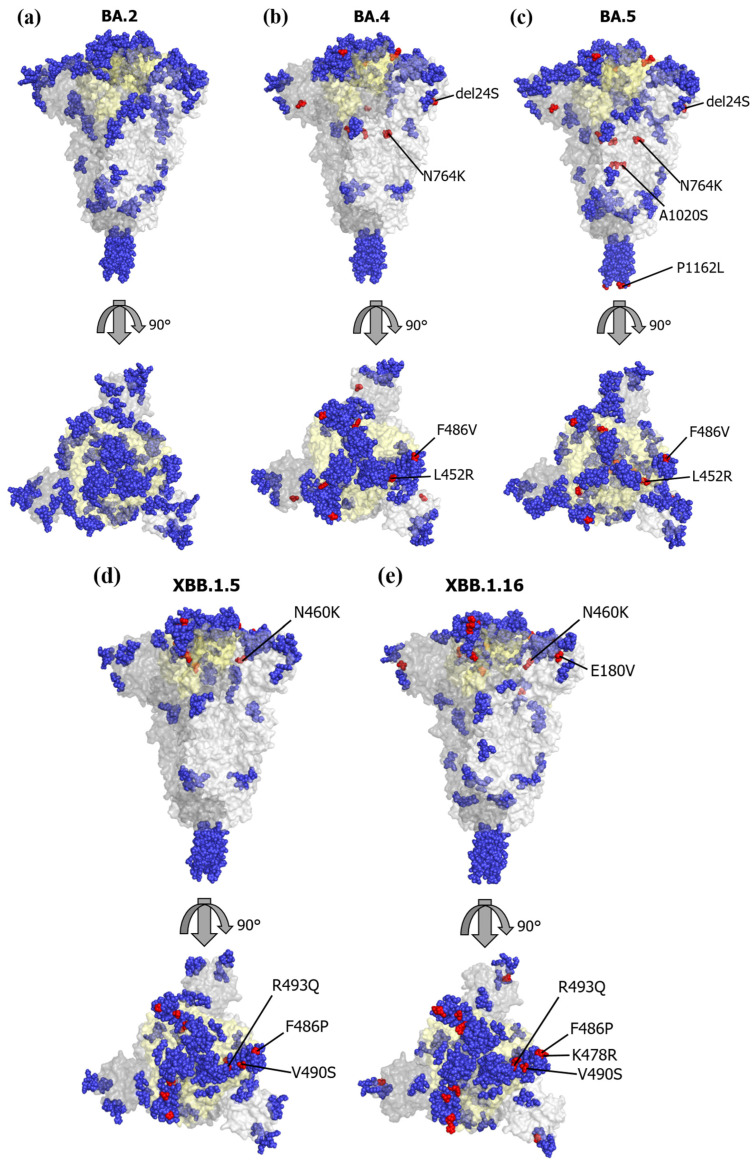
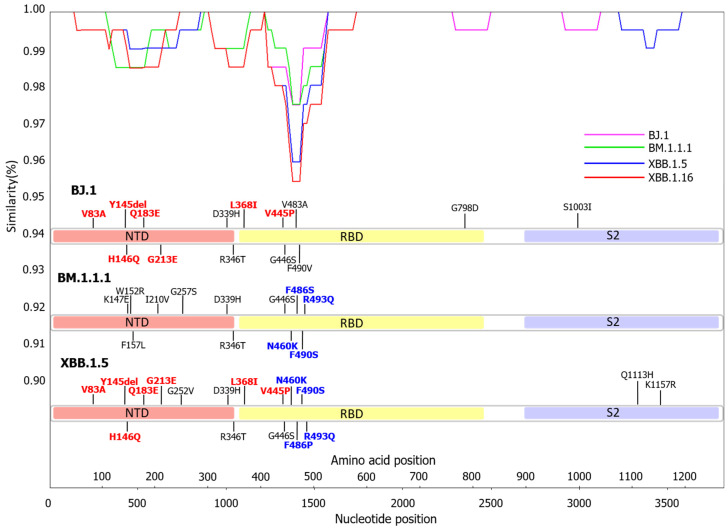
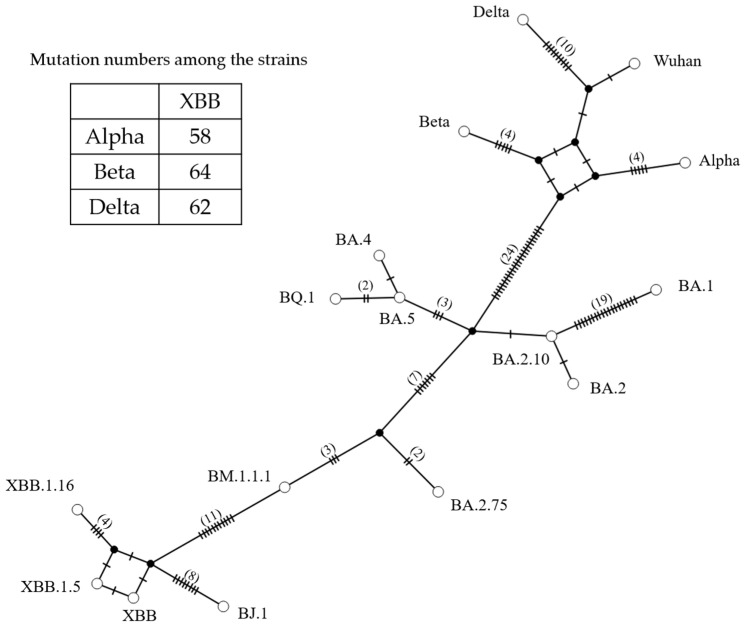
To better understand the evolution of the SARS-CoV-2 Omicron subvariants, we performed molecular evolutionary analyses of the spike () protein gene/S protein using advanced bioinformatics technologies. First, time-scaled phylogenetic analysis estimated that a common ancestor of the Wuhan, Alpha, Beta, Delta variants, and Omicron variants/subvariants diverged in May 2020. After that, a common ancestor of the Omicron variant generated various Omicron subvariants over one year. Furthermore, a chimeric virus between the BM.1.1.1 and BJ.1 subvariants, known as XBB, diverged in July 2021, leading to the emergence of the prevalent subvariants XBB.1.5 and XBB.1.16. Next, similarity plot (SimPlot) data estimated that the recombination point (breakpoint) corresponded to nucleotide position 1373. As a result, XBB.1.5 subvariants had the 5' nucleotide side from the breakpoint as a strain with a BJ.1 sequence and the 3' nucleotide side as a strain with a BM.1.1.1 sequence. Genome network data showed that Omicron subvariants were genetically linked with the common ancestors of the Wuhan and Delta variants, resulting in many amino acid mutations. Selective pressure analysis estimated that the prevalent subvariants, XBB.1.5 and XBB.1.16, had specific amino acid mutations, such as V445P, G446S, N460K, and F486P, located in the RBD when compared with the BA.4 and BA.5 subvariants. Moreover, some representative immunogenicity-associated amino acid mutations, including L452R, F486V, R493Q, and V490S, were also found in these subvariants. These substitutions were involved in the conformational epitopes, implying that these mutations affect immunogenicity and vaccine evasion. Furthermore, these mutations were identified as positive selection sites. These results suggest that the gene/S protein Omicron subvariants rapidly evolved, and mutations observed in the conformational epitopes may reduce the effectiveness of the current vaccine, including bivalent vaccines such as mRNA vaccines containing the BA.4/BA.5 subvariants.
为了更好地了解严重急性呼吸综合征冠状病毒2(SARS-CoV-2)奥密克戎亚变体的进化情况,我们使用先进的生物信息学技术对刺突(S)蛋白基因/S蛋白进行了分子进化分析。首先,时间尺度系统发育分析估计,武汉、阿尔法、贝塔、德尔塔变体以及奥密克戎变体/亚变体的共同祖先在2020年5月分化。此后,奥密克戎变体的共同祖先在一年多的时间里产生了各种奥密克戎亚变体。此外,BM.1.1.1和BJ.1亚变体之间的嵌合病毒,即XBB,在2021年7月分化,导致了流行亚变体XBB.1.5和XBB.1.16的出现。接下来,相似性图(SimPlot)数据估计重组点(断点)对应于核苷酸位置1373。结果,XBB.1.5亚变体在断点处5'核苷酸侧为具有BJ.1序列的毒株,3'核苷酸侧为具有BM.1.1.1序列的毒株。基因组网络数据显示,奥密克戎亚变体在基因上与武汉和德尔塔变体的共同祖先相关联,导致了许多氨基酸突变。选择性压力分析估计,与BA.4和BA.5亚变体相比,流行亚变体XBB.1.5和XBB.1.16在受体结合域(RBD)中具有特定的氨基酸突变,如V445P、G446S、N460K和F486P。此外,在这些亚变体中还发现了一些具有代表性的与免疫原性相关的氨基酸突变,包括L452R、F486V、R493Q和V490S。这些替换涉及构象表位,这意味着这些突变会影响免疫原性和疫苗逃逸。此外,这些突变被确定为正选择位点。这些结果表明,S基因/S蛋白奥密克戎亚变体迅速进化,在构象表位中观察到的突变可能会降低当前疫苗的有效性,包括含有BA.4/BA.5亚变体的二价疫苗,如mRNA疫苗。