Rabaan Ali A, Uzairue Leonard Ighodalo, Alfaraj Amal H, Halwani Muhammad A, Alawfi Abdulsalam, Alshengeti Amer, Al Kaabi Nawal A, Alawad Eman, Alhajri Mashael, Alwarthan Sara, Alshukairi Abeer N, Almuthree Souad A, Alsubki Roua A, Alshehri Nada N, Alissa Mohammed, Albayat Hawra, Zaidan Tasneem I, Alagoul Hassan, Fraij Ali Al, Alestad Jeehan H
Molecular Diagnostic Laboratory, Johns Hopkins Aramco Healthcare, Dhahran 31311, Saudi Arabia.
College of Medicine, Alfaisal University, Riyadh 11533, Saudi Arabia.
Pathogens. 2023 Sep 12;12(9):1157. doi: 10.3390/pathogens12091157.
The protozoan parasite may cause serious illness in the immunocompromised. The seropositive prevalence in pregnant women in WHO Eastern Mediterranean Region countries is inconsistent in the literature and it is associated with outcomes that have not be fully elucidated, hence the need for a better understanding of the pooled seroprevalence and associated maternal and fetal outcomes.
The objective was to conduct a systematic literature review and determine the pooled prevalence of WHO Eastern Mediterranean Regional countries' pregnant women's seroprevalence of and the maternal-fetal outcomes.
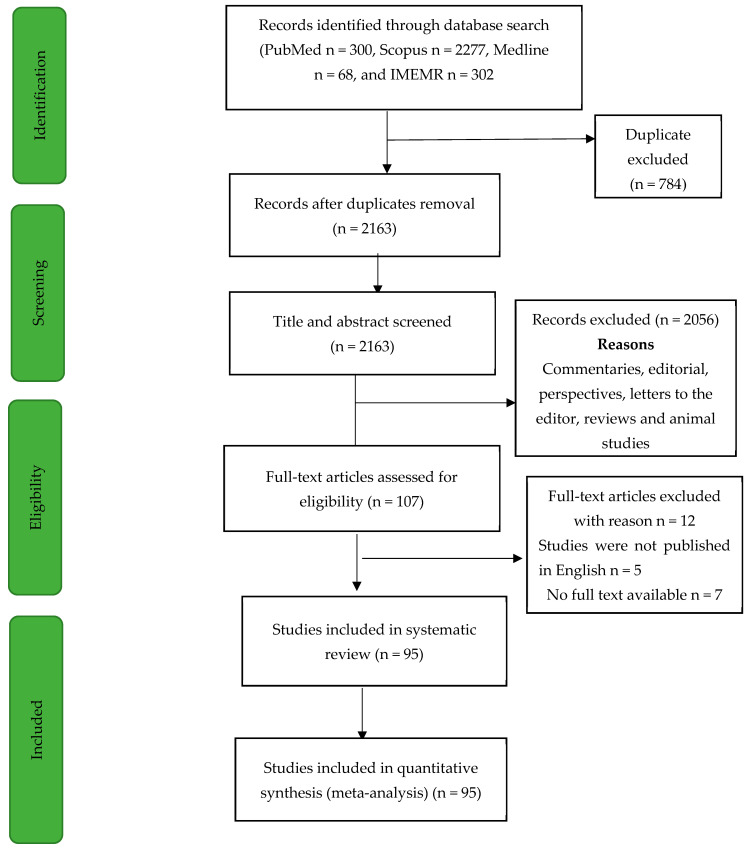
This quantitative study examined WHO Eastern Mediterranean countries' maternal-fetal outcomes and prevalence in pregnant women. The targeted population was pregnant women, while the primary outcome was seropositivity of , while other outcomes such as maternal and fetal associations and risk factors were determined PubMed, SCOPUS, MEDLINE, and Index Medicus for the Eastern Mediterranean Region (IMEMR) databases were searched up until 30 January 2023. The search terms used were "" OR " infection" AND "Pregnant woman" or pregnan* OR Antenatal OR Prenatal OR Gravidity OR Parturition OR Maternal AND WHO Eastern Mediterranean Region). OpenMeta-Analyst and Jamovi were used to analyze the generated data.
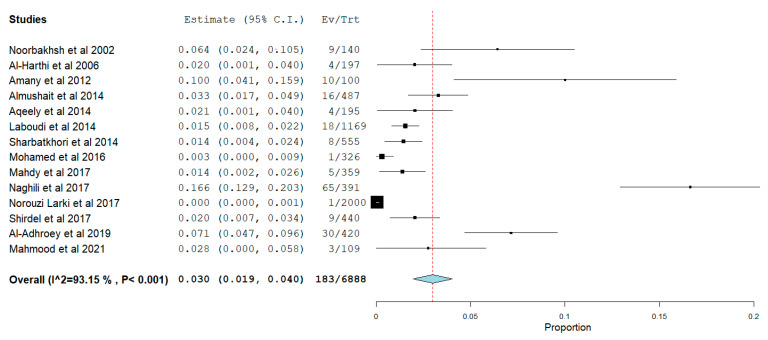
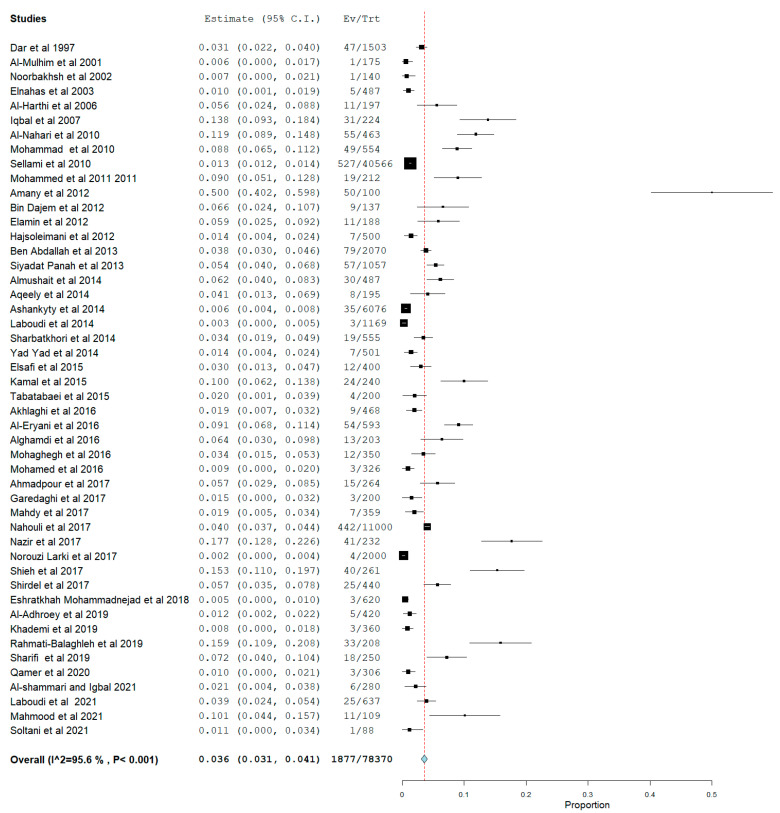
In total, 95 of 2947 articles meeting the inclusion criteria examined prevalence in pregnant women from WHO Eastern Mediterranean countries. The pooled prevalence of in pregnant women was 36.5% (95%CI: 32.6-40.4) with a median value of 35.64%, range values of 1.38-75.30%, with 99.61% heterogeneity. The pooled seroprevalence of IgG of was 33.5% (95%CI: 29.8-37.2) with a median value of 33.51%, and a range values of 1.38-69.92%; the pooled seroprevalence of IgM was 3.6% (95%CI: 3.1-4.1)) with a median value of 3.62 and range values of 0.20-17.47%, while cases of pooled seroprevalence of both IgG and IgM positivity was 3.0% (95%CI: 1.9-4.4) with a median value of 2.05 and a range values of 0.05-16.62%. Of the seropositive women, 1281/3389 (34.8%) 174/1765 (32.9%), 1311/3101 (43.7%), and 715/1683 (40.8%) of them had contact with cats, drank unprocessed milk, ate raw or undercooked meat and ate unwashed raw vegetables, respectively. The maternal-fetal outcomes associated with seropositivity were a history of abortions, miscarriage, stillbirth, intrauterine fetal death, and premature birth, which were found in 868/2990 (32.5%), 112/300 (36.1%), 111/375 (25.7%), 3/157 (1.9%) and 96/362 (20.1%) of women who tested positive for antibodies.
The study found a high proportion of seroprevalence in pregnant women in the WHO Eastern Mediterranean Region, which may be linked to poor outcomes for mothers and their babies. Thus, pregnant women require monitoring and comprehensive prevention strategies for infection.
原生动物寄生虫可能在免疫功能低下者中引发严重疾病。世界卫生组织东地中海区域国家孕妇的血清阳性率在文献中并不一致,且其与尚未完全阐明的结局相关,因此需要更好地了解合并血清阳性率以及相关的母婴结局。
目的是进行一项系统的文献综述,并确定世界卫生组织东地中海区域国家孕妇的血清阳性率及母婴结局的合并患病率。
这项定量研究考察了世界卫生组织东地中海国家的母婴结局以及孕妇中的患病率。目标人群为孕妇,主要结局是血清阳性,同时还确定了其他结局,如母婴关联和危险因素。检索了PubMed、SCOPUS、MEDLINE以及东地中海区域医学索引(IMEMR)数据库,截至2023年1月30日。使用的检索词为“[寄生虫名称]”或“[寄生虫名称]感染”以及“孕妇”或“pregnan*”或“产前”或“孕期”或“妊娠”或“分娩”或“母亲”以及“世界卫生组织东地中海区域”。使用OpenMeta-Analyst和Jamovi对生成的数据进行分析。
在符合纳入标准的2947篇文章中,共有95篇考察了世界卫生组织东地中海国家孕妇中的[寄生虫名称]患病率。孕妇中[寄生虫名称]的合并患病率为36.5%(95%置信区间:32.6 - 40.4),中位数为35.64%,范围值为1.38 - 75.30%,异质性为99.61%。[寄生虫名称]IgG的合并血清阳性率为33.5%(95%置信区间:29.8 - 37.2),中位数为33.51%,范围值为1.38 - 69.92%;IgM的合并血清阳性率为3.6%(95%置信区间:3.1 - 4.1),中位数为3.62,范围值为0.20 - 17.47%,而IgG和IgM均为阳性的合并血清阳性率情况为3.0%(95%置信区间:1.9 - 4.4),中位数为2.05,范围值为0.05 - 16.62%。在血清阳性的女性中,分别有1281/3389(34.8%)、174/1765(32.9%)、1311/3101(43.7%)和715/1683(40.8%)的人接触过猫、饮用过未加工的牛奶、食用过生的或未煮熟的肉类以及食用过未清洗的生蔬菜。与[寄生虫名称]血清阳性相关的母婴结局包括流产史、自然流产、死产、宫内胎儿死亡和早产,在检测出[寄生虫名称]抗体呈阳性的女性中,分别有868/2990(32.5%)、112/300(36.1%)、111/375(25.7%)、3/157(1.9%)和96/362(20.1%)出现这些情况。
该研究发现世界卫生组织东地中海区域孕妇中[寄生虫名称]血清阳性率较高,这可能与母亲及其婴儿的不良结局有关。因此,孕妇需要针对[寄生虫名称]感染进行监测和全面的预防策略。