Munnangi Siva Ram, Youssef Ahmed Adel Ali, Narala Nagarjuna, Lakkala Preethi, Vemula Sateesh Kumar, Alluri Rohit, Zhang Feng, Repka Micheal A
Department of Pharmaceutics and Drug Delivery, School of Pharmacy, The University of Mississippi, Oxford, MS 38677, USA.
Pii Center for Pharmaceutical Technology, The University of Mississippi, Oxford, MS 38677, USA.
Pharmaceutics. 2023 Aug 25;15(9):2203. doi: 10.3390/pharmaceutics15092203.
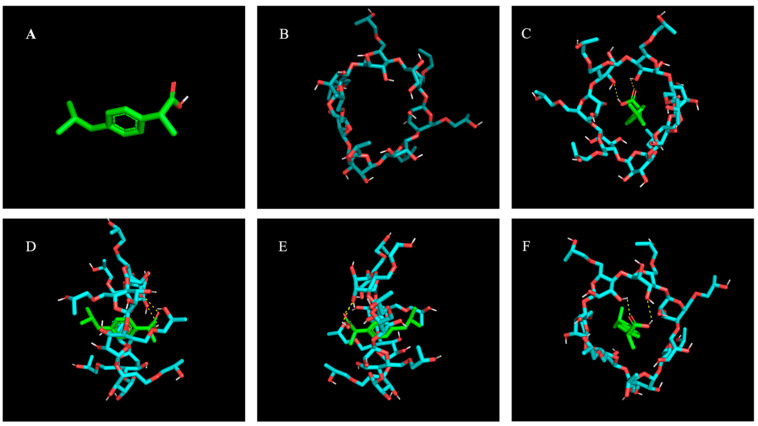
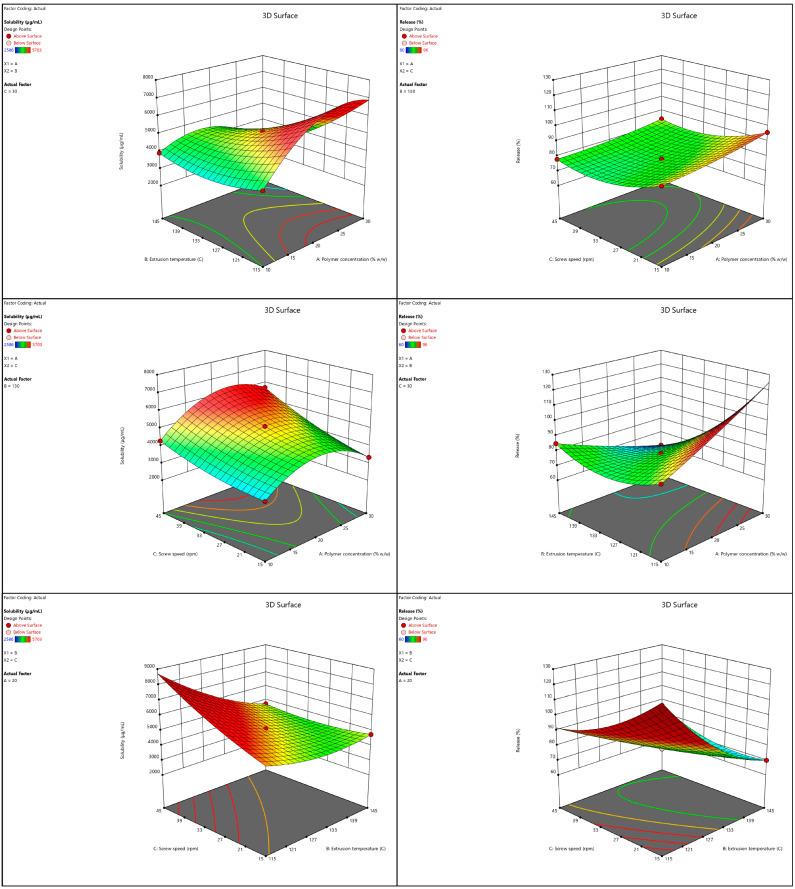
Conventional cyclodextrin complexation enhances the solubility of poorly soluble drugs but is solvent-intensive and environmentally unfavorable. This study evaluated solvent-free hot-melt extrusion (HME) for forming cyclodextrin inclusion complexes to improve the solubility and dissolution of ibuprofen (IBU). Molecular docking confirmed IBU's hosting in Hydroxypropyl-β-cyclodextrin (HPβ-CD), while phase solubility revealed its complex stoichiometry and stability. In addition, an 11 mm twin-screw co-rotating extruder with PVP VA-64 as an auxiliary substance aided the complex formation and extrusion. Using QbD and the Box-Behnken design, we studied variables (barrel temperature, screw speed, and polymer concentration) and their impact on solubility and dissolution. The high polymer concentration and high screw speeds positively affected the dependent variables. However, higher temperatures had a negative effect. The lowest barrel temperature set near the Tg of the polymer, when combined with high polymer concentrations, resulted in high torques in HME and halted the extrusion process. Therefore, the temperature and polymer concentration should be selected to provide sufficient melt viscosities to aid the complex formation and extrusion process. Studies such as DSC and XRD revealed the amorphous conversion of IBU, while the inclusion complex formation was demonstrated by ATR and NMR studies. The dissolution of ternary inclusion complexes (TIC) produced from HME was found to be ≥85% released within 30 min. This finding implied the high solubility of IBU, according to the US FDA 2018 guidance for highly soluble compounds containing immediate-release solid oral dosage forms. Overall, the studies revealed the effect of various process parameters on the formation of CD inclusion complexes via HME.
传统的环糊精包合作用可提高难溶性药物的溶解度,但溶剂用量大且不利于环境。本研究评估了无溶剂热熔挤出(HME)法形成环糊精包合物以改善布洛芬(IBU)的溶解度和溶出度。分子对接证实了IBU可嵌入羟丙基-β-环糊精(HPβ-CD)中,而相溶解度揭示了其包合物的化学计量比和稳定性。此外,以PVP VA-64作为辅助物质的11毫米同向双螺杆挤出机有助于包合物的形成和挤出。采用质量源于设计(QbD)和Box-Behnken设计,我们研究了变量(料筒温度、螺杆转速和聚合物浓度)及其对溶解度和溶出度的影响。高聚合物浓度和高螺杆转速对因变量有积极影响。然而,较高的温度有负面影响。在接近聚合物玻璃化转变温度(Tg)时设定的最低料筒温度,与高聚合物浓度相结合,会导致HME过程中的高扭矩并使挤出过程停止。因此,应选择温度和聚合物浓度以提供足够的熔体粘度,以辅助包合物的形成和挤出过程。差示扫描量热法(DSC)和X射线衍射(XRD)等研究揭示了IBU的无定形转变,而衰减全反射(ATR)和核磁共振(NMR)研究证明了包合物的形成。发现由HME制备的三元包合物(TIC)在30分钟内的溶出度≥85%。根据美国食品药品监督管理局(US FDA)2018年关于含速释固体口服剂型的高溶解性化合物的指南,这一发现意味着IBU具有高溶解度。总体而言,这些研究揭示了各种工艺参数对通过HME形成环糊精包合物的影响。