Keet Corinne, Sicherer Scott H, Bunyavanich Supinda, Visness Cynthia, Fulkerson Patricia C, Togias Alkis, Davidson Wendy, Perry Susan, Hamrah Sanaz, Calatroni Agustin, Robinson Katina, Dunaway Lars, Davis Carla M, Anvari Sara, Leong-Kee Susan M, Hershey Gurjit Khurana, DeFranco Emily, Devonshire Ashley, Kim Haejin, Joseph Christine, Davidson Brent, Strong Noel K, Tsuang Angela J, Groetch Marion, Wang Julie, Dantzer Jennifer, Mudd Kim, Aina Abimbola, Shreffler Wayne, Yuan Qian, Simmons Virginia, Leung Donald Y M, Hui-Beckman Jessica, Ramos Jania Arcia, Chinthrajah Sharon, Winn Virginia, Sindher Tina, Jones Stacie M, Manning Nirvana A, Scurlock Amy M, Kim Edwin, Stuebe Alison, Gern James E, Singh Anne Marie, Krupp Jennifer, Wood Robert A
Department of Pediatrics, University of North Carolina, Chapel Hill.
Icahn School of Medicine at Mount Sinai, New York.
J Allergy Clin Immunol Glob. 2023 Aug;2(3). doi: 10.1016/j.jacig.2023.100124. Epub 2023 Jun 3.
Food allergy (FA) and atopic dermatitis (AD) are common conditions that often present in the first year of life. Identification of underlying mechanisms and environmental determinants of FA and AD is essential to develop and implement effective prevention and treatment strategies. Objectives: We sought to describe the design of the Systems Biology of Early Atopy (SunBEAm) birth cohort.
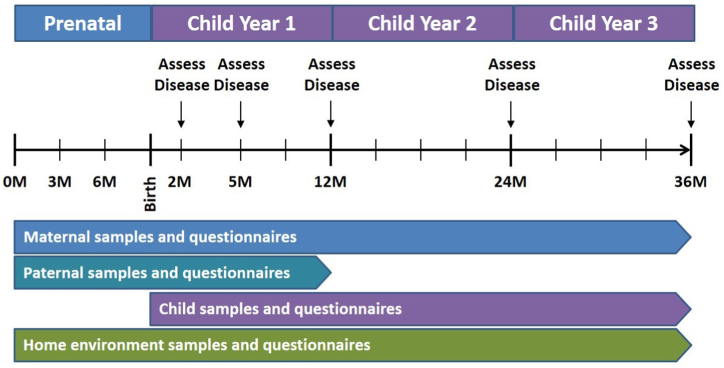
Funded by the National Institute of Allergy and Infectious Diseases (NIAID) and administered through the Consortium for Food Allergy Research (CoFAR), SunBEAm is a US population-based, multicenter birth cohort that enrolls pregnant mothers, fathers, and their newborns and follows them to 3 years. Questionnaire and biosampling strategies were developed to apply a systems biology approach to identify environmental, immunologic, and multiomic determinants of AD, FA, and other allergic outcomes.
Enrollment is currently underway. On the basis of an estimated FA prevalence of 6%, the enrollment goal is 2500 infants. AD is defined on the basis of questionnaire and assessment, and FA is defined by an algorithm combining history and testing. Although any FA will be recorded, we focus on the diagnosis of egg, milk, and peanut at 5 months, adding wheat, soy, cashew, hazelnut, walnut, codfish, shrimp, and sesame starting at 12 months. Sampling includes blood, hair, stool, dust, water, tape strips, skin swabs, nasal secretions, nasal swabs, saliva, urine, functional aspects of the skin, and maternal breast milk and vaginal swabs.
The SunBEAm birth cohort will provide a rich repository of data and specimens to interrogate mechanisms and determinants of early allergic outcomes, with an emphasis on FA, AD, and systems biology.
食物过敏(FA)和特应性皮炎(AD)是常见病症,常在生命的第一年出现。确定FA和AD的潜在机制及环境决定因素对于制定和实施有效的预防与治疗策略至关重要。目的:我们旨在描述早期特应性疾病系统生物学(SunBEAm)出生队列的设计。
SunBEAm由美国国立过敏与传染病研究所(NIAID)资助,并通过食物过敏研究联盟(CoFAR)进行管理,是一个基于美国人群的多中心出生队列,招募孕妇、父亲及其新生儿,并对他们进行为期3年的跟踪研究。制定了问卷和生物样本采集策略,以应用系统生物学方法来确定AD、FA及其他过敏结局的环境、免疫和多组学决定因素。
目前正在进行招募。基于估计6%的FA患病率,招募目标为2500名婴儿。AD根据问卷和评估进行定义,FA通过结合病史和检测的算法进行定义。虽然会记录任何FA,但我们重点关注5个月时鸡蛋、牛奶和花生的过敏诊断,从12个月开始增加小麦、大豆、腰果、榛子、核桃、鳕鱼、虾和芝麻的过敏诊断。样本采集包括血液、头发、粪便、灰尘、水、胶带条、皮肤拭子、鼻分泌物、鼻拭子、唾液、尿液、皮肤功能指标,以及母乳和阴道拭子。
SunBEAm出生队列将提供丰富的数据和样本库,用于探究早期过敏结局的机制和决定因素,重点关注FA、AD和系统生物学。