Takahashi Shunji, Matsumoto Koji, Ohba Kojiro, Nakano Yasuhiro, Miyazawa Yasushi, Kawaguchi Takumi
Department of Medical Oncology, The Cancer Institute Hospital of Japanese Foundation for Cancer Research, Tokyo, Japan.
Department of Medical Oncology, Hyogo Cancer Center, Akashi, Japan.
Cancer Manag Res. 2023 Sep 22;15:1033-1046. doi: 10.2147/CMAR.S417238. eCollection 2023.
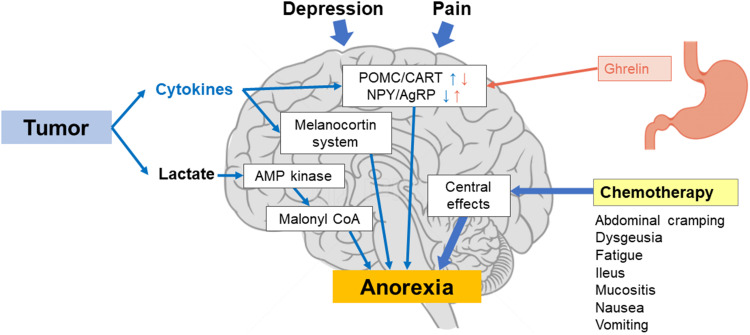
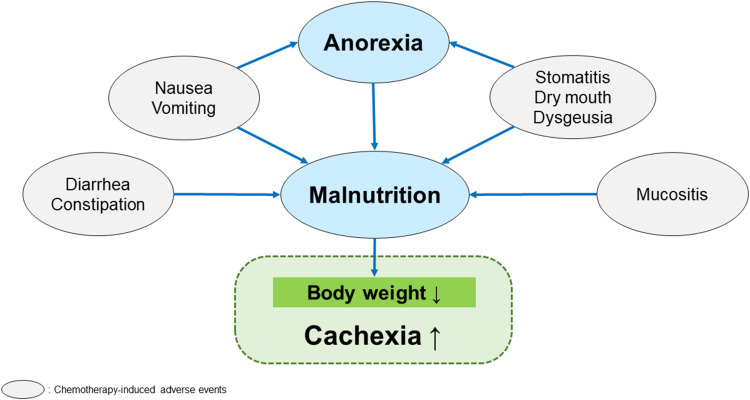
Cancer-related anorexia is a common complication and frequently occurs in cancer patients treated with vascular endothelial growth factor receptor-tyrosine kinase inhibitors (VEGFR-TKIs). Anorexia contributes to malnutrition, body weight loss, and cachexia in affected patients. Furthermore, patients who experience anorexia have worse outcomes than those who maintain their appetite, highlighting the importance of managing anorexia and related symptoms. However, as the causes of anorexia are both diverse and interconnected, there have been challenges in evaluating and implementing effective interventions. In this review, we described the contributing factors to cancer-related anorexia and reviewed recent literature for the frequency of anorexia symptoms in patients treated with VEGFR-TKIs. Additionally, we evaluated the evidence for current interventions and the potential benefits of multimodal and multidisciplinary approaches to care. The frequency of anorexia symptoms in patients who received VEGFR-TKIs ranged from 14%-58% for all-grade anorexia and 0%-6% for grade 3 or 4 anorexia. While many of the interventions for cancer-related anorexia have minimal benefit or adverse events, recent advances in our understanding of cancer-related anorexia suggest that multimodal therapy with multidisciplinary care is a promising avenue of investigation. Several studies currently underway are anticipated to further assess the effectiveness of multimodal approaches.
癌症相关性厌食是一种常见并发症,经常发生在接受血管内皮生长因子受体酪氨酸激酶抑制剂(VEGFR-TKIs)治疗的癌症患者中。厌食会导致受影响患者出现营养不良、体重减轻和恶病质。此外,经历厌食的患者比保持食欲的患者预后更差,这凸显了管理厌食及相关症状的重要性。然而,由于厌食的原因多种多样且相互关联,在评估和实施有效干预措施方面存在挑战。在本综述中,我们描述了癌症相关性厌食的促成因素,并回顾了近期关于接受VEGFR-TKIs治疗患者中厌食症状发生率的文献。此外,我们评估了当前干预措施的证据以及多模式和多学科护理方法的潜在益处。接受VEGFR-TKIs治疗的患者中,所有级别厌食的发生率为14% - 58%,3级或4级厌食的发生率为0% - 6%。虽然许多针对癌症相关性厌食的干预措施益处甚微或存在不良事件,但我们对癌症相关性厌食认识的最新进展表明,多模式治疗与多学科护理是一个有前景的研究途径。目前正在进行的几项研究预计将进一步评估多模式方法的有效性。